Showing posts with label net neutrality. Show all posts

Wednesday, October 28, 2009

Von Finckenstein on Throttling


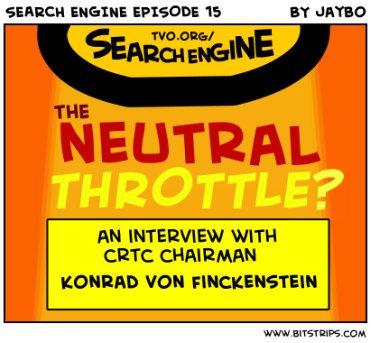
Here is an amazing interview with Konrad von Finckenstein, the Chairman of the CRTC, with Jesse Brown of Search Engine, a remarkable program that was CBC's loss and is TVO's gain.

Mr. von Finckenstein answers Jesse's questions about last week's controversial CRTC Net Neutrality decision - or Indecision as I called it, since it essentially confirms the status quo, puts off the likelihood of any real change by years and shifts the onus on consumers to lay complaints.

I don't have time now to comment on the questions or answers in detail. I hope that there is eventually a transcript published of this.

But this much can be noted. , without any value judgment on my part. It is extremely unusual in Canada - or even the USA or UK - for courts to defend or even explain their own decisions. The decision of a court is expected to speak for itself. Canadian judges rarely speak in public, except on very general issues. They normally avoid any reference to specific cases, especially recent ones and particularly ones that they have been involved in deciding. While the culture involving tribunals may differ somewhat from that of Courts on the issue of “speaking out”, still Mr. von Finckenstein's interview is quite remarkable and unusual in terms of its candour, content and timing.

It is certainly a “must listen” for anyone who cares about the internet or Canadian governance.

HK

PS - gotta love the internet! There's now an obviously unofficial transcript posted by one Bob Jonkman on his blog. Unofficial but helpful. Can't vouch for accuracy but here it is.

And here's an excerpt that's very revealing as to whether we can expect any improvements anytime soon:

08:24 JB: Bell and Rogers, they’ve come out saying that they feel that they’re already in compliance with these rulings. This, this ruling changes nothing, that they say they’re fine with it because they’re already doing what you suggest.

08:35 KvF: I hope, hope that’s true. I hope that’s true. We shall see. You know, if, uh, you, for instance, uh, advanced technological user, and we, let’s assume for argument’s sake you’re a client of Rogers find they’re not, then, then first of all you going to go on the Web site and see who’s the in, uh, apply internet management traffic practices, or have they been, perhaps they’ve been described there, and does it say what the effects of those are. If they aren’t, and you find out they applied them anyway what you going to do? You’re going to launch a complaint and we will look into it. On the other hand, if they are exactly doing what they’re saying, then wonderful, and then we have total compliance, which is the whole idea.


Wednesday, October 21, 2009

CRTC Indecision on Net Neurtality ("Throttling")

With respect, I cannot share the enthusiasm of Michael Geist, etc. for today's CRTC decision on Net Neutrality ("Throttling").

True, the CRTC agreed with the overall principles of net neutrality propounded by its exponents, which allows for network management subject to rational, justifiable and not overly restrictive network management by the ISPs. But the decision basically leaves the effective responsibility of enforcement of these principles in the hands of consumers via a complaint mechanism, ensuring years more of litigation, delay and full employment for the lawyers involved. One can be reasonably confident that individual complaints by individual users will not easily or quickly move the huge edifice of the CRTC and the major ISPs.

In the short term, the only thing that will change for Canadian consumers will be they will learn with more transparency more details of why they have some of the worst internet service in the world at some of the highest prices. More transparency will not promote more competition in the market because there is no real competition in an essentially duopolistic market with now virtually insurmountable barriers to new entry.

The CRTC once again accepted at apparent face value that congestion was a fact. This should have required extensive review of the extensive evidence, much of which was cloaked with confidentiality. This should have been a key and reasoned conclusion. Once again, network congestion has been regarded as a premise.

Moreover, once again, the fact that most Canadian consumers are faced in reality with a choice between two duopolists was glossed over. The third party independent ISPs who must depend on one of the duopolist's backbones cannot compete on service in any meaningful way.

The decision glosses over the P2P issue, which is the elephant in the room. Leaving aside the inconvenient question of whether downloading of music is legal in Canada by reason of the levy scheme, and even conceding that the unauthorized downloading of entire copyright protected movies would normally be illegal, there still remains the fact that P2P technology has fantastic innovative potential for the authorized distribution of software, movies, music and other “big” files. In the language of a landmark US case, it has “substantial non-infringing uses.” The CBC has, to its credit, tried to use it but was thwarted by throttling. This decision will leave P2P under a serious cloud that will hinder innovation. This should not be the case. The question of unauthorized downloading and file sharing is a complex and important one, but it should not be solved or even dealt with at the CRTC.

So - the CRTC perhaps outlined the right principles today. But it did little to make them a reality. "Placing the onus squarely on consumers" as Michael puts it simply won't work. Given the likely lawyering involved, complaints could take years to resolve. And we're talking about the in internet here, which evolves, even when throttled, much faster than the CRTC can move. There is an old maxim in law that “There is no right without a remedy. Ubi jus ibi remedium.”

Given the enormity of this hearing (it was really the second major proceeding) and all the efforts that went into it, the decision could have and should have decided much more.

Let's see whether tomorrow's announcement from the FCC in Washington is bolder, more decisive and more innovative. I'm betting that it will be.

HK

Monday, December 15, 2008

Google and Lessig on Net Neutrality

Is Google changing its tune on net neutrality? The Wall Stree Journals seems to be so so suggesting in a widely linked and discussed artcicle:

Here's a taste...According to WSJ:
Google Inc. has approached major cable and phone companies that carry Internet traffic with a proposal to create a fast lane for its own content, according to documents reviewed by The Wall Street Journal. Google has traditionally been one of the loudest advocates of equal network access for all content providers.
...

The developments could test Mr. Obama's professed commitment to network neutrality. "The Internet is perhaps the most open network in history, and we have to keep it that way," he told Google employees a year ago at the company's Mountain View, Calif., campus. "I will take a back seat to no one in my commitment to network neutrality."
[Barack Obama]

Barack Obama

But Lawrence Lessig, an Internet law professor at Stanford University and an influential proponent of network neutrality, recently shifted gears by saying at a conference that content providers should be able to pay for faster service. Mr. Lessig, who has known President-elect Barack Obama since their days teaching law at the University of Chicago, has been mentioned as a candidate to head the Federal Communications Commission, which regulates the telecommunications industry.

Is the Internet going to become more and more like cable and pay TV?

PS - UPDATE: Google's answer to this can be found here.

HK

Friday, November 21, 2008

Adequacy of Reasons in CRTC Throttling Decision?

A question that may arise about the CRTC decision is whether - irrespective of the conclusions - it meets the test of “adequacy” of the reasons. Despite its 80 paragraphs, the decision is arguably rather short on reasoning with respect to some of its main and most controversial conclusions.

As the Federal Court of Appeal ("FCA") said about the Copyright Board a couple of years ago:
[11] “Adequacy” is to be assessed in light of the functions performed by reasons: enhancing the quality of decisions, assuring the parties that their submissions have been considered, enabling the decision to be subject to a meaningful judicial review, and providing future guidance to regulates: see VIA Rail Canada Inc. v. National Transportation Agency, [2001] 2 F.C. 25 (C.A) at paras. 17-22. Equally important, the adequacy of the reasons must be assessed in context, including the agency’s record, the issues to which the reasons relate, and the scope of the agency’s expertise.
...

[15] The Board’s reasons are very thin. Nor could counsel for SOCAN or NRCC refer us to anything in the evidence that would explain how the Board arrived at the 10-15% range. Indeed, as the Board’s reasons indicate, the parties had not adduced evidence directly bearing on the quantification of the amount of the undervaluation. In effect, counsel argued that the Board was entitled to use its expertise to assess the evidence as whole and that it was not required to explain how it translated the evidence of undervaluation into a percentage.

[16] The Board is entitled to the greatest deference in the exercise of its discretion to set a rate and, accordingly, the discretionary decisions lying at the heart of its expertise are reviewable only for patent unreasonableness. However, it must explain the basis of its decisions in a manner that enables the Court on judicial review to determine on the basis of the reasons, read in context, whether the decision was rationally supportable. When an administrative tribunal's decision is reviewable on a standard of reasonableness, its reasons are the central focus of a judicial review: Law Society of New Brunswick v. Ryan, [2003] 1 S.C.R. 247, 2003 SCC 20, at paras. 48-9, 54-5.

[17] In my view, it was not sufficient in the circumstances of this case for the Board to justify its quantification of the undervaluation by merely referring to the evidence taken as a whole. It is not enough to say in effect: "We are the experts. This is the figure: trust us." The Board's reasons on this issue served neither to facilitate a meaningful judicial review, nor to provide future guidance for regulatees.
In fact, following this 2006 decision and the 2008 decision of the FCA that quashed the Board's decision to hold a hearing on an iPod "tax" (actually, levy), the Honourable Justice William J. Vancise, Chairman of the Copyright Board of Canada, has now written at length in a paper given at the 2008 Fordham conference on the issue of adequacy of reasons in a paper entitled REASONS – BECAUSE I SAID SO – NOT GOOD ENOUGH - BUT WHAT IS?

HK

Thursday, November 20, 2008

CRTC on Throttling - Round 1 to Bell

Here it is:


The Canadian Association of Internet Providers' application regarding Bell Canada's traffic shaping of its wholesale Gateway Access Service


Reference: 8622-C51-200805153

In this Decision, the Commission denies the Part VII application by the Canadian Association of Internet Providers requesting that the Commission order Bell Canada to cease and desist from traffic shaping of its wholesale Asymmetric Digital Subscriber Line services and, in particular, the wholesale service known as Gateway Access Service (GAS).

The Commission's determinations in this Decision relate solely to Bell Canada's traffic-shaping practices in relation to its wholesale GAS, and are based on the evidence filed in this proceeding.

The Commission notes that parties to this proceeding have raised concerns related to existing and emerging Internet traffic management practices that are beyond the scope of this proceeding. In light of the importance of these concerns, in a Public Notice issued today, the Commission initiates a proceeding to review the current and potential Internet traffic management practices of Internet service providers with respect to both retail and wholesale services. The process for this further proceeding, which will include an oral public hearing, is outlined in Telecom Public Notice 2008-19.

Here's the full text.

PS - In a rather unusual development, the Vice Chairman of Telecommunications at the CRTC, Len Katz, has extensively defended the decision in an interview with CBC here.

This decision was rendered in 7.5 months from the date the application was filed on April 3, 2008. In the meantime, there was an interim ruling. Much of the record can be seen here.

HK

Wednesday, November 19, 2008

CRTC Net Neutraltiy and Throttling Decision Tomorrow

Let's be cautiously optimistic about the decision expected tomorrow. The Chairman of the CRTC - Konrad Von Finckenstein - was formerly the Commissioner of Competition and a judge in the Federal Court. He has never been afraid of controversy - after all, he wrote the famous BMG decision that effectively stopped the file sharing lawsuits against individuals in Canada by protecting their privacy. That decision was essentially upheld in the Federal Court of Appeal. See my analysis here. Disclosure - I was involved.

The Competition Bureau is currently apparently not interested in doing anything about these types of issues. So maybe - just maybe - the CRTC will step up to the plate now and hit a home run.

A little inter agency competition is good for consumers. That may explain why the USA is way better off than Canada in matters having to with wireless and internet service and, indeed, net neutrality. The USA has the FCC, DOJ, and the FTC to look into these types of issues.

This question could quickly cross over into the copyright arena - because some ISPs have so many conflicting agendas these days that the copyright rights of users are seriously imperilled - especially if Canada ends up with protection for and not from DRM and TPM.

Anyway, the CBC has a good analysis of the current state of play here, which suggests, as we all know, that the war won't end one way or the other tomorrow morning.

HK

Wednesday, July 23, 2008

CIPPIC opens Bell/Rogers internet throttling investigation

My friends at CIPPIC (the Samuelson-Glushko Canadian Internet Policy and Public Interest Clinic) at the University of Ottawa are interested in hearing from individuals who are subscribers to Bell or Rogers’ high speed internet services and who are concerned about alleged internet throttling practices by Bell and Rogers. If you were or are a subscriber and would like to express your concerns, please contact Robert Hester at the CIPPIC.

Robert’s e-mail address is:

rhester@cippic.ca

CIPPIC’s phone number is:

613-562-5800 ext. 2553.

HK

Thursday, July 10, 2008

Weapons of Mass Congestion & Weapons of Mass Distribution

Yesterday, I heard Richard French, the very brilliant and usually convincing former Bell senior executive, CRTC Commissioner, Quebec Cabinet Minister and man of many other hats and skills, defend internet throttling at the University of Ottawa.

It seems that we must accept as a premise that there is network congestion. He didn’t offer any evidence or citations to elevate this beyond a mere premise. Somewhat like “weapons of mass congestion” (my term) that is caused by “weapons of mass distribution” (my term), namely P2P applications (his explanation).

Mr. French said that less than 20% of internet users are using more than 80% of the capacity and that throttling based upon applications (i.e. P2P) is not only justifiable but necessary and that other alternative such as usage based pricing are unrealistic.

He simply dismissed any suggestion that throttling is being done to satisfy copyright owners. There is however, evidence that suggests otherwise. For example, events such as this.

Net neutrality (and its antithesis, which is throttling) is going to become a very important issue. And I mean VERY.

The future of the internet is at stake. We are at risk that it is going to turn into a new version of cable and pay television, controlled by the usual suspects.

HK

Wednesday, May 28, 2008

Charlie Angus' Net Neutrality Bill

This is a private member's bill and they rarely go anywhere.

I have immense respect for Charlie Angus, but this bill as quoted - presumably accurately by Jon Newton - won't likely do much to stop the crude throttling that is now so apparent, irritating and damaging - even for unquestionably legitimate and authorized activity now.

There is a an exception that would allow for a network operator to:
(g) Prevent any violation of federal or provincial law.
That's a potentially wide open invitation to the ISPs to crudely throttle .torrent and .mp3 files on the basis that they may be in violation of copyright law. Naturally, some will be and some won't be. But it would arguably be a good enough excuse for the big ISPs.

And, of course, the ISPs could always throttle away as they do now by relying on the main exception, which would allow them to:
(a) Manage the flow of network traffic in a reasonable manner in order to relieve congestion;
If there really is congestion now, which is far from clear, is there not an onus on the ISPs to provide more bandwidth and higher speeds, such as we see in other countries that have actual competition and don't condone a duopoly?

HPK

Wednesday, May 14, 2008

ISPs and Content Providers Playing Footsie....

Anyone who wonders about why ISPs are degrading internet service - except for content that they they like - might want to look at the program for this conference coming up in the UK.

For example:
Day Two of the Summit will kickstart with an ISP-rights holder panel analysing consumer awareness on content online. Summit participants will then explore how an agreed self-regulatory model might work before discussing the feasibility of filtering technologies to prevent unlawful content and maintain clear and running networks, and the viability of other decryption and digital rights technologies.
Meanwhile, in the USA, where some people still believe in antitrust law and an open internet, a bill has been introduced that would treat interference or content-blocking as violations of antitrust law.

HK

Sunday, May 04, 2008

Q & A on Net Neutrality from Fordham

Here's an interesting Q & A on net neutrality from Fordham on March 27, 2008. The questioner is Richard Pfohl from CRIA. The question was addressed to Richard Cotton, Executive Vice President and General Counsel, NBC Universal. The question suggests that content owners should bring ISPs "to the table to partner with you to try to control the movement of infringing traffic across their networks":

QUESTION: Richard Pfohl with the Canadian Recording Industry.

A question for Rick Cotton. Rick, you talked about building partnerships with ISPs, but you also talked about how a lot of their business model is effectively built on moving infringing traffic across their networks. Given that that’s how they are making money now, how is it that you bring them to the table to partner with you to try to control the movement of infringing traffic across their networks?

MR. COTTON: I actually don’t believe that at this point in time they are making money by transporting pirated content, quite the reverse. There may have been a point in time when, in terms of attracting broadband customers, it was useful from their point of view to have a lot of free video and other pirated material out on the Internet that people needed faster bandwidth to access. But today, with the amount of traffic in, particularly, pirated video ― taking as much bandwidth as it is, number one; and number two, virtually every ISP is also in the business of selling content to their customers – that is no longer the case. So I think, while we may like to think that it is our persuasive powers that bring them to the table, I think their self-interest has changed.

When I said that there are companies and commercial interests that do profit from weakening of intellectual property laws, they are not the ISPs. There are companies whose business model is enhanced by virtue of being able to provide their customers access to any and all content. But it’s not the ISPs.

Could content owner pressure to "partner" be a factor in the practice of ISP "throttling" and the emerging and escalating net neutrality debate?

Note: The above transcript excerpt is subject to editing and correction and is not in final form.

HK