Showing posts with label cmpda. Show all posts

Sunday, July 10, 2011

CMPDA rebrands to Motion Picture Association - Canada (MPAC)

A vigilant reader has pointed out that I missed another major name change in my post yesterday about CRIA’s change to MUSIC CANADA.

The Canadian Motion Picture Distributors Association (CMPDA) has changed its name, effective May 31, 2011, to Motion Picture Association - Canada. 

CMPDA has long been a powerful force in Canadian copyright policy. It was successful in convincing the Federal government to enact stronger anti-camcording legislation.

At its redesigned website, the Motion Picture Association - Canada describes itself as follows:
The Motion Picture Association – Canada serves as the voice and advocate of the major international producers and distributors of movies, home entertainment and television programming in Canada. The motion picture studios served by the Motion Picture Association – Canada are:

    Walt Disney Studios Motion Pictures
    Paramount Pictures Corporation
    Sony Pictures Entertainment Inc.
    Twentieth Century Fox Film Corporation
    Universal City Studios LLLP
    Warner Bros. Entertainment Inc.
(Emphasis added)

To its credit, The Motion Picture Association – Canada is not seeking to convey the impression that its mission is to protect the interests of Canadian producers and distributors. In fact, its new website states that it is “The Voice and Advocate for the Major International Producers and Distributors of Movies, Home Entertainment and TV Programming in Canada”.

A short article dated May 31, 2011 about this name change states that:
This should clear everything up: The Canadian Motion Picture Distributors Association, which has long lobbied north of the border on behalf of the major Hollywood studios, has changed its name to Motion Picture Association - Canada (MPAC).

The rebranding aligns the association more closely with its parent, the Motion Pictures Association of America.
As this article indicates, the acronym of the Motion Picture Association - Canada is MPAC. This acronym may also be familiar to Ontario real property owners who believe that their municipal tax assessment is too high and who have had the pleasure of appealing to the Municipal Property Assessment Corporation (MPAC), the URL of which is www.mpac.ca.

The URL for the Motion Picture Association - Canada (MPAC) is www.mpa-canada.org.

HK

Wednesday, March 17, 2010

The iPod "Tax": Misinformation re Heritage Committee's Report

It seems necessary to dispel certain inaccurate and misleading blog commentary about what actually happened in the Heritage Committee yesterday concerning the NDP's proposed iPod “tax”.

It is simply not correct to state, as James Gannon puts it in his blog, that:
To be clear, the MPs who voted in favour of this motion were not voting “for”, or signalling any kind of “support” for, this amendment to the Copyright Act, but merely voting for the Committee to consider the amendment at a later time.
That's not what happened. Here is what actually happened - according to the official source, which is Parliament itself. This, according to the Committee's official website, is what the Heritage Committee actually said:
Pursuant to Standing Order 108(2), that the Committee report the following to the House as soon as possible:
That the Committee recommends that the government amend Part VIII of the Copyright Act so that the definition of “audio recording medium” extends to devices with internal memory, so that the levy on copying music will apply to digital music recorders as well, thereby entitling music creators to some compensation for the copies made of their work.
(emphasis added)
That seems pretty clear to me and quite clearly contradicts Mr. Gannon's speculation. Here are the minutes of the meeting, which back up the Report.

The rest of Mr. Gannon's blog is largely a polemic against Prof. Michael Geist for "an over-politicization of the actual facts" and other various allegations.

However, all that Prof. Geist did in his blog was to describe succinctly and accurately what happened in the Committee, and the party affiliation of the members involved, along with the position of the two responsible Ministers of the Crown. That is essential information for anyone who tracks legislation. How exactly the provision of such information is "politicization" is quite incomprehensible.

Ironically, Mr. Gannon's blog is entitled “Depoliticizing the iPod levy”. Even more ironically, his concluding paragraph begins with this otherwise agreeable sentiment:
As the experience with "Fox News" in the U.S. has shown, by highly politicizing debated issues, the public will often be swayed into a narrative with "good guys" on one side of the political spectrum and "bad guys" on the other.
It strikes me that Mr. Gannon is the one who is being rather too political in this instance.

Mr. Gannon, who was called to the bar in 2009, is an associate at McCarthy, Tétrault, working under Barry Sookman, a well known lawyer/lobbyist for some very politically savvy clients, i.e. CRIA, CMPDA, and the Canadian Chamber of Commerce. While Mr. Gannon may very well have been speaking on his own, Mr. Sookman was very quick to tweet a link to his blog.

HK

March 18, 2010

PS - Speaking of "politicization" of copyright, here' s Mr. Sookman's latest blog entitled "Should Canada adopt “fair use” as proposed by NDP MP Charlie Angus?" wherein he says:
The fundamental role of copyright in Canada will not be lost on the Bloc and Liberals with strong roots in the Province of Quebec, or on the Tories with strong ambitions in that province.
(emphasis added)

I wonder how Mr. Gannon would characterize this analysis.

PS #2:

Mr. Gannon has now issued a "correction" to his post from yesterday.

Wednesday, June 24, 2009

Copyright Reform Back on Course?


There's very encouraging news from Michael Geist, who was at Monday's exclusive government digital agenda pow wow.

There are strong indications that Ministers Clement and Moore really "get it" when it comes to copyright reform and its relation to innovation, and matters generally digital and cultural.

Minister Clement, who has incredibly important responsibilities for everything from competition to communications to copyright, notes that a lot has changed since Bill C-61. And the twittering, young, and very tech savvy Minister Moore once again prominently notes Michael Geist's tweets as a positive example of all that can be done with the various gadgets that he carries in his pockets and uses so often and so well.

All of these positive statements and strong hints at what could be a very exciting and constructive consultation process can be seen on Michael's posting today.

Lobbying organizations such as CRIA and CMPDA, which have clearly spent a fortune trying to hijack the copyright policy agenda in Canada for their members' special purposes and engage in "policy laundering" regarding their own role, may be worried about ministers who actually care about balance, innovation, cool technology and culture - and who are clearly listening to voices other than those of the usual suspects.

Could Canada get back on track and show some world leadership here? That would be cool indeed.

Clearly, what we are currently seeing in France, the UK, and in the USA is not the way to go. Any smart politician - and both Ministers are clearly very smart - can see that directions such as three strikes, statutory minimum damages against individuals, and digital lock downs are neither good policy nor good politics.

This could be an interesting and hopefully very productive summer.

Hopefully, we finally have the right Ministers, the right officials, the right politics and the right timing to modernize Canada's copyright law in a constructive, balanced and forward thinking manner - rather than resorting to desperate and artificial attempts to preserve failed and obsolete business models.

HK

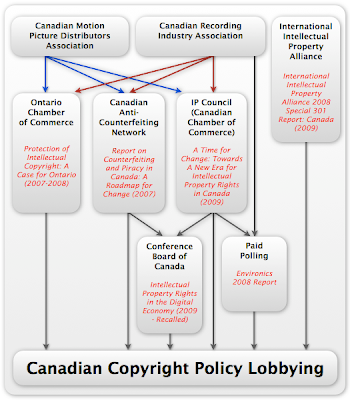
A Canadian Copyright Policy Laundering Flow Chart


Michael Geist/The Register

Michael Geist has a thorough and excellent analysis today of the role of CRIA and CMPDA in copyright "policy laundering", as he calls it, in Canada - including in the recent Conference Board imbroglio. I had raised some questions about these two organizations in this context on June 17, 2009.

All of this may even be more incestuous than Michael's chart shows. For example, the USTR gets its "301" information from the International Intellectual Property Association ("IIPA"), a Washington advocacy group that runs out of a couple of Washington law offices and is heavily influenced by the US entertainment industries. As I have mentioned earlier, the reports on Canada are prepared with the considerable input of a well known Washington lawyer named Steve Metalitz.

And do you wonder where the IIPA gets its information about Canada?

HK

Wednesday, June 17, 2009

Still More Conference Board of Canada Fallout

The Conference Board has taken the next step in damage control arising from its recent plagiarism scandal. Here's today's statement.

The most notable and useful disclosure from the Conference Board is that:
The evidence indicates there was undue reliance on feedback from a funder who was deemed to have important technical expertise.
(Emphasis added)

The Conference Board should identify the funder who provided the “feedback”, and why this funder's “deemed” technical expertise managed to effectively poison the process. It should, as a matter of course, identify all funders of all its reports. This is normal practice, and is absolutely essential if a report is to have any serious credibility in academic, policy, business and government circles. The Conference Board must guard against letting its good name be used by special interest lobbyists in what Dr. Michael Geist calls “policy laundering.”

The report in question was to have been rolled out as a key item at a Conference Board conference on May 29, 2009. Here is the program, which shows a list of sponsors and the Advisory Board of that rather imbalanced and expensive event, which, in fairness, covered quite a lot of material other than copyright. Nonetheless, and despite the breadth of the conference, two of the four members of the “Advisory Board” for the conference were the heads of CRIA and CMPDA. These have been two of the most, if not the most, energetic, persistent and successful (in terms of legislative influence) copyright lobbyist organizations in Canada since the 1980's. It's a fair question to ask whether either or both these two well known and well funded organizations (which represent mainly American interests) were among the funders or were otherwise involved in the specific ill-fated research project now in issue.

BTW, here's what it costs to “sponsor” a Conference Board conference.

Interestingly, the Conference Board has engaged Dr. Ruth Corbin to “to review all relevant research and consult multiple sources, and redo the reports.”

The Board indicates that:
When completed, this work will be presented to a multi-stakeholder Roundtable to be held in the fall. We will publish a summary of the Roundtable discussion, reflecting the full spectrum of views on the issue, as an Appendix to the research.
One can only wish Dr. Corbin and the Board luck in sorting all of this out. The scandal may not reside only in the fact that much of the key content of the now withdrawn work was plagiarized but that much of the IIPA material that was apparently recycled as “research” may have been utterly unreliable to begin with. I'm not sure that it's possible to “redo” that kind of work.

HK

PS & Update - the Conference Board did acknowledge the financial support of several coalition or umbrella groups in this case. But that still leaves questions unanswered - namely who was really actively involved in the sponsored research. See comments below.

PS and update #2 - more connecting of dots and about the courageous Curtis Cook, former employee of the Confernce Board, in a Canwest story here.

Saturday, August 02, 2008

ACTA Secrecy Concerns Increase

On July 28, 2008 Michael Geist reported in the Toronto Star that:

According to documents obtained under the Access to Information Act and reported here for the first time, the government has been crafting an Intellectual Property and Trade Advisory Group. The initial plans for membership in the group were limited exclusively to 12 government departments and 14 industry lobby groups. These include the Canadian Recording Industry Association, the Canadian Motion Picture and Distributors Association, and the Entertainment Software Association of Canada. [CRIA, CMPDA, ESA]

The early membership lists omit several key industry representatives likely to be affected by ACTA, including telecommunications, technology, and Internet companies. Moreover, there is absolutely no representation of the public interest — no privacy representation despite the obvious privacy implications of the treaty (the Office of the Privacy Commissioner of Canada was not included on the government invitee list), no consumer representation despite the effects on consumer interests, and no civil liberties representation on a treaty that could fundamentally alter Canadian civil rights.

CRIA, CMPDA, and ESA are highly influential American dominated lobbyist groups whose influence can be readily seen in Bill C-61.

Today, the highly regarded Intellectual Property Watch summarizes the current state of secret negotiations:
Sources described the closed-door negotiations which continued this week in Washington, DC as “very special", “unique in its secrecy” and the “first time that industry has been kept in the dark about an agreement of such importance.”
There are persistent rumours - based upon a leaked draft text - that ACTA could not only affect what happens at border crossings (laptop and iPod searches and confiscations?), but what is happening inside ISPs and ordinary people's internet accounts and activity, which could be monitored. This secrecy is very troubling. Moreover, Canada's lack of transparency is excessive compared to other countries - e.g. Canada, unlike the USA, hasn't published stakeholder submissions. This is especially troubling.

HK

Wednesday, May 07, 2008

MPAA & Canada

According to IP-Watch:
Mike Robinson, who joined MPAA's anti-piracy department two years ago as vice president of US anti-piracy will now also take over anti-piracy management in Canada as senior vice president of North American anti-piracy operations.
(emphasis added)

The Canadian counterpart to the MPAA is the CMPDA.

HK