Showing posts with label Library and Archives Canada. Show all posts

Sunday, July 01, 2012

Substantial Clarification on what is a “Substantial Part of a Work” and other aspects of Fair Dealing


There are some very nice and straightforward clarifications in the recent Federal Court decision in Warman v. Fournier penned by Justice Rennie about:
  • What constitutes a “substantial part” of a work. 
  •  Why merely linking is not copyright infringement.·      
Richard Warman brought a lawsuit alleging infringement of a work by Jonathan Kay, a National Post journalist, and certain photographs in which Warman had acquired rights by way of an exclusive license and assignment, respectively. There was a third work, namely a speech by Warman. However, that claim was dismissed due to limitation period issues, which are not relevant to this posting.

Regarding the Kay article, the Judge found that the work “is a highly critical article about the applicant and it appears he sought the exclusive license to the Kay Work in order to prevent its further publication.”

No doubt there is a long and interesting story to this litigation and there are hints of this in the judgment. Mr. Warman was represented by counsel. The defendants are the people behind the Freedominion website.  They represented themselves here and won quite decisively. 

Here are the Judges exact words on the “substantial part” issue, which should clarify a lot of the “confused and confusing” and incorrect statements we have recently heard and read on this point:
No Reproduction of a Substantial Part
[23] The applicant submits that the respondents infringed his copyright in the Kay Work by reproducing excerpts from it. He argues that the reproduced excerpts constitute a substantial part of the Kay Work, contrary to sections 3 and 27 of the Copyright Act. Whether a substantial part of a work has been reproduced is a question of fact and involves a qualitative rather than quantitative analysis. The relevant factors to be considered include:
a. the quality and quantity of the material taken;
b. the extent to which the respondent’s use adversely affects the applicant’s activities and diminishes the value of the applicant’s copyright;
c. whether the material taken is the proper subject-matter of a copyright;
d. whether the respondent intentionally appropriated the applicant’s work to save time and effort; and
e. whether the material taken is used in the same or a similar fashion as the applicant’s:
U & R Tax Services Ltd v H & R Block Canada Inc, [1995] FCJ No 961, at para 35.
[24] Applying those factors to this case, I find that the respondents did not reproduce a substantial part of the Kay Work, and therefore there is no infringement.
[25] Quantitatively, the reproduction constitutes less than half of the work. The Kay Work itself consists of a headline and eleven paragraphs. The reproduction on Free Dominion included the headline, three complete paragraphs and part of a fourth. Qualitatively, the portions reproduced are the opening “hook” of the article, and the summary of the facts on which the article was based. Most of the commentary and original thought expressed by the author is not reproduced.
[26] Most of the other factors are not directly relevant in this case given the circumstances in which the applicant obtained the copyright: he does not appear to “use” the subject matter of the copyright in the sense of reproducing or publishing the Kay Work. It is a highly critical article
about the applicant and it appears he sought the exclusive license to the Kay Work in order to prevent its further publication.
[27] It does not appear that the excerpts of the Kay Work were reproduced to “save time and effort”. Based on the context of the posting, the respondents reproduced portions of the Kay Work to preserve a record of the facts summarized in the article, so that members of Free Dominion could
continue to discuss those facts on the forum. Also, contrary to the applicant’s argument, the reproduction does include a summary or paraphrase of part of the work, specifically the second paragraph.
[28] Thus, considering the matter as a whole, I find as a fact that the applicant has not established that the excerpts of the Kay Work reproduced by the respondent constitute a “substantial part” of
the work, and there is therefore no infringement. (emphasis added)
This does not make new law. But it confirms very nicely that “substantial” needs to be taken in context and that there is no arbitrary rule that, for example, copying more than one sentence is copying a “substantial part”.  In fact, copying just one sentence will rarely amount to “any substantial part” of work, unless that work is a haiku. And there is a lot of authority that very short creations may not even be entitled to copyright protection – such as the titles of books, songs and movies. No doubt there will be a “tweet” test case about whether 140 characters can warrant copyright protection, and, if somehow so, what would a “substantial part” of that be.

Michael Geist praises the decision and says in his current Toronto Start column that:
While many assume that anything more than a sentence or two goes beyond insubstantial, the court’s ruling sends a signal that a more liberal approach is possible.  If the decision is upheld (an appeal seems likely), it will have significant implications for copying in a wide range of venues including collective licensing for educational institutions. (Emphasis added)

Actually, Justice Rennie does not break any new ground here. There has never been a rule that copying more than a sentence or two is infringing – despite occasional suggestions by some who urge otherwise. But he does clarify very neatly what most copyright experts have always known – that what is “substantial” cannot be defined by a bright quantitative line or formula. The determination of what is substantial is context specific. In the academic context, the copying of several sentences or even paragraphs or more may be necessary to make a point and to ensure that sufficient context is provided. Such copying still may not be "substantial" in the particular context and therefore would not even trigger any need for a "fair dealing" analysis.  Attribution is necessary, of course, as a matter of academic protocol and to avoid any allegation of plagiarism. But such "insubstantial" copying is not prevented by the Copyright Act, and requires neither permission nor payment. Unfortunately, there have been recent misstatements or misunderstandings relating to this point that have appeared in crucial contexts ranging from thesis approval procedure policy as stated by Library and Archives Canada to submissions by counsel in the K-12 case in the Supreme Court of Canada, where the issue arose right at the very outset of oral argument. 

David Vaver explains this issue very well in his discussion of “Taking a Particle Does Not Infringe” at p. 184-188 of his 2011 book.  Indeed, Vaver states that even where the writing is of the quality of Dickens or Shakespeare, it is “simply nonsense” to suggest that “the taking of even a single sentence” may infringe copyright.

Michael is right that this point could impact on collective licensing for educational institutions, and we could see this as early as in the forthcoming K-12 decision in the Supreme Court. It’s sad to say that it appears that many educators, librarians and perhaps even some associations that represent them have simply not understood that:
  • Copying several sentences or even paragraphs or more may not be a “substantial part” of a work, depending on the context;
  • Only if the copying is “substantial” is there any need to worry about “fair dealing”; and,
  • Above all, there is no need to get permission or to make any payment for copying anything that is not a “substantial part” of the work, or if it is,  that is “fair dealing”.·     
For example the administration of a certain university very recently posted that it pays Access Copyright for exercising its fair dealing rights. That reflects a frankly fundamental misunderstanding. Moreover, the unfortunate truth is that this is essentially what we do in Canada in many respects. We pay Access Copyright for exercising what are or ought to be users’ fair dealing rights. This need not be the case, if those responsible were to fully understand and take advantage of the empowerment of the Supreme Court of Canada’s Magna Carta 2004 decision in CCH v. LSUC

American lawyers shake their heads in disbelief. Here is what one US lawyer from a prominent Boston law firm recently said about Access Copyright:
But what is really striking from the U.S. perspective is that, for all that money, the license only allows copying of up to about 10-20% of each text, or one full chapter. Some critics argue that such a license is unnecessary, because educators are already permitted to copy approximately that amount without a license under existing Canadian law, or at least they will be upon the passage of Bill C-11, which is currently pending before Parliament. That legislation would expand Canada’s fair dealing exception to include education, parody and satire as non-infringing uses, aligning it more closely to fair use under U.S. copyright law.

As for hyperlinking, Warman had apparently sued because the defendants had linked to a photo that he had posted on his own website. Justice Rennie again provides succinct clarity:
[37] The evidence is clear that the Barrera Work was posted on the applicant’s personal website and thus the communication of the Barrera Work occurred by creating a hyperlink to the applicant’s own website. Thus, the applicant authorized communication of the Barrera Work by posting it on his website and therefore there is no infringement.
[38] Counsel for the applicant argued that the respondents cannot rely on the fact that the Barrera Work was posted on the applicant’s website because that would amount to “blaming the victim”. However, the applicant is only a victim of infringement if the respondents did something only he has the right to do without his authorization. As the respondents submit, the Barrera Work was within the applicant’s full control and if he did not wish it to be communicated by telecommunication, he could remove it from his website, as he eventually did.

The brief judgment refers several times to CCH v. LSUC and continues in the pursuit of a “large and liberal interpretation” of users’ rights, noting, for example, that:
The Kay Work is not currently published, which supports a finding of fair dealing because one of the purposes of copyright law is to promote wider dissemination of works (CCH, at para 58). Furthermore, the dealing is not competing with the applicant’s use of the Kay Work because he does not seek to publish it.

Justice Rennie quite usefully encapsulates several conclusions that Access Copyright and others would like to deny – such as that:
  •  Copying a headline, three paragraphs and part of a fourth out of  an 11 paragraph newspaper article was not “substantial” in this context 
  • Hyperlinking to something posted by a person entitled to post it isn’t copyright infringement. If this person does not want folks to hyperlink to something, it should not be posted. This conclusion should be seen as a vindication of the “implied right” concept that that linking, printing, displaying and other normal non-commercial activity associated with publicly available material on the internet is already legal and that there was no need to pass a special provision confirming such legality for the educational community.
This decision should be very useful at the Copyright Board in AC’s quest to get $24 per year for each full time provincial employee, even if that employee’s job is driving a snow plow and summer road maintenance, or photocopying endless internal planning and personnel reports.

As for the current post-secondary hearing, with the AUCC apparently having abandoned ship while leaving all of its members on board and ACCC’s future role unclear, it is difficult to know how there can be any adequately fought fight battle the Board. However, if there is, this decision should further expose the lack of value in AC’s proposed tariff and the lack of legitimacy to AC’s claim of entitlement to be recognition of hyperlinking as any direct or indirect basis for compensation.

Michael suggests that Warman may appeal this decision. This would not be surprising, given his prolific activity in the courts and the Canadian Human Rights Tribunal. However, if he does, I would predict two things:
  • There may be applications to intervene – both supporting him and opposing him. 
  • He will have a steep uphill battle because Justice Rennie’s reasons are clear, correct and, indeed, clearly correct. Moreover, to the extent Justice Rennie's conclusions are based upon fact finding in contrast to legal reasoning, they are even harder to overturn on appeal.
Moreover, the forthcoming decisions from the Supreme Court of Canada on fair dealing - which could be rendered any time now – may have a significant impact on the issues of “substantial copying” and “fair dealing”.

H

Monday, January 16, 2012

FACT, FICTION, AND FALSEHOODS ABOUT THE “F WORD” IN COPYRIGHT LAW


FACT, FICTION, AND FALSEHOODS ABOUT THE “F WORD” IN 
COPYRIGHT LAW

We must confront the “F word” in copyright law.  It is not a dirty word.  To the contrary, the Supreme Court of Canada went to great lengths in its landmark 2004 CCH v. LSUC decision to clearly describe the meaning of this word in the context of what it called “users’ rights”. That case involved the right of profit-seeking lawyers to engage in research on behalf of even their commercial clients.  The CCH decision - arguably the Magna Carta of Canadian copyright law – was, in fact, all about the “F word”. The word, of course, is “fair”, as in “fair dealing” or “fair use”, as the Americans call their “kissing cousin” of our Canadian doctrine. Unfortunately, many who should relish and rely upon the word are afraid to do so or to even talk about it because they don’t understand, or haven’t been accurately told, what the word actually means.

A particularly disconcerting but hardly isolated example of this fear of “fair” dealing has recently come to light.  Here is what the website of McMaster University, one of Canada’s more prominent research institutions, says on its FAQ concerning “Copyright in the Library – Course Reserves”:

The AUCC [Association of University and Colleges of Canada] Fair Dealing Policy states that library reserve must not substitute for the purchase of books, coursepacks or other published materials, which means that textbooks cannot be placed on reserve.  (Emphasis added) 

The emphasized portion is simply wrong. Let’s be clear.  It is perfectly legal under copyright law to put any printed book on reserve for the simple reason that doing so involves no act of reproduction or anything else mentioned in the Copyright Act.  Unfortunately, it seems that other university libraries also question whether they can put a required reading textbook or indeed ANY “textbook” on reserve.

It does not matter if the books are required reading. In fact, that is often the very reason why books are placed on reserve.  It does not matter whether the book is a “textbook”, a “treatise”, a “reference”, simply an interesting book or falls into more than one of these categories.   A book is a book. The professor requesting the “reserve” treatment and the librarian facilitating it are entitled to presume that the book will not be copied illegally.

Sadly, such incorrect views about library reserves are just the tip of an iceberg of other fictions in circulation concerning fair dealing and other users’ right. This particular misunderstanding does not come from any Copyright Board or court decision. Nor has the issue of putting printed books on reserve arisen in any of the cases currently before Canada’s Supreme Court.  In fact, it does even not come from the AUCC policy, which is widely regarded as being much too restrictive, that McMaster purports to rely upon.  The AUCC FAQ actually state that “The fair dealing policy does not apply to placing an original work on library reserve because no reprographic or electronic copy is made.  There is nothing that would prevent putting the original work on library reserve.”  It would seem that McMaster’s flawed reserve policy may have come from Access Copyright, the powerful reprography collective empowered by Canada’s Copyright Board. Access Copyright misstates on its website that:

The AUCC fair dealing policy clearly states that: …
Required course readings cannot be put on library reserve.

One wonders why this false statement by Access Copyright remains posted and, apparently, not contradicted.  But while the AUCC got the “reserve” issue right, at least for “original works” (presumably meaning printed books, journals, etc.), its fair dealing policy may, however, be causing real problems in several other ways. Questions have arisen as to whether its provisions are unnecessarily arbitrary and limited.  It is also regrettable that, rather than educating its members about their rights and encouraging them to exercise their freedoms to their fullest extent, the AUCC imposes restrictions that could arguably result in a gratuitous concession of key users’ rights confirmed in the 2004 CCH v. LSUC decision. Above all, there is serious concern that these guidelines could become the new “normal” in Canada and thereby be adopted by the Copyright Board and even the courts as indicative of what constitutes “fair” dealing.

Another recent example of a faulty position based upon a misunderstanding of users’ rights and fair dealing was the written policy of Library and Archives Canada that required the author of a thesis to obtain written permission from third party copyright owners for the inclusion of any excerpt from any copyrighted work.  This policy was apparently oblivious to the fact that the quotation of a less than a “substantial part” of a copyrighted work requires no permission and that even a substantial part may be quoted without permission if it falls within “fair dealing”.  Several universities were imposing this incorrect policy. I am pleased that the error seems to have been rectified following its exposure on my blog.

One is hearing time and again from conscientious academics, students, and the librarians who serve them that they are being seriously impeded in their pursuit of teaching, learning and innovation by a made in Canada copyright chill. In order to lessen this chill, educators need sound understanding of their freedoms and of what “fair” means in copyright law.  The Supreme Court has clarified in the CCH decision that exceptions to copyright infringement are “perhaps more properly understood as users’ rights”, that “they must be given a large and liberal interpretation in order to ensure that users’ rights are not unduly constrained”, that allowable fair dealing purposes “should not be given a restrictive interpretation or this could result in the undue restriction of users’ rights, and that “User rights are not just loopholes”.  Users need to be encouraged to use their rights, and not made afraid to do so. “Fair” dealing in copyright is about freedom, and not about fear. It should not be an “F word”.

Howard Knopf
© Howard Knopf 2012
Howard Knopf is Counsel to Macera & Jarzyna, LLP in Ottawa, Canada. He writes a blog on copyright issues called “Excess Copyright”. The views expressed herein a solely his own and are not legal advice.

HK

PS - There are several other interesting pieces on copyright in today's Hill Times, which has a special Policy Briefing on Media & Copyright.


PS - Yesterday, I received the following email from Anne Pottier of McMaster,  which I am posting with her permission. The FAQ in question has now been updated.


"Anne Pottier" 17/01/2012 3:56 pm 

Good afternoon Mr Knopf
The following entry in your blog was brought to my attention yesterday -  http://excesscopyright.blogspot.com/2012/01/fact-fiction-and-falsehoods-about-f.html

We have a Copyright Working Group which when working on the implementation of the AUCC Fair Dealing Policy had interpreted the clause 16. c) "the use of library reserve must not substitute for the purchase of books, course packs or other published materials" too narrowly, failing to take full note of the introductory statement which reads:

   15. This policy applies to paper copies made by a staff or faculty member for library reserve, and to electronic copies made by a staff member of the university library or other administrative unit from Published Works for a student of the university.
Once we realized this, we revised our Copyright in the Library - Reserve (FAQ) right away, on September 22nd.  I was surprised to see that this information has not been updated on our university's copyright website. I have contacted the person responsible for this website asking that this information be updated as soon as possible.
We updated our library information and course reserves pages at the time, and sent email blasts to our professors and instructors.
   I am sorry this information did not get updated right away, and that this has caused confusion beyond our own institution.
   Please let me know if anything else is unclear.
   Thanks
   Anne
   Anne Pottier
   Associate University Librarian, Library Services
   

Sunday, May 30, 2010

Pernicious Permissions Policies in Canada

Padraic Ryan, CC license

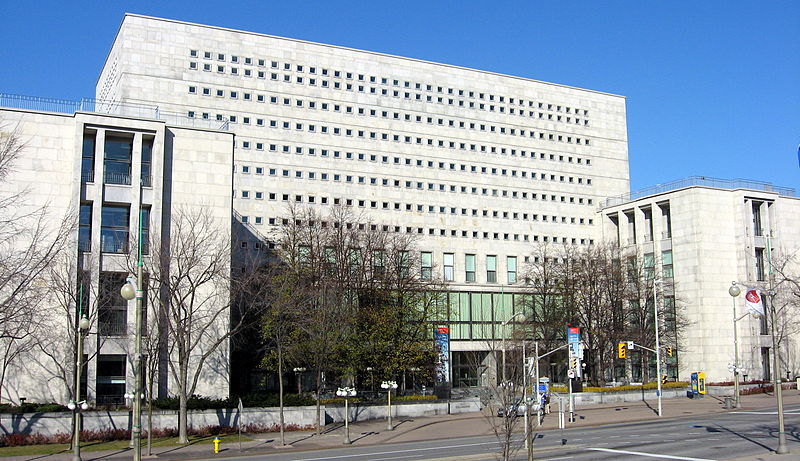
Library and Archives Canada (“LAC”), that esteemed national public institution and repository of Canadian knowledge, has some seriously misleading language in the license it requires for the deposit of all graduate theses and on its website. This reflects an apparently inadequate understanding of the Supreme Court of Canada’s landmark CCH v. LSUC ruling. This is nothing if not ironic, given that the LAC and the Supreme Court of Canada are next door neighbours in Ottawa.

LAC requires the author/depositor of a graduate thesis to agree to the following:

I represent and promise that my thesis is my original work, does not infringe any rights of others, and that I have the right to make the grant conferred by this non-exclusive license. [HK: So far, so good.] If third-party copyrighted material was included in my thesis, I have obtained written copyright permission from the copyright owners to do the acts mentioned in paragraph (a) above for the full term of copyright protection. [HK: Not good, to say the least]

The second bolded sentence, if read literally as many have not surprisingly done, suggest that any excerpt from any copyrighted work requires written permission from the copyright owner. This is simply wrong from both a legal and academic standpoint. The error is repeated and compounded at the part of the LAC site that provides information about copyright to students and universities here:

Please ensure that you haven't included copyrighted material from other sources unless you've received written permission from the copyright holder(s).

This may take quite some time especially if some of the copyrighted material is older, if the copyrighted source(s) you need to contact is out of the country and/or you need to contact multiple sources. We strongly recommend that you contact the copyrighted source(s) early in your thesis preparation.

This erroneous, or at the least badly drafted, language has caused a lot of confusion in the university community, as I have seen in several instances.

Clearly, it is a basic principle of copyright law that the quotation of a less than a “substantial part” of copyright work requires no permission. This is hardwired into s. 3(1), which is keystone arch of the Copyright Act, and explained in lots of case law. S. 3(1) states that

…“copyright”, in relation to a work, means the sole right to produce or reproduce the work or any substantial part thereof … (emphasis added)

Many institutions understand that much, even if it’s far from clear on the LAC site. But they don’t necessarily go on to explain the next step as to why permission will rarely be required for quotations in graduate theses, namely the users’ right of “fair dealing".

Even when the quotation is a “substantial part”, it is still permissible to use it without permission, if it falls within the very big and “flexible” tent of “fair dealing” for purposes such as “research” or “criticism or review” – which will be the case in most if not all properly done graduate theses.

See s. 29 of the Copyright Act, and see the Supreme Court of Canada's decision in CCH v. LSUC. Unfortunately, many who should know better in the educational community and some of the lawyers who advise them have apparently still not assimilated this landmark decision and/or are in denial as to its implications.

The LAC language should have made it clear that permission is only required when the quotation is “substantial” and when it does not fall within “fair dealing”. That is the law. The LAC passage suggests that permission will indeed be routinely required - which will rarely be the case in the context of graduate theses.

It’s hard to imagine a thesis that wouldn’t include “third-party copyrighted material.” How else can the writer demonstrate that his or her work is in fact new and creative and adds something of value to the state of knowledge in a particular field? All competent research builds on previous research. Remember Isaac Newton, who said “If I have seen further it is by standing on the shoulder of giants.”

Most theses, especially in the humanities, are quite properly replete with quotes, which are invariably attributed, as required by norms of academic protocol and strict policies against plagiarism. Mostly, they will be so short that they don’t constitute a “substantial part” of the work they come from or they will fall within fair dealing for the purpose of “research” and/or "criticism or review" of the work of other scholars. Furthermore, the purpose of reading such theses will invariably be for “research”. They are usually not particularly entertaining.

Moreover, the problem of excessively long quotes that go beyond fair dealing is normally self-regulating because any competent thesis supervisor and committee, if applicable, wants to read the work of the student, and not someone else's work. There cannot and should not be any absolute or formulaic rules about how long is too long.

It is very disappointing that LAC would adopt such language in this important document and on its website. This license document confronts all successful Canadian graduate students who have written a thesis. I’m told that even some publishers who ought to know better have now accepted that such language actually represents the state of the law in Canada and are refusing to publish books based on a thesis unless all permissions for all quotations have been obtained. I can understand why even some publishers might rely on LAC, given its prestige and role. But, in this case, I'm sorry to say that LAC has got it wrong.

Badly drafted, ill-advised and/or ill-conceived language that gets included in important public documents has a way of creeping into the common vocabulary and acquiring virtually authoritative status. This has apparently already happened in this example of LAC, and is clearly quite harmful because of LAC’s prominent and official role.

In fact, I gather that LAC compounds the problem by devoting taxpayer resources to vetting theses for copyright violations before putting them online. This is also a problematic policy for many reasons which I won’t go into here because this post is already too long. One obvious question, however, is how much taxpayer money is being spent on such efforts, and how many graduates students have had their research work wrongfully interfered with by such a process.

This is even worse in some ways than the arbitrary, unfounded and incorrect 2% or 500 word requirement that was in force and still may be at Simon Fraser University and still is on the website at UBC and who knows where else. It is astonishing that leading Canadian institutions presumably dedicated to research can promulgate policies that are so antithetical to it and just plain wrong. I’m sure that they don’t intend this to be the result.

Not surprisingly, Access Copyright has done its bit to compound the confusion here with misleading and incomplete information that will discourage legitimate permissible quotation that doesn’t require permission.

I don’t know how Canadian students can write decent theses, much less expect to make them available online, publish them and compete on the world stage, if they believe that they have to get permission to quote material that doesn’t require permission to quote.

Here’s an actual example of how all of this muddled and wrong thinking has translated into a seriously incomplete, misleading and counterproductive statement on thesis requirements from no less illustrious an institution than York University:

No substantial amount of copyrighted material may be included in the thesis/dissertation. Under the Copyright Act, if more than a reasonable extract of another person’s work is included in the thesis/dissertation, written permission must be obtained from the copyright holder(s).

Who knows what “reasonable” means? Why not refer to “fair dealing”, quote s. 29 of the Copyright Act, and at least point to the SCC decision in CCH. v. LSUC?

I hope that LAC and the Canadian universities that have misunderstood or misstated the role of copyright law in the writing and publishing of theses take appropriate steps to correct the current misinformation situation.

"Respect for copyright" is not increased by mindless insistence on clearance and permission when none is necessary. In fact, the result is quite the contrary.

I will address this and other issues in a pre-conference talk at the CLA conference in Edmonton on June 2, 2010. Unfortunately, although Access Copyright had agreed to send a senior person to this event, it has since backed out and no replacement speaker from Access Copyright will be on the program.

HK

PS June 1, 2010: UBC now appears to have removed the "2% or 500 word" language - but still has this chilling and incorrect statement on the page heading up the "Avoiding Copyright Violations" section of its website:
When you submit the final copy of your thesis, you must sign a document confirming that you have permission to use any copyrighted material in your thesis. (emphasis added)
Even the University of Toronto appears oblivious to the "substantial part" threshold and the "fair dealing" exception. See this:

When is Copyright Permission Required?

Does your thesis contain someone else’s work (third party materials)? For example, text, figures, maps, images, questionnaires, photos, etc.

  1. Does your thesis contain your own previously published materials (e.g. journal article)?
  2. Does your thesis include material (e.g. a chapter, an article) that was co-written with another author(s)?

If you answered “yes” to any of these questions then you must obtain written permission to reproduce the material from the copyright owner (e.g. journal publisher and/or co-authors).