Showing posts sorted by relevance for query joint committee. Sort by date Show all posts

Tuesday, February 19, 2008

Minutes of the Heritiage Committee re Proposed Special Joint Committee

The Minutes of the Heritage Committee meeting in which the Committee indicated its desire to get involved in the proposed copyright bill and to have it referred before second reading reveal some interesting remarks by the Hon.Hedy Fry, whose motion led to the Report:

I think we have heard repeatedly on this committee that one of the greatest challenges to copyright is the advent of digital media, and that this in fact seems totally insurmountable and uncontrollable because people are downloading intellectual property of creators and artists on iPods and everything they can. That has left us with a huge copyright vacuum.

I think the way Industry Canada may look at this would be very different from the way Heritage Canada would look at this. I believe the things that concern us at Heritage Canada and this committee here are the issues of pure intellectual property. When someone uses their intellectual property to invent a new piece of technology or widget, patent laws and all of those other things can come into place, because you can see the thing, hold it, feel it, touch it—like the BlackBerry, for instance. When you write a play or a song and someone picks it up on an iPod or on whatever and there's piracy going on and all of those things, that is really harming the creator, the artist. Therefore, I think we need to be at that table. We need to inject this perspective into any discussion on any copyright legislation.

It's most important, especially since we know that the CRTC has given an indication that they don't intend to deal with anything to do with the Broadcasting Act or copyright for the next 10 years. We are already the only one of the industrialized nations that doesn't have a copyright act that deals with these issues.

(emphasis added)

Having now seen the above, the idea of a Special Joint Committee becomes rather problematic. If Minister Prentice is listening to the advice he is getting from those who believe in balanced copyright, especially the recently formed Business Coalition for Balanced Copyright ("BCBC") and his bill, if and when it comes, truly reflects these concerns, it should be passed quickly and could mark a major positive achievement for Canada. However, the proposed Special Joint Committee could slow this down or even stop such a good bill from going through, if Mme Fry's frankly reckless rhetoric represents the prevailing view of the Heritage Committee.

My earlier (November 20, 2006) potential sympathy for a Special Joint Committee was predicated on the likelihood that the Bill would wind up before the Heritage Committee alone, a troubling prospect at that time. As I said on November 20, 2006:
If there is a copyright bill, and if it gets as far as committee hearings, it is imperative that it be considered by a balanced committee that represents the mandate of both of the sponsoring departments. The Heritage Committee alone cannot be entrusted alone with this task. Even with Mme Bulte gone, the institutional structure militates against both actual and apparent balance in the hands of that Committee alone. Even before Bulte, that Committee often gave the appearance of imbalance and of being too prone to influence by the Department of Canadian Heritage and the usual lobbying suspects. Indeed, the appearance probably reflected the reality. Clifford Lincoln may have appeared more balanced than Mme Bulte, but the result too often left much to be desired.
If Ms. Fry represents anything like the current consensus of the Heritage Committee, then a Special Joint Committee is not likely a good idea - at least for those who believe in a balanced copyright policy informed by facts and sound reasoning.

One also hopes that she is not speaking for the Liberal party - whose views on the bill could be crucial in terms of whether it stands a chance of being passed or not before the next election. Ms. Fry has been something of a controversial loose canon in the past with her comments in the House of Commons on cross burnings on the lawns of Prince George BC.

HK

Monday, November 20, 2006

PARLIAMENTARY COMMITTEES AND COPYRIGHT

I am somehow assuming, though not conceding, that the Government is going to ignore, for the moment, my call for a special judicial copyright commission - though I am pleased that Michael Geist has already effectively endorsed it:

Instead of hurriedly introducing a bill that will leave everyone unhappy, the Conservatives would do far better to launch a consultation or commission (as Howard Knopf suggested this week) on copyright.

I am also somehow assuming that the Government is going to keep to Mme Oda’s word by tabling a bill very soon that will be very controversial and that the controversies will be very complex, as they usually are in copyright matters.

If there is a copyright bill, and if it gets as far as committee hearings, it is imperative that it be considered by a balanced committee that represents the mandate of both of the sponsoring departments. The Heritage Committee alone cannot be entrusted alone with this task. Even with Mme Bulte gone, the institutional structure militates against both actual and apparent balance in the hands of that Committee alone. Even before Bulte, that Committee often gave the appearance of imbalance and of being too prone to influence by the Department of Canadian Heritage and the usual lobbying suspects. Indeed, the appearance probably reflected the reality. Clifford Lincoln may have appeared more balanced than Mme Bulte, but the result too often left much to be desired.

The effective low point of copyright committee proceedings was back in the C-32 days in 1996-1997. The Bill that went into committee was a bad one - especially for the educators and broadcasters. But at least there were a few exceptions for users. When it came out of committee, it had exceptions to the exceptions that vitiated the exceptions. It was a dark day for users. And the process was not pretty.

There are two structural improvements that would go a long way to ensuring both the appearance and reality of balanced and transparent committee hearings. They are cumulative and not alternative.

1. There should be a “special joint committee” that brings together all or at least the most knowledgeable and interested members of the Heritage and Industry committees. This would mirror the joint responsibility of the two Ministers and Departments. Such a Committee would have joint chairs. There is ample precedent for this approach.

2. There must be two or even three outside expert counsel to advise the Committee. Bill C-32 had only one outside counsel. For many reasons, the resulting product was a disaster for users. Likewise with the so-called "Bulte Report" in 2004. Fortunately, the Bulte Report had no immediate legal effect, though we may well see its influence infecting the forthcoming bill. In fairness to the counsel involved, we will never know for sure what transpired behind the scenes and whether the results were more because of or in spite of their work. This is simply too much responsibility to put on one person’s shoulders, given the polarization of policy views on copyright and even of expert opinions on legal copyright matters. For example, there is a great cacophony of divergent “expert” opinion on whether downloading P2P music files to a PC hard drive is legal. Another example is whether CCH v. LSUC protects, as fair dealing, much of the activity in the educational system that currently results in passive, massive and arguably greatly excessive payments of millions a year to Access Copyright and much of the internet related activity that CMEC is lobbying about. Whatever Committee considers this bill should have access to frank discussion of the range of opinions. That can only come from hearing all sides - not only from witnesses but from its own expert counsel.

Frankly, I cannot think of any one person who is sufficiently knowledgeable, balanced, experienced, expert in both the common law and “droit d’auteur” perspectives, and who would generally be perceived to be both actually and apparently sufficiently neutral and independent to do the job of committee counsel on their own.

It is no answer for the Government or Parliament to say that it will cost too much to have two or three counsel. How does the Department of Canadian Heritage justify 20 FTEs (full time employees) more or less to work on copyright policy? I suspect that this is probably more than any other government anywhere - and certainly far more than Industry Canada. Presumably, Heritage got the FTEs because copyright is important and because, as many believe, “copyright matters.” Well, if copyright matters, then the money will somehow be found and find its way into the right budget. There’s a huge surplus out there, and it just got bigger with the recent cuts.

What is needed amongst the suggested two and preferably three special committee counsel is a real and perceived balance between common and civil law approaches, and between creators’, owners’, and users’ rights and interests. That is why there ideally should be three people. There should be one person who would have the confidence of creators, owners and collectives on the one hand and another who would have the confidence of users. We would likely need a third person to sit in the middle to facilitate communication and consensus. That person might be a sufficiently experienced, knowledgeable and neutral academic, or, if such a person could not be found, perhaps a retired judge with some good IP decisions under his or her belt. The committee counsel must have the experience and stature to be able to provide frank advice and guidance to committee members, and not simply serve as a passive research or drafting resource. Any relevant client or consulting interests regarding policy matters should be fully disclosed, not only to the committee but to the public.

It will not be easy to implement these suggestions. There are a lot of vested interests who would love to replay Bill C-32 and go back to the Heritage Committee (and not a joint committee) and see it with only one outside expert counsel, as in 1996-1997. But we cannot allow that to happen.

I have not forgotten about the official languages problem. That’s another issue and it may require a ruling from the Federal Court of Appeal and maybe even the Supreme Court of Canada. I’m working on that. However, whatever committee handles the copyright bill can temporarily solve the problem by agreeing, as many committees do, to accept written material in either official language and not demanding it in both - but unfortunately this has not been the practice of the Heritage Committee under the previous government. This is a real issue for less well financed interest groups (i.e. most user groups) who cannot afford the cost of translating essential documentation, which in many cases will exceed the cost of preparing or collecting it - even assuming there is time, which there invariably is not. Although this is a huge legal and political problem, it is not a structural one. It is simply a question of the committee following what many more expert than myself in official languages believe to be the law of Canada. As I’ve said before and will have to say again, “either” means “one or the other.” It does not mean “both”.

BOTTOM LINE

If there is to be a bill, we must have the best possible committee structure with the best and most balanced advice available.

We must take the time to get this right. Currently, there are two lobby groups dominating and pushing the agenda. The one that appears to be in the most desperate hurry is CRIA, which has little or no connection with Canadian interests. The other most vociferous demandeur is CMEC, whose approach to copyright matters as reflected in Copyright Matters! is similar to that of Access Copyright as reflected in Captain Copyright, concerning which comparison Michael essentially agrees with me. Ironically, CRIA and CanCopy (the former name for Access Copyright) were the two big winners in Bill C-32.

With all of these difficulties ahead, and the very real likelihood that the bill as expected cannot get through any committee process - fair and balanced or otherwise - before the next election, my judicial copyright commission project begins to look better and better.

Even if there is a majority government after the next election, it may well wish to take the decisive step of calling for and properly constituting a judicially led commission. The current governance model of delegating arguably far too much law making power to the Copyright Board and leaving the ongoing development to be sorted out between two competing departments is not only far from ideal. In too many ways, it isn’t even working.

Perhaps an independent and fully transparent judicial commission can come up with a better way. How should this be set up? We’ll go into that another day.

Ministers may wish to take note.

HK

Monday, February 18, 2008

Politics More than Usual on the Hill

The Standing Committee on Heritage Committee has just released an interesting Report calling for the following:
The Standing Committee on Canadian Heritage recommends that the Government Bill entitled “An Act to amend the Copyright Act” for which notice was given on December 7th 2007, once introduced and read a first time, be referred to a Special Joint Committee made up of members or associate members of the Standing Committee of Canadian Heritage and of the Standing Committee on Industry, Science and Technology before second reading.
(emphasis added)

This means two important things:
  1. The Heritage Committee wants a piece of the action.
  2. The Heritage Committee wants to see the referral of the Bill before second reading, which is unusual, and would allow for major additions and alterations to the bill that would otherwise not be possible from a procedural standpoint.
This could mean that, in principle, "anything goes" with the bill. In such as case, the result would be quite unpredictable, but the lobbying would be predictably formidable, especially on the part of those who feel their issue was left out.

I've written before about the potential wisdom of having a special joint committee (rather than the Heritage Committee alone), and as well the need for balanced expertise - i.e. two or preferably three outside counsel to advise the committee members. This will be all the more important if the bill becomes a "free for all" as a result of referral after first reading.

HK

Tuesday, December 15, 2009

US Takes Postive Step Towards Possible Treaty for the Blind

The US Delegation in Geneva at WIPO - notably and interestingly led by the very capable Prof. Justin Hughes - has just delivered as very positive statement on a possible treaty for the blind....

The US is clearly open to the possibility of a multilateral treaty. And the USA is specifically suggesting "a properly-limited international rule of exhaustion in relation to special format copies made under existing national law exceptions for persons with print disabilities."

This is good news.

Here is the US opening statement, courtesy of Jamie Love. Even Jamie is impressed....and his tweets say the EU "is beginning to look pretty bad, in comparison to US statement."
*****************************************

World Intellectual Property Organization
Standing Committee on Copyright and Related Rights (SCCR)
Nineteenth Session
December 14-18, 2009

United States of America

Statement on Copyright Exceptions and Limitations for
Persons with Print Disabilities

As Delivered

December, 2009

Geneva, Switzerland


Thank you, Mr. Chairman.


The United States is proud to have a series of specific exceptions and
limitations in our copyright law, including for education, libraries,
and persons with print disabilities.


The law of the United States has these exceptions because we believe
access to information, cultural expression, and ideas is essential and
we know that governments have a role to play in facilitating that access
and reducing barriers to information, education and full participation
in a democratic society. So while the United States believes profoundly,
in the words of our Supreme Court, that copyright law is “the engine of
free expression,”1we are also committed to policies that ensure everyone
has a chance to get the information and education they need and to live
independently as full citizens in their communities.


Because education and civic engagement can be severely limited when
information is not available in accessible formats, under US copyright
law qualified non-profit organizations and government agencies are free
to reproduce and distribute published literary works under copyright in
specialized formats for use by blind persons or persons with other print
disabilities. We acknowledge that more is needed, but we are proud of
what this copyright exception has achieved. One of the main providers of
materials under this exception, the National Library Service,
distributes two (2) million Braille and audiobook copies of works to
nearly 800,000 users each year. And we have had this provision in our
law since 1996.


Of course, the United States is not alone in serving those with print
disabilities through carefully crafted limitations and exceptions in
copyright law. As we all know, over 50 countries have specific statutory
exceptions addressed to the needs of the visually-impaired and persons
with print disabilities. Other countries like India are in the midst of
thoughtful deliberations on their own national exceptions.


So the United States is pleased that WIPO is addressing this issue. We
believe that WIPO can move forward on this issue meaningfully and
seriously.


In that respect, the United States wants to first acknowledge the WIPO
Study on Copyright Limitations and Exceptions for the Visually Impaired,
prepared by Ms. Judith Sullivan, and presented to the Standing Committee
in 2006.2 This Study represents the kind of thorough comparative work we
must always do as a foundation for the development of new norms in
international copyright law. We also recognizes the on-going work of the
WIPO Stakeholders' Platform, which continues to explore in detail how
the needs of persons with print disabilities can be better addressed
through trusted intermediaries, new technologies, better formats, and
improved "best practices" in the publishing industry.


The United States also wants to acknowledge and express our appreciation
for the draft treaty language prepared by the World Blind Union and
submitted as a formal proposal at the last session of the Standing
Committee by our colleagues from Brazil, Ecuador, and Paraguay.3 We want
to recognize the tremendous work on that draft that was done by the
World Blind Union, the International Federation of Library Associations,
the DAISY Consortium, and several other groups and individuals. The WBU
treaty proposal will help the Standing Committee focus on this problem
and find the right means of addressing access to materials for people
with print disabilities through well-crafted exceptions to copyright
protection that can become an integral part of the international
copyright system.


As we explained in the last meeting of the Standing Committee, the
United States has been engaged in a process of understanding the
problems that confront persons with print disabilities in our own
country. This has been a joint effort of the U.S. Patent and Trademark
Office and the U.S. Copyright Office with leadership from the White
House. This process included a Notice of Inquiry in March 2009 that
generated numerous public responses; a public roundtable in May with
many stakeholder representatives presenting different perspectives on
making copyrighted works accessible to persons with print disabilities;
a further public comment period in October and December that included
specific questions on the WBU treaty proposal; and, just last week, an
informal White House meeting of representatives from our country’s
leading organizations for the blind and visually-impaired, our library
community, and our copyright industries.


Those of us working on this issue in the U.S. Government believe that we
are genuinely studentsof this problem; we are still in the process of
learning. But we are committed to doing our homework and doing it well.


Having said that we are still learning and studying, the United States
comes to this meeting with greater clarity and conviction in our views
on how the international copyright community should proceed in
addressing the needs of those with print disabilities.


Our commitment to reaching an international consensus

on copyright exceptions for persons with print disabilities


First, the United States believes that the time has come for WIPO
Members to work toward some form of international consensus on basic,
necessary limitations and exceptions in copyright law for persons with
print disabilities. This international consensus could take multiple
forms, including a model law endorsed by the SCCR, a detailed Joint
Recommendation to be adopted by the WIPO General Assemblies, and/or a
multilateral treaty. The United States is open to discussing and
exploring all these options.

The United States believes that the initial most productive course of
action may be a work program that begins with a series of serious,
focused consultations aimed at producing a carefully-crafted Joint
Recommendation of the Berne Assembly and the WIPO General Assembly. We
further believe this initial Joint Recommendation could be a step toward
the development of a treaty establishing basic copyright limitations and
exceptions for persons with print disabilities.


The first goal of international consensus in this area


In our consultations and review it has become clear to us that the most
pressing problem – the one identified repeatedly by experts – is the
cross-border distribution of special format materials made for persons
with print disabilities, whether these special format materials are made
under copyright exceptions in national law or special licensing
arrangements. Therefore, the United States believes that our first goal
should be to reach international consensus on the free exportation and
importation of special format materials for persons with print
disabilities in all countries.


We are confident that this body, the Berne Assembly, and the WIPO
General Assembly have the expertise, wisdom, and resolve to find a
suitable solution to this problem. We are prepared to work with other
countries to explore creative solutions to this problem, including, but
not limited to, [a] the establishment of a properly-limited
international rule of exhaustion in relation to special format copies
made under existing national law exceptions for persons with print
disabilities and/or [b] an international legal norm that trusted
intermediaries and non-profit organizations working for persons with
print disabilities must be able to exchange special format copies
without fear that copyright law bars such activities.


We believe that a solution to the problem of cross-border distribution
of special format materials, properly delineated to prevent abuses,would
solve the foremost problems identified by the print disability and
visually-impaired communities.


Further international consensus on basic exceptions for print
disabilities


The United States is also prepared to participate in a WIPO work program
to establish further international consensus on specific exceptions and
limitations for persons with print disabilities that should be part of
national copyright laws.


As a practical matter, we believe that this project will take longer
than finding common ground on the cross-border distribution of special
format copies made under existing national exceptions. First, any such
consensus should acknowledge the diversity of established national laws
in this area and the diversity of successful experiences with copyright
exceptions for persons with print disabilities that WIPO Members have
had. Second, any such consensus should ensure that WIPO Members retain
the flexibility to craft copyright exceptions and limitations to meet
changing social, economic, and technological conditions that affect the
print disability community. Third, the specific exceptions and
limitations that emerge from such a process should acknowledge – as many
in the visually impaired and print disability communities have told us
-- that market practices can often help to solve problems of access to
materials and that mandatory exceptions are most needed to address
market failures. Finally, consensus on basic copyright exceptions for
the print disability communities can and should be reached within the
framework of the Berne acquis; Berne Article 9(2); and the corresponding
provisions of TRIPS, the WCT, and the WPPT.


A balanced system of international copyright law


We recognize that some in the international copyright community believe
that any international consensus on substantive limitations and
exceptions to copyright law would weaken international copyright law.
The United States does not share that point of view. The United States
is committed to both better exceptions in copyright law and better
enforcement of copyright law. Indeed, as we work with countries to
establish consensus on proper, basic exceptions within copyright law, we
will ask countries to work with us to improve the enforcement of
copyright. This is part and parcel of a balanced international system of
intellectual property.


Thank you.


# # #

Tuesday, October 16, 2007

Copyright and Throne Speech

Here's the speech.

Copyright revision was mentioned briefly.

That's good news.

Even if a bill is not passed before the next election, it would be good to see it.

If it gets as far as committee, it is essential that it be dealt with wisely, effectively and properly through a joint committee with the appointment of two or three expert counsel who can work together to provide balanced advice. I have suggested all of this before.

Mercifully, the Speech omitted any specific reference to "counterfeiting" as such. Hopefully, this will mean that the efforts of various IP lobbyists that can have the effect of erroneously confusing and conflating counterfeiting (which I abhor) with legitimate parallel imports (which I support and have successfully defended in the Supreme Court of Canada) will be put off to another day.

We already have very strong measures, including criminal offenses, on the books against both commercial "counterfeiting" (which term is generally used in the trade-marks context) and "piracy" (which generally applies in the copyright context). Some activity involves both. It's far from clear that we need to gratuitously guild the lily. Hopefully, the Government agrees and will take care not to enact excessively strong or unnecessary remedies that would catch dolphins in a drift net or impede legitimate (i.e. parallel import) trade.

Of course, the absence of a reference in the speech to counterfeiting doesn't mean that we won't see legislation at some point. Anti-piracy measures (hopefully not excessive) will probably be in the copyright bill.

HK

Wednesday, July 07, 2010

On the Right to Read for Blind Persons and others with print disabilities


As reported by KEI Online, below is Ambassador Gero's statement at the recent WIPO SCCR/20 meeting (June 21-24, 2010 in Geneva) on the subject of a possible treaty dealing with rights for the blind. It is rather unusual for an Ambassador to attend a working level meeting such as this. John Gero was very active on IP matters at the very early stages of the FTA, NAFTA and the WTO agreements beginning in the mid to latter part of the 1980's. It is unclear why he chose to personally deliver Canada's main intervention - but, at the very least, it would suggest that Canada regards this as a very important issue.
***************************
Intervention — International instrument on access to protected materials by persons with print disabilities

Thank you Mr. Chairman

Canada is pleased once again to address this Committee on the important issue of access to work by the print disabled. We would like to thank Brazil, Ecuador, Paraguay and Mexico – the co-sponsors of the Visually Impaired Persons (VIP) Treaty Proposal – for their contribution to this discussion. We would also like to thank the U.S., the European Union, and the Africa Group for their respective proposals that address access to print materials by persons with print disabilities, which have been recently submitted to this Committee.

Canada would like to take the opportunity to reconfirm our interest in finding expeditious and pragmatic solutions for access to works by the print disabled. Today, Canada would like to offer our perspective on the general principles that should apply to a possible instrument. We would also like to highlight how some potential reforms to Canada’s domestic regime could positively contribute to the work of this Committee.

In terms of some considerations that could serve the work towards an international instrument, Canada would like to note the following:

First, the element of flexibility is vitally important. It is Canada’s position that any solution to the problems of access by print disabled persons to copyright works should allow for a variety of means for domestic production of accessible material. Members States should have the choice of using exceptions, compulsory licensing or conditional exceptions. Providing Member States with flexibility in this regard is important as some Member States have laws that provide different types of limitations and exceptions for different types of accessible materials. Although there are some Member States here that suggest a mandatory exception is necessary, it is Canada’s view that enabling Member States to implement provisions which reflect local realities by having more than one type of limitation or exception, including for different types of accessible material, would not prevent but actually enhance the international exchange of such materials.

In this regard, a mandatory exception in all countries to allow for the import and export of special format materials does not seem necessary. It is important to recognize and account for the reality that not all Member States have identical laws. Moreover, it is also important to provide Member States with the ability to account for cultural differences and not to restrict their capacity to innovate in their legal framework.

With respect to the various proposals that have been tabled, we note that the Consensus Instrument proposed by the U.S. and the Joint Recommendation proposed by the EU allow for flexibility in laws. Canada sees this as an advantage for it recognizes effective regimes which are already in place, including those which may require payment in certain circumstances.

Another important consideration is that of the trusted intermediary. In order for the discussion to progress, it will be key to address the role and obligations of trusted intermediaries. Canada takes note that some proposals introduce the concept of trusted intermediaries. Canada would welcome a discussion on the range of circumstances in which these organizations could play a role.

Aside from Canada’s preference for flexibility, we view the ability of individuals with print disabilities to import special format materials for their own use without necessarily going through a domestic organization, such as a trusted intermediary, to be an important feature of the copyright modernization bill recently introduced in Canadian parliament that we will now turn to briefly describe.

As stated at the beginning of our intervention, Canada would also like to highlight how some potential reforms to Canada’s domestic regime could positively contribute to the work of this Committee. Earlier this month, a copyright modernization bill was introduced in the Canadian Parliament. This bill implements the rights and protections under the WIPO Copyright Treaty and the WIPO Performances and Phonograms Treaty, it creates new exceptions for educators, librarians, consumers and innovators and it strengthens the tools for rights owners to fight piracy. More to the point of our current discussion, the bill also explicitly addresses the issue of the import and export of special format materials for the print disabled.

With respect to importation, Canadian law – and this principle has existed in our law for many years – provides that it is only necessary to look at the limitation or exception in Canadian law to determine whether material can be imported. The copyright modernization bill clarifies for print disabled persons the existing rule that copyright materials can be imported into Canada if they could have been made in Canada under one of the exceptions in our law. This includes the importation of special format material for the perceptually disabled including importation by individuals with print-related disabilities.

We think that this example from Canadian law demonstrates that the importation of special format materials can be achieved in a variety of ways.

We would also like to note that this principle on importation may already exist in the laws of a number of Member States.

With respect to exportation, the bill in front of the Canadian parliament also has specific measures related to the export of special format materials. It includes a number of provisions to ensure that there is an appropriate balance between the interests of the parties involved. First, exportation is limited to special format versions of works by Canadian authors or authors of the country of importation. Second, the bill allows for the possibility of a royalty collected for export material even though there is a complete exception for domestic production of special format materials. Third, export from Canada can only be done by organizations, not by individuals; and the importer recognized by the law can only be an organization and not an individual. And fourth, the bill allows for the possibility of requiring a contract between the Canadian exporting organization and the foreign importing organization. A contract of this type could stipulate, for example, that the copies could only be used by persons with print disabilities. In this sense, this provision is aligned with the concept of trusted intermediaries by ensuring that the distribution is limited to persons with print disabilities.

Of note, the bill allows the export of special format materials to foreign countries regardless of what the law is in the foreign country and regardless of whether the foreign country has a limitation or exception for the creation of special format materials.

Although the bill does not allow for the export of third country material, any international instrument should establish rules and principles under which third country material can be exported.

In conclusion, we hope that Canada’s perspective on general principles and the approaches set out in our new copyright modernization bill are helpful in advancing the dialogue on this issue.

In terms of next steps, Canada does not see a consensus instrument or a joint recommendation as excluding the possibility of a treaty. Indeed, it can be considered as an important building block.

Thank you Mr. Chairman.

**************************
BTW, KEI is very active on this issue and has lots of useful resources and references. Start here.

This issue is not only important for those who are blind or have other reading disabilities. It is increasingly being seen as a a crucial test of whether WIPO can broker a meaningful multilateral agreement, or whether we will continue to see more erosion of multilateralism and the United Nations spirit. This is indeed what we are seeing in the controversial ACTA negotiations and countless bilateral and plurilateral agreements, such as the proposed CETA (Canada Europe Trade Agreement).

Those who are blind or who have print disabilities should at least have the right to read. Many of them have to struggle to do everyday things that most people take for granted. This right should not be controversial.

It would be very unfortunate if certain vested interests in the copyright world play politics in Geneva at the expense of blind and otherwise print disabled persons. The WIPO Secretariat will no doubt do its best to see a positive and concrete result - which most advocates for the blind would consider to be nothing less than a treaty. "Soft law" is probably not good enough any more on this issue.

But if major countries or blocs, spurred on by major copyright trade associations or acting for other reasons, frustrate efforts for this worthy cause, WIPO's ability to do what is right, just and necessary will be limited.

HK

PS - here is IP Watch's excellent report on how a "golden opportunity" was missed.

Friday, March 13, 2015

Update on Canadian Copyright Board Matters: What is Happening and Not Happening

Supreme Court of Canada

There’s a lot going on – or not going on – concerning the Copyright Board.

The Board has promptly posted all the responses to its Working Group Committee Report. I won’t begin to analyze them, other than to say that there was a surprising amount of agreement amongst a number of normally strange bedfellows (including Music Canada, Access Copyright, major broadcasters and yours truly) that the recommendations might actually make proceedings even longer and more expensive at the Board.

Simon Doyle has written a timely piece in the Globe and Mail – unfortunately it’s heavily pay-walled – about the slowness of the Government to appoint a new Board chairperson. He mentions some – though not all – of the names that are being talked about in various circles. He describes some of the apparently intense lobbying that is taking place. He also quotes me as follows:
“There’s no apparent reason why it now often takes the board four years to get to a hearing and two years or more to render a decision,” Howard Knopf, a copyright lawyer in Ottawa with Macera & Jarzyna LLP, said by email.

Mr. Knopf said the Copyright Board has oversight of about $500-million a year “of collective copyright activity in Canada. Also, the board’s processes have generated a lot of money over the years for certain lawyers, consultants and perennial ‘expert’ witnesses.”

Mr. Knopf said the government can implement regulations that could address the steps, stages and timelines of a hearing, the interrogatory process, the qualification of experts, and timelines for the rendering of a decision after a hearing.

Meanwhile, back in the Courts, on Monday morning, March 16, 2015 the Supreme Court of Canada will hear the CBC v SODRAC appeal, which involves yet another judicial review of a Copyright Board decision. This will be  the 17th case involving important consideration of the Copyright Act that this Court will have heard  beginning with the 2002 case of Théberge v Galerie d’Art du Petit Champlain inc. Seven of these have arisen from judicial review of Copyright Board decisions.  Five others were infringement cases. Prior to 2002, the last important copyright case from the Court was Bishop v. Stevens, [1990] 2 S.C.R. 467, which will be referred to very often on Monday.

CBC v SODRAC will focus mainly on technological neutrality. I should disclose my involvement as counsel for the Centre for Intellectual Property Policy at McGill and Prof. Ariel Katz. They have been given leave to intervene on what they call the “mandatory tariff” theory. Their position is that it:
…lacks any basis in law: standard principles of statutory interpretation contradict it; the case law debunks it; and the legislative history discredits it. In addition to absurd results that contradict fundamental tenets of the rule of law, the “mandatory tariff” theory threatens to upset the balance in Canadian copyright law. It would overly compensate owners, contrary to this Court’s holding in Théberge, and it could gut fair dealing and others users’ rights, contrary to what this Court cautioned against in CCH.

The webcast will be delayed because SODRAC has filed some material that it regards as confidential. The music industry will present two joint interventions, and CIPPIC will also appear. All the factums can be found here.

Those who want to watch this live in real time will have to attend at the Court. Proceedings start at 9:30 AM.

HPK


Monday, November 26, 2007

The Dire Dozen

How many presidents and other senior honchos of big trade associations and collectives does it take to write one op-ed purporting to refute "bloggers like Michael Geist" (hopefully, this includes me) and the increasingly noticed landmark, independent Industry Canada study on downloading and file sharing based upon an independent and fully professional survey of 2,100 Canadians?

The answer is literally a full dozen. A whole dozen VIPs comprising a Who’s Who of the entertainment and copyright collective world in Canada, including some strange bedfellows in the music industry who - when they aren’t fighting with each other at the Copyright Board or in Court or on other fronts - usually try to close ranks at copyright revision time. Which is now.

(The complete list of apparent joint authors is: David A. Basskin, Jesse Feder, Doug Frith, Graham Henderson, Jackie Hushion, André LeBel, Guy Mayson, Duncan McKie, Danielle LaBossiere Parr, Catharine Saxberg, Stephen Waddell and Carolyn Wood)

They have published an op-ed in the November 26, 2007 edition of the influential Hill Times aimed at Michael and the Industry Canada file sharing study. It’s interesting that it takes all twelve them to come up with such a an unconvincing piece of spin, doubtless aimed at persuading the PMO, the responsible ministers and committee members that stronger copyright laws (which may result in RIAA-style mass lawsuits against children and dead grandmothers and put digital locks on our culture and technology) will restore Canadian investment and innovation.

They also repeat the litany about how Canada has failed to honour its decade old WIPO "commitments." So, I will repeat that we have no such commitments, since signing a treaty is a far cry from ratification. It's the difference between dating and marriage.

So, without these stronger laws, we apparently face a bleak future of the "lost jobs, growth and prosperity we can expect as a result of reduced investment and innovation."

A dire dozen indeed.

Now, who is "escalating the rhetoric?"

BTW, the Barker study upon which this op-ed relies to a significant extent does, to its credit, contain the following disclosure in footnote 5:
This work was supported by a grant from the Canadian Recording Industry Association. The views expressed however are those of the authors. No responsibility for them should be attributed the Canadian Recording Industry
Speaking of the Hill Times, I have a modest offering of my own in the November 26, 2007 edition, to which I will link to and reproduce shortly.

HK

Monday, September 22, 2025

Access Copyright + Copibec: Their Offensive Budget Bluster

As an affiliate of Access Copyright, from whom I annually receive enough for a nice lunch for one or a rather modest lunch for two, I also get Access’s Updates. Here’s the latest from September 2025. Note this passage towards the end:

Access Copyright and Copibec Make Joint Submissions for Federal Pre-Budget Consultations

Access Copyright, in collaboration with Copibec, the reproduction rights organization for Quebec, participated in the pre-budget consultations undertaken by the Standing Committee on Finance and the Department of Finance in advance of the tabling of the 2025 federal budget this fall.

In both submissions, our organizations made four recommendations, reflecting the growing importance of implementing a regulatory framework for the fair and responsible development of Generative AI (GenAI) in Canada as well as the continuing need to repair the educational marketplace for published works.

Our recommendations are:

·        That compliance with the Copyright Act be an obligation of any normative framework concerning GenAI.

·        That no exceptions for text and data mining be introduced to the Copyright Act.

·        That transparency requirements for AI training be included in any normative framework concerning GenAI.

·        That the government amend the Copyright Act to clarify fair dealing for education, make tariffs set by the Copyright Board of Canada mandatory and enforceable, and ensure statutory damages are available to all collectives.

(highlight added)

These recommendations do not belong in a budget. Budgets are for important fiscal announcements that deal with financial issues affecting Canada as a whole. They are not for the purpose of hiding and deflecting attention from self-serving senseless lobbying efforts aimed at enriching narrow corporate interests and burying such initiatives deep in omnibus legislation where they can escape adequate parliamentary scrutiny.

Justin Trudeau shamefully resorted in 2022 – contrary to his explicit promise to the contrary – to using the budget process to hide bad copyright legislation amidst and omnibus legislation. See Oops! He Did It Again: Budget 2022 Hides Copyright Time Bomb By Throwing Parliamentary Scrutiny Under the Omnibus Bus. Trudeau caved then to the copyright content crowd.  Let us hope that PM Mark Carney will NOT repeat that shameful error in the budget expected on November 4th, 2025. The unexpected, early, and regrettable departure of David Lametti as Principal Secretary to the Prime Minister removes a potentially highly principled and expert source of wise advice.

The Access Copyright and Copibec proposal to make tariffs mandatory and enforceable with statutory damages is drastic, indefensible, and contrary to very longstanding legislation and Supreme Court jurisprudence.

Trying to sneak this into the budget process is indefensible and, indeed, extremely offensive. And I’m not using the word offensive in the strategic sense of aggressive but rather in the more fulsome sense of disgusting and deplorable.

HPK


Friday, June 19, 2015

The Canadian Copyright Board – Can We Move On With Substance and Process, or Do We Need Still More Statistics?


Figures often beguile me, particularly when I have the arranging of them myself; in which case the remark attributed to Disraeli would often apply with justice and force: "There are three kinds of lies: lies, damned lies and statistics."
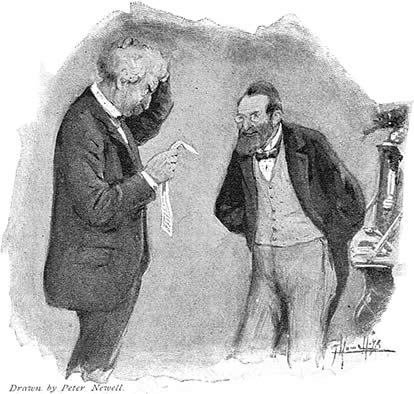
- Mark Twain's Own Autobiography: The Chapters from the North American Review
Illustration by Peter Newell from COSMOPOLITAN,
August 1898
http://www.twainquotes.com/Statistics.html

“The Times They Are A-Changin'”

There are signs that things are changing at the Canadian Copyright Board. We have recently seen a landmark decision involving Access Copyright’s proposed Provincial Government tariff that is nothing short of a “devastating defeat” for the collective and will not yield enough revenue to begin to pay for the cost of obtaining the tariff. This is the second time in a year that a major collective has apparently failed to recover enough in tariff revenue even to pay its likely legal and expert costs. The other involves Re:Sound’s Tariff 8, which I've written about, and  which the music industry continues to complain about. (Some aspects of the irony of how this case plays out inside the music industry are dealt with by Michael Geist here). It would frankly be surprising if judicial review will make a big difference in either case.  Inaugural tariffs are, it seems, no longer bankable assets that can justify spending several million dollars on lawyers and “experts” on the nearly guaranteed expectation of generating several tens of millions in return in a few short years mostly at the expense of the general public, as the CPCC and others once counted upon.

Moreover, the economics of defending tariffs are changing, with the new phenomenon of major objector associations withdrawing their objections and leaving their membership in the lurch of what is now effectively a default proceeding mid-way through Access Copyright’s Post-Secondary tariff application. Why this happened is another matter that has not been publicly explained. In the absence of any other plausible explanation, one can only suspect that this is because the objectors’ funding well had run dry. Questions might be asked about whether that withdrawal was inevitable, along with why the interrogatories were answered by so many members at clearly enormous cost to the educators and benefit to Access Copyright, when even the Board would have been happy with a “…a reasonable amount of relevant information, from a reasonable number of institutions….”. But the result is obviously what it is – which is a serious problem for the Board and for Canadian copyright policy, not to mention for Access Copyright and the Canadian educational community. More about this to follow soon.

Hope For Optimism with the Appointment of a New Chair

Potentially even far more importantly in the long term than these recent events, we have just seen the recent appointment by the Government of Justice Robert A. Blair of the Ontario Court of Appeal as Chair of the Copyright Board. He has had important involvement in high profile IP cases and systemic institutional justice reform in the Ontario system.  Hopefully, his appointment augurs extremely well for some much needed change at the Copyright Board.

He was the Co-Chair of the pioneering Civil Justice Review initiative in Ontario in the 1990s and has long been recognized as one of the lead architects of reform in that province’s court system. That reform was also influential in other provinces and at the Federal level. The Copyright Board is surely a much smaller ship to turn if course correction is needed, as many from all viewpoints now believe to be the case.

These developments are very promising and set the stage for the implementation of much needed regulations to ensure that the Board gets back and stays on course with the original vision from Judge Parker in 1935. 

Forces Favouring Go Slow or the Status Quo or More Studies

However, there are some who are apparently reluctant to conclude that there are serious problems at the Board that need to be addressed. Even the “working committee” process set up a long time ago by the Board and its belated and disappointing report has led to a remarkable consensus among a strange group of bedfellows that this report would only likely make things even worse in terms of delay and expense.

Another interesting development involves the publication of a much anticipated study released on April 16, 2015 by Prof. Jeremy de Beer of the University of Ottawa paid for by Industry Canada and Canadian Heritage concerning Canada’s Copyright Board. Prof. de Beer concludes, among other things, that:

The Board certified 852 different tariffs in respect of the 15-year study period between 1999 and 2013. Only 8 proposed tariffs were not certified. There remain 209 tariffs proposed during that period but not yet certified. When (and assuming) those tariffs are eventually certified, the Board will have dealt with more than 1050 tariffs applicable to the 15-year period since the 1997 legislative amendments entered into force. That amounts to more than 70 tariffs per year on average. (emphasis added) (footnotes omitted)

It’s commendable that the Government – through both Industry Canada and Canadian Heritage – has co-operatively sponsored a study from such a well-known author/researcher as Prof. de Beer. We have seen only a few outside studies on copyright law and/or economics by well qualified experts since the long hiatus after the golden age of the early 1980’s. For example there are these from Industry Canada. The Canadian Heritage website appears to be significantly out of date. It does not refer to any events since 2010 and doesn’t seem to include any longer any of the studies it has sponsored on its own in recent times, such as this one that I commented on in 2007. Therefore, any well done study would be welcome – and more cooperation between these historically rivalrous departments is potentially a very welcome sign. That said, the institutionalized rivalry is there for a reason – and the joint role of both departments mirrors the inherent dichotomy of the copyright debate overall. Both departments should continue to have a role and keep an eye out on each other.

Prof. de Beer has undertaken what is essentially a statistical analysis of key milestones in the timelines of cases at the Copyright Board over a 15 year period. For the reasons below, and with the utmost respect, I must, however, seriously question whether such a statistical analysis was necessary or even useful, and, indeed in any event, whether the methodology was appropriate.  I remain quite baffled by the above numbers, which are surprising, counter-intuitive and arguably counterfactual. The Board itself makes no claim to this magnitude or annual rate of “tariff” activity. Indeed, as shown below, Prof. de Beer’s numbers of 852 certified tariffs overall for the 15 years in question at the rate of 70 per year are, in comparison to the Board’s taxonomy as seen on its own website information, apparently approximately  1,150% and 1,400%  more respectively than the Board itself claims.  The figure of 209 pending tariffs is equally and incredibly astonishing.

I had a brief posting on this almost immediately after Prof. de Beer’s report was released but I took it down because I thought his report deserved a more detailed  and reflective analysis, which follows.

My overall take on Prof. de Beer’s study is that:

  •        Some will use this study to suggest that the Board is very productive, since it supposedly certifies 70 tariffs a year according to Prof. de Beer. However, as I show below, even the Board’s own numbers suggest a much more modest rate of 4.9 “tariffs” a year, using what both I and the Board would consider a more realistic notion of what “tariff” means. And those who keep close watch are likely to feel, on an “anecdotal” basis, that even that number seems high. For example, we are now almost half way through 2015 and the Board has rendered only two significant substantive decisions and has certified only two tariffs by any normal measure, both of which have roots going back a total of about 14 years and one of which was a redetermination ordered by the Federal Court of Appeal.  I have discussed both of them recently, namely here and here. When dealing with such low numbers, “anecdotal” observations may be more important than any so-called statistical analysis, which may not even be possible with such little actual data, if the meaning of “tariff” is realistically interpreted.
  •      Others may see these high numbers and the methodology used to generate them as lowering the average delay time and tending to hide the unexplained and inexplicable fact that too many tariffs take at least four years to get to a hearing and at least two or more years thereafter for a decision to be rendered, and that the quality of the decisions is such that they are often reversed, if not corrected quickly by the Board itself in two recent instances.
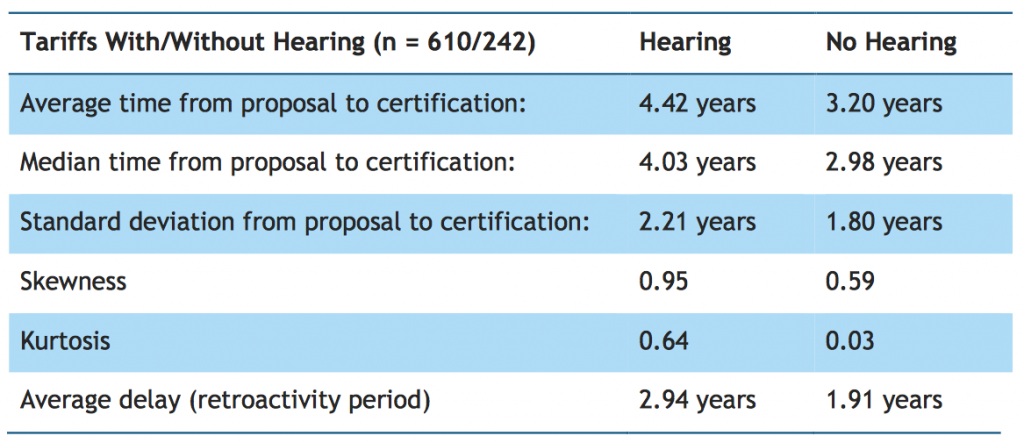
  •       Even allowing for the possible diluting effect of Prof. de Beer’s methodology, the fact that it takes an average of 3.2 and 4.42 years to certify a tariff without and with a hearing respectively is still cause for considerable concern.
  •      The statistics generated by Prof. de Beer will no doubt be used by those who perennially argue that the Board needs more resources. However, without any identification of the causes of the delays at the Board and without any “normative” analysis and judgments, there is no basis whatsoever to support such a suggestion. Indeed, given readily available comparisons to other tribunals close by, most notably the Competition Tribunal, it is at least as plausible in principle that the Board already has too much in the way of resources and this may be part of its problem. These real questions need, at least, to be explored. 
  •       Prof. de Beer explicitly stops short of any normative judgments or analysis of why things take so long and repeatedly suggests that more even more data and studies are needed. However, in my view, the last thing we need is more studies to prove that things take too long. Even retired Board Chairman Justice William Vancise, who promised about a decade ago to shorten the pendency time from hearing to decision to six months (see below), would likely not dispute that things have gone from bad to worse. We don’t need expensive statistical studies to prove what is obvious and incontestable. What we need to do is figure out why things take so long and how to fix the problem.
Prof. de Beer’s surprisingly large “tariff” numbers both overall and annually are explained at page 10 of his report by his decision to “disaggregate” data from every “tariff”:

Accordingly, this study’s approach was to disaggregate data from every “tariff” proposal based on the multiple procedural possibilities between publication and certification. During the research proposal, every certified tariff was broken into its constituent components and subcomponents, dissected by year, number, and letter (where relevant). For example, the Board’s decision on Re:Sound’s Tariff 6.B (Use of Recorded Music to Accompany Physical Activities) for 2008-2012 dated July 6, 2012 became five units of analysis; Re:Sound 6.B 2008, Re:Sound 6.B 2009, Re:Sound 6.B 2010, Re:Sound 6.B 2011, and Re:Sound 6.B 2012. The disaggregated data was then correlated backwards to the collective society’s original proposal that had initiated the tariff-setting process. One consequence of this approach may be to complicate the statistical analysis by raising independence issues in the data. Although each tariff will be unique in at least one respect, some units of analysis may involve identical data-points, such as a common proposal or certification date. Nonetheless, this approach was clearly the best, if not the only, feasible option for analysis.

By breaking each subdivision of each tariff down to separate years, numbers and letters, he comes to the conclusion that the Board has certified 852 tariffs in the 15 year period of the study. I profess no expertise in statistics, but this seems to be very questionable. To suggest, for example,  that SOCAN Tariff 10 which covers Strolling Musicians and Buskers in Part “A” and Marching Bands and Floats with music in Part “B” is really two separate tariffs for each year it has existed may be useful for data gathering purposes for Prof. de Beer’s study. However, it is always best to compare apples with apples. Clearly, not all tariffs are equal in terms of complexity, economic importance, or the process by which they are treated. To equate the “marching band” tariff with SOCAN’s never ending Tariff 22.A “making available” tariff for purposes of measuring delay and inefficiency is unrealistic in my view. This methodology begs the question as to why it takes any significant amount of time and delay to certify long-standing tariffs that are unopposed and often of little economic importance. It also begs the question of why these tariffs are not certified for much longer periods of time. Marching bands are, after all, a long-established use of music and the technology has remained quite stable and even static:


Thus, Prof. de Beer’s  methodology is arguably questionable because it appears to equate the numerous unimportant, simple and unopposed tariffs proceedings that should occupy little or no Board time with those that seem to never end. That, very likely, will lower the average overall delay times by a significant amount.

Indeed, I suspect that if the Board’s own classification of what is a “tariff” and a “decision” were to be used, as shown below, which more accurately corresponds to the way the Board actually works, the result would be that there is simply not enough statistical data to warrant the detailed type of statistical treatment that Prof. de Beer and his team have undertaken.

With that lengthy preface, here are Prof. de Beer’s own key summary charts:

Distribution of certified tariffs applicable for the years 1999-2013.

Distribution of certified tariffs applicable for the years 1999-2013.


Table 6
Statistics Regarding Tariffs Certified With and Without Hearings

In his own words, he summarizes all this as follows:

According to my data, 852 different tariffs were certified by the Copyright Board in respect of the 15-year period between and including 1999-2013. There are 209 pending tariffs that were proposed for that period but have not yet been certified. The certified tariffs took an average of 3.5 years to certify after filing. The average pending tariff has been outstanding for 5.3 years since filing as of March 31, 2015. On average, tariffs are certified 2.2 years after the beginning of the year in which they become applicable, which is in effect a period of retroactivity. The standard deviation in the time from proposal filing to tariff certification is 2 years. A hearing was held in 28% of tariff proceedings. The average time from proposal filing to a hearing in those proceedings was just over 3 years. The average time from a hearing to tariff certification was almost 1.3 years.
(emphasis added)

The hundreds (according to Prof. de Beer’s methodology) of minor, unopposed and economically insignificant separate tariffs that Prof. de Beer’s methodology apparently identified and measured are not the main problem at the Board, although they are still a big problem because there is no apparent reason why there is any significant delay whatsoever in certifying them. The real problem is the contested and often very important tariffs that result in hearings – and, more recently, default proceedings in the case of the  Post-Secondary file that is apparently stalled indefinitely and presents very serious challenges to the Board and to the public interest. Even according to Prof. de Beer’s numbers, about 20% of Board cases that involve hearings take at least 6 years to be certified. And these are not “outlier” cases. Those who follow the Board know that these are probably among the more visible and important hearings that the Board deals with, such as the most recent tariff. This was the “fitness” tariff, which I have discussed elsewhere in some detail and briefly below, that has taken almost 8 years to reach what may still be an inconclusive resolution. It would have been very helpful and presumably not too difficult to provide links to the actual tariffs and decisions that took more than six years to certify. Indeed, links to all of the tariffs, using the Board’s taxonomy, would have been helpful and not difficult to provide – see below.

Another problem with the study’s methodology is that it does not deal with the fact that many tariffs are certified in huge batches periodically, of which some elements attract little or no attention and some do attract varying degrees of opposition. Here’s a decision from 2004 that covers SOCAN tariffs on everything from marching bands to magic shows, from restaurants to planes and trains,  not to mention  adult entertainment clubs to fireworks displays. Some elements were opposed. Others not. The process was spread over several years, with some of the tariffs being filed as early as October 18, 1997 and others up to April 19, 2003 and with hearings held in 2002 and 2003 on various aspects. The Board’s decision on the whole batch was not released until June 18, 2004. It’s far from clear how Prof. de Beer’s methodology could “disaggregate” this eclectic smorgasbord of a decision in any meaningful way. This raises the question of why the Board cannot simply quickly approve an unopposed tariff, especially one that may have previously been considered, and why these things are allowed to accumulate and linger and grow old together.

Some elements of this decision were economically trivial. SOCAN’s Tariff 10.B for “marching bands” actually generated $4,984 in the year 2000. In that year, its tariff 13.C  for trains and buses generated $378. On the other hand the tariff for Cabarets, Cafes, Clubs, etc. – Live Music) generated $2,145,057 that year. The Board used to provide these kinds of numbers, but it seems that it does not see the need to necessarily do so anymore – for example in the fitness tariff discussed below, where such numbers would be expected, if not essential, given the public interest aspect of that tariff and it importance to so many people.

Moreover, we see tariff files that never seem to end. These include SOCAN’s Tariff 22 internet tariff, which has been going on in one way or another since 1994, with the current iteration concerning the alleged “making available” right and SOCAN’s never-ending quest concerning its Tariff 22.A. The current iteration of proposed SOCAN Tariff 22.SA which was filed as a proposed tariff in 2012, is  still in a preliminary phase.   This preliminary phase was not supposed to include any evidence but now has extensive evidence from experts around the world, which seems strange since the Supreme Court of Canada and the 2012 Copyright Modernization Act would appear to be quite clear on the issues at hand, This issue – or more likely in the end a non-issue – could have already been to the Federal Court of Appeal if not the Supreme Court of Canada had it been handled more decisively by the Board and some of the main parties, who seem in no hurry for this file to come to an end. The Access Copyright Post-Secondary Tariff has been in a state of suspended animation since the Board ruled on January 17, 2014 that “For these reasons, and because of the additional drain on Board's resources this implies, the Board postpones sine die the hearing in this matter. After having received and analysed all answers from Access, and replies from Mr. Maguire, the Board will either decide when to reschedule the hearing or proceed on paper.” This was a tariff that was filed in 2010 and is now, for various complicated reasons, unopposed. The Board has still not indicated how it will proceed on this matter.

Here is my own chart – prepared in couple of hours and based upon the Board’s website information concerning “certified tariffs”  and “decisions”, with links provided. The comments are my own and very brief:

TYPES OF TARIFFS CERTIFIED BY COPYRIGHT BOARD BETWEEN 1999 - 2013
NUMBER CERTFIFIED TARIFFS   FROM 1999 – 2013 (including “redeterminations”)
COMMENTS and LINKS TO ACTUAL DECISIONS
4
This tariff is now extinct, since the collective was never able to recover its costs
4
This is a minor tariff that has occupied little Board time.
9
Opposition to this tariff has essentially evaporated, since it now only applies to the obsolete medium of blank CDs. The Board lists each year from 2012 to 2016 as separate tariffs, but there were only two proceedings for that period.
39
This is by far the major sector covered by the Board. There are 47 tariffs listed, but 8 of them involved both SOCAN and Re:Sound (formerly NRCC), so they should not be counted separately. There are 41 decisions between 1999 and 2013, some of which concern relatively minor matters.
11
1
2
4
22 decisions, many or most of which are procedural or “interim”
N/A
The Board has rendered 14 decisions between 1999  and 2014 – all but one of which (now pending in the SCC in CBC v SODRAC) were “interim”. These are not part of Prof. de Beer's analysis but are included in this chart for the sake of completeness to show the Board’s level of activity. These are not “tariffs” and even the term “arbitration” is a misnomer.
TOTAL NUMBER OF TARIFFS CERTIFIED
74
Even this is an inflated number, and reflects a number of minor “redeterminations” and other less than significant events. But it is still the Board’s own number, as calculated from the Board’s own posted information. Still, this is less than 10% of Prof. de Beer’s number of 852.
Number of tariffs  per year on average
4.9
This the total of 74 certified tariffs divided by the number of years being studied (15). This is greater than the number of decisions per year, since many of these tariffs are unopposed because they are unimportant or the objectors cannot afford to participate in the Board’s process, or for other reasons – such as the oppressive and intrusive interrogatory process.

I make no reference to the “unlocatable” decisions, also studied at great length by Prof. de Beer and the Board’s former general counsel, Mario Bouchard. I have commented at some length about that study and those decisions. I agree with Prof. de Beer, though perhaps for different reasons, that this corpus of about 283 issued licenses and 8 denied licenses to date need not be considered as a factor in the Board’s overall productivity or performance.

So, if the Board is right, and I am right, then Prof. de Beer’s conclusion that the Board has certified 852 tariffs in the last 15 years is off by a factor of 852 ÷ 74, i.e. ~1,150%. His conclusions that the Board certifies 70 tariffs a year would likewise be off by a factor of 70 ÷ 4.9, i.e. more than 1,400%.

I have repeatedly suggested on an anecdotal basis that:
  • It often takes that Board four years or more for a tariff to reach the hearing stage
  • It often takes the Board two years or more after the hearing to render a decision
  • The decision is too often wrong
  • The decision is invariably retroactive
Few, if any, who are familiar with the recent history of the Board would disagree with my “anecdotal” observations, which are easy to confirm – as seen below. Even the recently retired Chairman stated almost 10 years ago that the delay in decision rendering was excessive. This was at a time when parties were grumbling about mere 18 month delays. In a published speech from 2006, the now retired Chairman of the Copyright Board (William Vancise) stated shortly after his appointment:
I am not at all happy with the time it takes to render a final decision. I have tried to address the issue and I can assure you it will be resolved. If the Supreme Court of Canada can render a decision within six months of a hearing, there is no reason why this Board cannot do the same. My goal is to see that this occurs. (emphasis added)

Quite apart from the rather inapposite conflation of the Copyright Board and the Supreme Court of Canada, the bottom line is that the trend clearly seems to be getting worse rather than better. Hence, Prof. de Beer’s overall conclusions are instantly questionable, for example when he suggests at page 37 that “It took on average a further 1.29 years for the Board to issue a decision and certify the tariff following a hearing.” That obfuscates the fact that, many if not most of the recent important decisions have taken much longer, for example:


·        First, we don’t know what he means by a “hearing” or a “decision”. Some of the Board’s hearings and decisions are quite perfunctory. His conclusion that “hearings last on the average 22 days” (page 37) is highly questionable. To be fair, he does indicate that this figure is unreliable because some hearings may be spread over a prolonged period.  But, if actual hearing days are counted, there are very few hearings indeed that have lasted that long.

One of the key findings of the study is easy to miss – because it concerns the 209 “pending tariffs” – i.e. proposed but not yet certified. That average time outstanding, as of March 31, 2015, was a disconcerting 5.31 years.

Consider the recent decision of the Board from March 27, 2015 concerning Re:Sound’s “fitness” tariff. This battle may – and I emphasize “may” – only now finally be over after about eight years as a result of the Board’s most recent “fitness” decision, which I have discussed in detail here. Here’s the timeline of the recently certified fitness tariff:
  • Tariff is filed June 2, 2007
  • Board Hearing April 27 to May 11, 2010 
  • Board Decision July 6, 2012
  •  Judicial Review Application Filed August 7, 2012
  • Hearing by Federal Court of  Appeal (“FCA”) November 19, 2013
  • Decision by Federal Court of Appeal February 24, 2014
  • Parties File Settlement March 21, 2014
  • Board approves settlement agreement with minor adjustment March 27, 2015


 Note the highlighted lengthy delays while the Board contemplated its decisions. The last delay of over a year is particularly ironic, since the parties had submitted a consent agreement in February of 2014. How long should it take to approve a consent agreement submitted by sophisticated parties after a seven year struggle? I have commented on this on this case in much more detail here.

As I have earlier pointed out, the Canadian Judicial Council has recently stated that “judges should render decisions within six months of hearing a case, except in very complex matters or where there are special circumstances.” It is difficult to find, if not impossible, to find any examples of cases at the Board that would warrant an exception to this benchmark.

I may have more to say in due course about Prof. de Beer’s statistical study. However, the bottom line for the moment is that we do not need to know about statistics, and such statistical exotica as “skewness”, “kurtosis”, and “regression analysis”. This is unnecessary when the Board holds so few actual hearings and renders so few actual real decisions and “tariffs” each year, with or without a hearing. We know there are problems and we need answers as to why and proposals for solutions. We don’t need more data or more statistical studies, as Prof. de Beer repeatedly calls for. Above all, we are facing a non-sustainable situation and we don’t need more delay.  Therefore, it is somewhat disappointing to be told, towards the end (page 45) of this elaborate study, that:

At the present time, it is simply unclear whether the Copyright Board is
now settling into its role and the process is becoming faster, or whether the complexity continues to grow and the tariff-setting process is in fact taking longer than it was several years ago. Only more time, and more data, will tell.

It does not require any sophisticated study to illustrate that the Board is taking much longer to issue comparatively far fewer decisions than other comparable institutions at the Federal level. What we need now is to look at how other comparable tribunals in Ottawa operate with the benefit of established regulations and how such regulations might be adapted to work in the Copyright Board context.

If we focus on a realistic notion of what a “tariff” is, which is what the Board certifies in the Canada Gazette a few times each year at the most, we can get back to common sense and then perhaps move forward. We need to focus above all on the factors that have resulted in what virtually everyone considers to be the unacceptable timelines and delays prevalent at the Board. These delays depart far from other judicial and tribunal norms but now seem to be the new normal at the Board. It may prove to be the case that human, institutional and political factors, which are not measurable by Prof. de Beer’s or any other statistical methodology no matter how scientific and reliable, need to be addressed. 

Judge Parker’s remarkable report about collective activity in Canada that led to the creation of the predecessor of today’s  Copyright Board, which worked a lot better in may respects for more than 50 years than does the current Board, has just had its 80th anniversary. We don’t need more dithering and distraction. Even the “working group” process set up a long time ago by the Board has led to a remarkable consensus among a strange group of bedfellows that thelong-overdue report will likely make things even worse in terms of delay andexpense.

New Opportunites

We now have, after a hiatus of more than a year, a new Chair of the Copyright Board who is remarkably well qualified for the challenges that must be dealt with. With his notable experience in reforming the Ontario judicial system, Justice Blair is eminently qualified to initiate regulations, which would require approval by the Governor in Council,  governing such matters as “the practice and procedure in respect of the Board’s hearings…” pursuant to s. 66.6(1).

Hopefully, now, the Government can also undertake a consultation to ultimately ensure that other necessary and inevitable regulations are implemented pursuant to s. 66.91 to deal with “policy directions”  and what constitutes “fair and equitable royalties” and “rendering its decisions”. Other comparable tribunals at the federal level have such regulations in place. There is no reason that the Copyright Board should be without such guidance, especially when the authority for these regulations has long been in place.

So, a couple of decisions in the last year show some hope of some change from within the Board in terms of its substantive dealing with evidence and law. However, there are still some very fundamental issues that can only be addressed in the long term through regulation and/or statutory change. Hopefully, the regulatory process - which is available now and does not require the involvement of Parliament - will suffice.

The Government has used regulation before guide the Board. One example was the Retransmission Royalties Criteria regulation, which was too vague to be clearly effective. Another was in relation to private copying levies, an  issue with which I was long involved. The result was a highly specific and totally effective regulation to ensure that “microSDs” would be excluded from the definition of "audio recording medium" and thus be beyond the Board’s reach. 

Hopefully, now, we can look for progress in Ottawa both at 56 Sparks Street and around the corner at the Langevin Block. The appointment of Justice Blair as Chair, with his background that is perfectly suited for the task of institutional reform, seems to indicate that the Government recognizes that change is needed now.

One thing, at least, is quite clear. What we do not need now is more statistical analysis.

HPK