Intellectual property law is good. Excess in intellectual property law is not. This blog is about excess in IP and related law. I have practiced law with prestigious firms and successfully acted for interveners in several important Supreme Court cases. I've also been in government & academe. My views are purely personal. Nothing on this blog should be taken as legal advice. I am a policy provocateur and currently not practising law. My email address is hknopf@gmail.com.
This recent November 6, 2025 decisionof
the Federal Court of Appeal (FCA) is a big smackdown of Re:Sound
- the big music
collective that represents “artists and record companies”. This is an
interesting decision for more than one reason.
Re:Sound – which has long been represented by the same law
firm that has also represented Universities Canada and York University –
apparently didn’t get around to making certain arguments below before the
Copyright Board.
The FCA was clearly not pleased with the attempt to “raise
for the first time before this Court” new arguments that had not been put
forward when they could and should have been in the forum below. So, the FCA
unsurprisingly and decisively – about one week after the hearing - dismissed
the judicial review.
What is rather interesting is that two the three judges here
(including Pamel, J.A., the author of this decision, and Webb, J.A., the
presiding judge) had heard the Blacklock’s appeal about a month earlier on
October 7, 2025, upon which I commented. During that
hearing, that panel was concerned that Blacklock’s had long ago discontinued its
copyright infringement claims in the case before them. Upon being confronted
with this and issue of whether its appeal was “moot”, Blacklock’s desperately tried
to amend its appeal factum and arguments on the spot in the FCA, or at least
adjourn to another day. At the close of the hearing, the FCA said it would rule
soon on the Blacklock’s case – though
that was on October 7, 2025.
The Re:Sound decision may suggest that the FCA will not be
thrilled by Blacklock’s attempt to do a makeover in the FCA.
After a very lengthy and careful discussion of “standard of
review”, the Court concluded that the Board is entitled to deference when
dealing with s. 19 of the Copyright Act – which deals with equitable remuneration
and not the kind of infringement issues that come before the superior courts.
Hence, its review was done on a reasonableness rather than correctness basis. The result is hardly surprising - though the nature and depth of the reasoning will no doubt be of great interest to copyright and administrative law types.
This was a very rich decision in terms of jurisprudence,
harkening back to Roncarelli v. Duplessis. It was up to date with scholarly
references including to the work of David Lametti, now Parliamentary Secretary
to the Minister of ISED.
There was much good discussion about “balance”,
technological neutrality and evidence or lack thereof in in this instance, treaty
law, the difference between exclusive rights and equitable remuneration, etc.
It took about 16 months for the FCA to render this careful and learned decision.
It will take a while for copyright scholars to analyze it with the care that it
deserves.
The Court concluded with some unusual language that can be
seen as praiseworthy of the Copyright Board:
[100]
The reiterate, overall the Board was entitled to a broad margin of appreciation in considering
the complex and specialized issues in this case. The applicant has not persuaded
me that the Board’s decision was outside of that margin of appreciation.
(highlight added)
The word “appreciation” is perhaps unusual in this context
and may, indeed, be appreciated by the Board in the circumstances.
Though there was no reference, of course, and the Court was
presumably unaware of it, all Canadian copyright
lawyers are very aware of the shameful behaviour of Music Canada
in 2015 in attacking the Copyright Board with respect to this case and attempting
to lobby its then new Chairman though a letter writing campaign.
More to come from me and others without doubt. Between this
and Equustek – it’s been a busy
IP day in Canada.
Figures often beguile me, particularly when I have the arranging of them
myself; in which case the remark attributed to Disraeli would often apply with
justice and force: "There are three kinds of lies: lies, damned lies and
statistics."
- Mark Twain's Own Autobiography: The
Chapters from the North American Review
Illustration by Peter Newell from COSMOPOLITAN,
August 1898
http://www.twainquotes.com/Statistics.html
“The
Times They Are A-Changin'”
There are signs that things are
changing at the Canadian Copyright Board. We have recently seen a landmark decision involving Access Copyright’s
proposed Provincial Government tariff that is nothing short of a “devastating
defeat” for the collective
and will not yield enough revenue to begin to pay for the cost of obtaining the
tariff. This is the second time in a year that a major collective has apparently
failed to recover enough in tariff revenue even to pay its likely legal and
expert costs. The other involves Re:Sound’s Tariff 8, which I've written about, and which the music industry
continues to
complain about. (Some aspects of the irony of how this case plays out inside the music industry are dealt with by Michael Geist here). It would frankly be surprising if judicial review will make a big difference in
either case. Inaugural tariffs are, it
seems, no longer bankable assets that can justify spending several million dollars
on lawyers and “experts” on the nearly guaranteed expectation of generating several tens of
millions in return in a few short years mostly at the expense of the general public, as the CPCCand others once counted upon.
Moreover, the economics of defending
tariffs are changing, with the new phenomenon of major objector associations withdrawing
their objections and leaving their membership in the lurch of what is now
effectively a default proceeding mid-way through Access Copyright’s Post-Secondary
tariff application. Why this happened is another matter that has not been publicly
explained. In the absence of any other plausible explanation, one can only
suspect that this is because the objectors’ funding well had run dry. Questions
might be asked about whether that withdrawal was inevitable, along with why the
interrogatories were answered by so many members at clearly enormous cost to
the educators and benefit to Access Copyright, when even the Board would have been
happy with a “…a reasonable amount of relevant information, from a
reasonable number of institutions….”. But the result is obviously what it is – which is a
serious problem for the Board and for Canadian copyright policy, not to mention
for Access Copyright and the Canadian educational community. More about this to
follow soon.
Hope
For Optimism with the Appointment of a New Chair
Potentially even far more importantly
in the long term than these recent events, we have just seen the recent
appointment by the Government of Justice Robert A. Blair of the Ontario Court
of Appeal as Chair of the Copyright Board. He has had important involvement in
high profile IP cases and systemic institutional justice reform in the Ontario system. Hopefully,
his appointment augurs extremely well for some much needed change at the
Copyright Board.
He was the Co-Chair of the pioneering Civil
Justice Review initiative in Ontario in the 1990s and has long been recognized as
one of the lead architects of reform in that province’s court system. That
reform was also influential in other provinces and at the Federal level. The
Copyright Board is surely a much smaller ship to turn if course correction is
needed, as many from all viewpoints now believe to be the case.
These developments are very promising
and set the stage for the implementation of much needed regulations to ensure
that the Board gets back and stays on course with the original vision from Judge Parker in 1935.
Forces
Favouring Go Slow or the Status Quo or More Studies
Another interesting development
involves the publication of a much anticipated study released on April 16, 2015 by Prof. Jeremy de Beer of the University of Ottawa paid for by
Industry Canada and Canadian Heritage concerning Canada’s Copyright Board.
Prof. de Beer concludes, among other things, that:
The
Board certified 852
different tariffs in respect of the 15-year study period
between 1999 and 2013. Only 8 proposed tariffs were not certified. There remain
209 tariffs proposed during that period but not yet certified. When (and
assuming) those tariffs are eventually certified, the Board will have dealt
with more than 1050 tariffs applicable to the 15-year period since the 1997
legislative amendments entered into force. That amounts to more than 70 tariffs per year on
average.(emphasis
added) (footnotes omitted)
It’s commendable that the Government –
through both Industry Canada and Canadian Heritage – has co-operatively sponsored
a study from such a well-known author/researcher as Prof. de Beer. We have seen
only a few outside studies on copyright law and/or economics by well qualified
experts since the long hiatus after the golden age of the early 1980’s. For example there
are these from Industry Canada. The Canadian Heritage website appears to be significantly out
of date. It does not refer to any events since
2010 and doesn’t seem to include any longer any of the studies it has sponsored
on its own in recent times, such asthis onethat I commented on in 2007. Therefore, any well
done study would be welcome – and more cooperation between these historically
rivalrous departments is potentially a very welcome sign. That said, the
institutionalized rivalry is there for a reason – and the joint role of both
departments mirrors the inherent dichotomy of the copyright debate overall.
Both departments should continue to have a role and keep an eye out on each
other.
Prof. de Beer has undertaken what is
essentially a statistical analysis of key milestones in the timelines of cases at
the Copyright Board over a 15 year period. For the reasons below, and with the utmost
respect, I must, however, seriously question whether such a statistical
analysis was necessary or even useful, and, indeed in any event, whether the
methodology was appropriate. I remain quite
baffled by the above numbers, which are surprising, counter-intuitive and arguably
counterfactual. The Board itself makes no claim to this magnitude or annual
rate of “tariff” activity. Indeed, as shown below, Prof. de Beer’s numbers of 852
certified tariffs overall for the 15 years in question at the rate of 70 per
year are, in comparison to the Board’s taxonomy as seen on its own website
information, apparently approximately 1,150% and 1,400% more respectively than the Board itself
claims. The figure of 209 pending
tariffs is equally and incredibly astonishing.
I had a brief posting on this almost
immediately after Prof. de Beer’s report was released but I took it down
because I thought his report deserved a more detailed and reflective analysis, which follows.
My overall take on Prof. de Beer’s
study is that:
Some will use this study to suggest
that the Board is very productive, since it supposedly certifies 70 tariffs a
year according to Prof. de Beer. However, as I show below, even the Board’s own
numbers suggest a much more modest rate of 4.9 “tariffs” a year, using what both
I and the Board would consider a more realistic notion of what “tariff” means.
And those who keep close watch are likely to feel, on an “anecdotal” basis,
that even that number seems high. For example, we are now almost half way
through 2015 and the Board has rendered only two significant
substantive decisionsand has certified only two tariffs by any normal
measure, both of which have roots going back a total of about 14 years and one
of which was a redetermination ordered by the Federal Court of Appeal. I have discussed both of them recently,
namely here and here. When dealing with such low numbers, “anecdotal” observations
may be more important than any so-called statistical analysis, which may not
even be possible with such little actual data, if the meaning of “tariff” is
realistically interpreted.
Others may see these high numbers and
the methodology used to generate them as lowering the average delay time and tending
to hide the unexplained and inexplicable fact that too many tariffs take at
least four years to get to a hearing and at least two or more years thereafter
for a decision to be rendered, and that the quality of the decisions is such
that they are often reversed, if not corrected quickly by the Board itself in
two recent instances.
Even allowing for the possible diluting
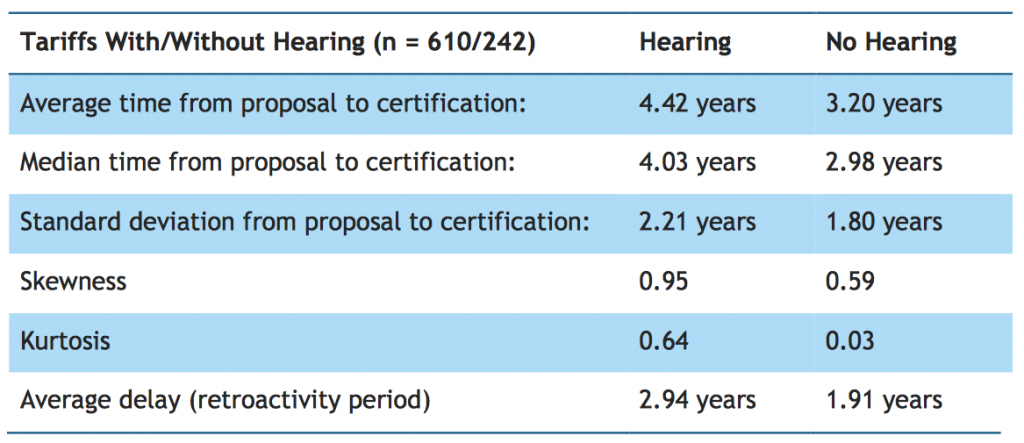
effect of Prof. de Beer’s methodology, the fact that it takes an average of 3.2
and 4.42 years to certify a tariff without and with a hearing respectively is
still cause for considerable concern.
The statistics generated by Prof. de
Beer will no doubt be used by those who perennially argue that the Board needs
more resources. However, without any identification of the causes of the delays
at the Board and without any “normative” analysis and judgments, there is no
basis whatsoever to support such a suggestion. Indeed, given readily
available comparisons to other
tribunals close by, most notably the Competition Tribunal,
it is at least as plausible in principle that the Board already has too much in
the way of resources and this may be part of its problem. These real questions
need, at least, to be explored.
Prof. de Beer explicitly stops short
of any normative judgments or analysis of why things take so long and
repeatedly suggests that more even more data and studies are needed. However,
in my view, the last thing we need is more studies to prove that things take
too long. Even retired Board Chairman Justice William Vancise, who promised
about a decade ago to shorten the pendency time from hearing to decision to six
months (see below), would likely not dispute that things have gone from bad to
worse. We don’t need expensive statistical studies to prove what is obvious and
incontestable. What we need to do is figure out why things take so long and how
to fix the problem.
Prof. de Beer’s surprisingly large
“tariff” numbers both overall and annually are explained at page 10 of his
report by his decision to “disaggregate” data from every “tariff”:
Accordingly, this study’s approach was
to disaggregate data from every “tariff” proposal based on the multiple
procedural possibilities between publication and certification. During the
research proposal, every certified tariff was broken into its constituent
components and subcomponents, dissected by year, number, and letter (where
relevant). For example, the Board’s decision on Re:Sound’s Tariff 6.B (Use of
Recorded Music to Accompany Physical Activities) for 2008-2012 dated July 6,
2012 became five units of analysis; Re:Sound 6.B 2008, Re:Sound 6.B 2009,
Re:Sound 6.B 2010, Re:Sound 6.B 2011, and Re:Sound 6.B 2012. The
disaggregated data was then correlated backwards to the collective society’s
original proposal that had initiated the tariff-setting process. One
consequence of this approach may be to complicate the statistical analysis by raising
independence issues in the data. Although each tariff will be unique in at
least one respect, some units of analysis may involve identical data-points,
such as a common proposal or certification date. Nonetheless, this approach was
clearly the best, if not the only, feasible option for analysis.
By breaking each subdivision of each
tariff down to separate years, numbers and letters, he comes to the conclusion
that the Board has certified 852 tariffs in the 15 year period of the study. I
profess no expertise in statistics, but this seems to be very questionable. To
suggest, for example, that SOCAN Tariff 10 which covers Strolling
Musicians and Buskers in Part “A” and Marching Bands and Floats with music in
Part “B” is really two separate tariffs for each year it has existed may be
useful for data gathering purposes for Prof. de Beer’s study. However, it is
always best to compare apples with apples. Clearly, not all tariffs are equal
in terms of complexity, economic importance, or the process by which they are
treated. To equate the “marching band” tariff with SOCAN’s never ending Tariff
22.A “making available” tariff for purposes of measuring delay and inefficiency
is unrealistic in my view. This methodology begs the question as to why it
takes any significant amount
of time and delay to certify long-standing tariffs that are unopposed and often
of little economic importance. It also begs the question of why these tariffs
are not certified for much longer periods of time. Marching bands are, after
all, a long-established use of music and the technology has remained quite
stable and even static:
Thus, Prof. de Beer’s methodology is arguably questionable because
it appears to equate the numerous unimportant, simple and unopposed tariffs
proceedings that should occupy little or no Board time with those that seem to
never end. That, very likely, will lower the average overall delay times by a
significant amount.
Indeed, I suspect that if the Board’s
own classification of what is a “tariff” and a “decision” were to be used, as
shown below, which more accurately corresponds to the way the Board actually works,
the result would be that there is simply not enough statistical data to warrant
the detailed type of statistical treatment that Prof. de Beer and his team have
undertaken.
With that lengthy preface, here are
Prof. de Beer’s own key summary charts:
Distribution
of certified tariffs applicable for the years 1999-2013.
Statistics Regarding Tariffs Certified With and
Without Hearings
In his own words, he summarizes all
this as follows:
According to my
data, 852 different tariffs were certified by the Copyright Board in
respect of the 15-year period between and including 1999-2013. There are 209
pending tariffs that were proposed for that period but have not yet been
certified. The certified tariffs took an average of 3.5 years to certify after
filing. The average pending tariff has been outstanding for 5.3
years since filing as of March 31, 2015. On average, tariffs are certified 2.2
years after the beginning of the year in which they become applicable, which is
in effect a period of retroactivity. The standard deviation in
the time from proposal filing to tariff certification is 2 years. A hearing was
held in 28% of tariff proceedings. The average time from proposal filing to a
hearing in those proceedings was just over 3 years. The average time from a
hearing to tariff certification was almost 1.3 years.
(emphasis added)
The hundreds (according to Prof. de
Beer’s methodology) of minor, unopposed and economically insignificant separate
tariffs that Prof. de Beer’s methodology apparently identified and measured are
not the main problem at the Board, although they are still a big problem
because there is no apparent reason why there is any significant delay whatsoever
in certifying them. The real problem is the contested and often very important tariffs
that result in hearings – and, more recently, default proceedings in the case
of the Post-Secondary file that is apparently
stalled indefinitely and presents very serious challenges to the Board and to
the public interest. Even according to Prof. de Beer’s numbers, about 20% of Board
cases that involve hearings take at least 6 years to be certified. And
these are not “outlier” cases. Those who follow the Board know that these are
probably among the more visible and important hearings that the Board deals
with, such as the most recent tariff. This was the “fitness” tariff, which I have
discussed elsewhere in some detail
and briefly below, that has taken almost 8 years to reach what may still be an
inconclusive resolution. It would have been very helpful and presumably not too
difficult to provide links to the actual tariffs and decisions that took more
than six years to certify. Indeed, links to all of the tariffs, using the
Board’s taxonomy, would have been helpful and not difficult to provide – see
below.
Another problem with the study’s
methodology is that it does not deal with the fact that many tariffs are
certified in huge batches periodically, of which some elements attract little or
no attention and some do attract varying degrees of opposition. Here’s
a decision from 2004 that covers SOCAN
tariffs on everything from marching bands to magic shows, from restaurants to planes
and trains, not to mention adult entertainment clubs to fireworks
displays. Some elements were opposed. Others not. The process was spread over
several years, with some of the tariffs being filed as early as October 18, 1997 and others up to April 19, 2003 and with hearings held in 2002 and 2003 on various
aspects. The Board’s decision on the whole batch was not released until June
18, 2004. It’s far from clear how Prof. de Beer’s methodology could
“disaggregate” this eclectic smorgasbord of a decision in any meaningful way.
This raises the question of why the Board cannot simply quickly approve an
unopposed tariff, especially one that may have previously been considered, and
why these things are allowed to accumulate and linger and grow old together.
Some elements of this decision were
economically trivial. SOCAN’s Tariff 10.B for “marching bands” actually generated
$4,984 in the year 2000. In that year, its tariff 13.C for trains and buses generated $378. On the
other hand the tariff for Cabarets, Cafes, Clubs, etc. – Live Music) generated
$2,145,057 that year. The Board used to provide these kinds of numbers, but it
seems that it does not see the need to necessarily do so anymore – for example
in the fitness tariff discussed below, where such numbers would be expected, if
not essential, given the public interest aspect of that tariff and it
importance to so many people.
Moreover,
we see tariff files that never seem to end. These include SOCAN’s Tariff 22
internet tariff, which has been going on in one way or another since 1994, with
the current iteration concerning the alleged “making available” right and
SOCAN’s never-ending quest concerning its Tariff 22.A. The current iteration of
proposed SOCAN Tariff 22.SA which was filed as a proposed tariff in 2012, is still in a preliminary phase. This
preliminary phase was not supposed to include any evidence but now has
extensive evidence from experts around the world, which seems strange since the
Supreme Court of Canada and the 2012 Copyright Modernization Act would
appear to be quite clear on the issues at hand, This issue – or more likely in
the end a non-issue – could have already been to the Federal Court of Appeal if
not the Supreme Court of Canada had it been handled more decisively by the
Board and some of the main parties, who seem in no hurry for this file to come
to an end. The Access Copyright Post-Secondary Tariff has been in a state of suspended
animation since the Board ruled on January 17, 2014 that “For these reasons,
and because of the additional drain on Board's resources this implies, the
Board postpones sine die the hearing in this matter. After having received and
analysed all answers from Access, and replies from Mr. Maguire, the Board will
either decide when to reschedule the hearing or proceed on paper.” This was a
tariff that was filed in 2010 and is now, for various complicated reasons,
unopposed. The Board has still not indicated how it will proceed on this
matter.
Here is my own chart – prepared in
couple of hours and based upon the Board’s website information concerning “certified tariffs” and “decisions”, with links provided. The comments are my own and
very brief:
TYPES OF
TARIFFS CERTIFIED BY COPYRIGHT BOARD BETWEEN 1999 - 2013
NUMBER
CERTFIFIED TARIFFS FROM 1999 – 2013 (including “redeterminations”)
Opposition to this tariff has essentially
evaporated, since it now only applies to the obsolete medium of blank CDs.
The Board lists each year from 2012 to 2016 as separate tariffs, but there were only two proceedings for that
period.
This is by far the major sector covered by the
Board. There are 47 tariffs listed, but 8 of them involved both SOCAN and
Re:Sound (formerly NRCC), so they should not be counted separately. There
are 41 decisions between 1999 and 2013, some of which concern relatively minor matters.
The Board has rendered 14 decisions between 1999 and 2014 – all but one of which (now pending
in the SCC in CBC v SODRAC) were “interim”. These are not part of Prof. de
Beer's analysis but are included in this chart for the sake of completeness
to show the Board’s level of activity. These are not “tariffs” and even the
term “arbitration” is a misnomer.
TOTAL NUMBER OF TARIFFS CERTIFIED
74
Even this is an inflated number, and reflects a
number of minor “redeterminations” and other less than significant events.
But it is still the Board’s own number, as calculated from the Board’s own
posted information. Still, this is less than 10% of Prof. de Beer’s number of
852.
Number of tariffs per year on
average
4.9
This the total of 74 certified tariffs divided by
the number of years being studied (15). This is greater than the number of
decisions per year, since many of these tariffs are unopposed because they
are unimportant or the objectors cannot afford to participate in the Board’s
process, or for other reasons – such as the oppressive and intrusive
interrogatory process.
I make no reference to the
“unlocatable” decisions, also studied at great length by Prof. de Beer and the
Board’s former general counsel, Mario Bouchard. I have commented at some length about that
study and those decisions. I agree with Prof. de Beer, though perhaps for different reasons, that
this corpus of about 283 issued licenses and 8 denied licensesto
date need not be considered as a factor in
the Board’s overall productivity or performance.
So, if the Board is right, and I am
right, then Prof. de Beer’s conclusion that the Board has certified 852 tariffs
in the last 15 years is off by a factor of 852 ÷ 74, i.e. ~1,150%. His
conclusions that the Board certifies 70 tariffs a year would likewise be off by
a factor of 70 ÷ 4.9, i.e. more than 1,400%.
I have repeatedly suggested on an
anecdotal basis that:
It
often takes that Board four years or more for a tariff to reach the
hearing stage
It
often takes the Board two years or more after the hearing to render a
decision
The
decision is too often wrong
The
decision is invariably retroactive
Few, if any, who are
familiar with the recent history of the Board would disagree with my “anecdotal”
observations, which are easy to confirm – as seen below. Even the recently
retired Chairman stated almost 10 years ago that the delay in decision rendering
was excessive. This was at a time when parties were grumbling about mere 18
month delays. In a published speech from 2006, the
now retired Chairman of the Copyright Board (William Vancise) stated shortly after his appointment:
I
am not at all happy with the time it takes to render a final decision. I have
tried to address the issue and I can assure you it will be resolved. If the Supreme Court of Canada can render a decision
within six months of a hearing, there is no reason why this Board cannot do the
same.My
goal is to see that this occurs.(emphasis
added)
Quite apart from the rather inapposite
conflation of the Copyright Board and the Supreme Court of Canada, the bottom
line is that the trend clearly seems to be getting worse rather than better.
Hence, Prof. de Beer’s overall conclusions are instantly questionable, for
example when he suggests at page 37 that “It took on average a further 1.29
years for the Board to issue a decision and certify the tariff following a
hearing.” That obfuscates the fact that, many if not most of the recent
important decisions have taken much longer, for example:
The “fitness” tariff discussed below took more than two years to decide initially, and more than a year to redetermine, after submission of a settlement agreement. It took about 8 years to inconclusively resolve.
·First, we don’t know what he means by a
“hearing” or a “decision”. Some of the Board’s hearings and decisions are quite
perfunctory. His conclusion that “hearings last on the average 22 days” (page
37) is highly questionable. To be fair, he does indicate that this figure is
unreliable because some hearings may be spread over a prolonged period. But, if actual hearing days are counted,
there are very few hearings indeed that have lasted that long.
One of the key findings of the study is
easy to miss – because it concerns the 209 “pending tariffs” – i.e. proposed
but not yet certified. That average time outstanding, as of March 31, 2015, was
a disconcerting 5.31 years.
Consider the recent decision of the Board from March 27, 2015 concerning
Re:Sound’s “fitness” tariff. This battle may – and I
emphasize “may” – only now finally be over after about eight years as a result
of the Board’s most recent “fitness” decision, which I have discussed in detail here. Here’s the timeline of the recently
certified fitness tariff:
Tariff is filed June 2, 2007
Board Hearing April 27 to May 11, 2010
Board Decision July 6, 2012
Judicial Review Application Filed August 7, 2012
Hearing by Federal Court of Appeal (“FCA”) November 19, 2013
Decision by Federal Court of Appeal February 24, 2014
Parties File Settlement March 21, 2014
Board approves settlement agreement with minor adjustment March 27, 2015
Note the highlighted lengthy delays while the Board contemplated its decisions. The last delay of
over a year is particularly ironic, since the parties had submitted a consent
agreement in February of 2014. How long should it take to approve a consent
agreement submitted by sophisticated parties after a seven year struggle? I have
commented on this on this casein much more detail here.
I may have more to say in due course
about Prof. de Beer’s statistical study. However, the bottom line for the
moment is that we do not need to know about statistics, and such statistical exotica
as “skewness”, “kurtosis”, and “regression analysis”. This is unnecessary when
the Board holds so few actual hearings and renders so few actual real decisions
and “tariffs” each year, with or without a hearing. We know there are problems
and we need answers as to why and proposals for solutions. We don’t need more
data or more statistical studies, as Prof. de Beer repeatedly calls for. Above
all, we are facing a non-sustainable situation and we don’t need more delay. Therefore, it is somewhat disappointing to be
told, towards the end (page 45) of this elaborate study, that:
At the present time, it is simply unclear whether
the Copyright Board is
now settling into its role and the process is
becoming faster, or whether the complexity continues to grow and the tariff-setting
process is in fact taking longer than it was several years ago. Only more time,
and more data, will tell.
If we focus on a realistic notion of
what a “tariff” is, which is what the Board certifies in the Canada Gazette a
few times each year at the most, we can get back to common sense and then
perhaps move forward. We need to focus above all on the factors that have
resulted in what virtually everyone considers to be the unacceptable timelines and
delays prevalent at the Board. These delays depart far from other judicial and
tribunal norms but now seem to be the new normal at the Board. It may prove to
be the case that human, institutional and political factors, which are not
measurable by Prof. de Beer’s or any other statistical methodology no matter how
scientific and reliable, need to be addressed.
We now have, after a hiatus of more
than a year, a new Chair of the Copyright Board who is remarkably well
qualified for the challenges that must be dealt with. With his notable
experience in reforming the Ontario judicial system, Justice Blair is eminently
qualified to initiate regulations, which would require approval by the Governor
in Council, governing such matters as
“the practice and procedure in respect of the Board’s hearings…” pursuant to s.
66.6(1).
Hopefully, now, the Government can also
undertake a consultation to ultimately ensure that other necessary and inevitable
regulations are implemented pursuant to s. 66.91 to deal with “policy
directions” and what constitutes “fair
and equitable royalties” and “rendering its decisions”. Other comparable
tribunals at the federal level have such regulations in place. There is no
reason that the Copyright Board should be without such guidance, especially
when the authority for these regulations has long been in place.
So, a couple of decisions in the last
year show some hope of some change from within the Board in terms of its
substantive dealing with evidence and law. However, there are still some very fundamental issues that can only be addressed in the long term through regulation and/or statutory change. Hopefully, the regulatory process - which is available now and does not require the involvement of Parliament - will suffice.
Hopefully, now, we can look for
progress in Ottawa both at 56 Sparks Street and around the corner at the
Langevin Block. The appointment of Justice Blair as Chair, with his background that is perfectly suited for the task of institutional reform, seems to indicate that the Government recognizes that change is needed now.
One thing, at least, is quite clear. What
we do not need now is more statistical analysis.
Those parts of Re:Sound Tariff No. 6.B (Use of Recorded Music to
Accompany Physical Activities) that were set aside on February 24, 2014 in
Re:Sound v Fitness Industry Council of Canada et al. (2014 FCA 48) are
reinstated on an interim basis effective as of January 1, 2008 and until the
Board issues a further interim decision or a final decision.
Board approves settlement agreement with minor
adjustment March 27, 2015
That is
almost 8 years from the beginning to the inconclusive end. True, this one did
involve an unusually great amount of money – or at least Re:Sound tried to make
that be the case. Re:Sound was seeking “roughly
$86 million per year” fromfitness
facility operators, etc. The objectors proposed a formula that would have
yielded about $3 million a year. That’s a big discrepancy. Revenues from fitness clubs are about $2
billion a year. Lots of zeros sometimes seem to have a way of making things very
complicated and protracted at the Copyright Board. Although this was an
“inaugural” (first instance) tariff for Re:Sound, SOCAN has had a
“fitness” tariff for years
and the issues should not have been all that complicated, or so one would have
thought.
To remind readers, SOCAN is the collective for composers,
authors and music publishers. Re:Sound (formerly
NRCC) represents performers and sound
recording producers. Readers may also recall that it was Re:Sound that tried – not surprisingly unsuccessfully – to convince the Supreme Court of Canada that the
word “excludes” actually means “includes”, after having not surprisingly failed
to do so before the Board and the Federal Court of Appeal.
But even after all of this, and eight years later, the Board still
doesn’t tell us what the final tariff will actually cost Canadian fitness fans
in the end. One would think that such information would be useful if not
indispensable. The Board sometimes estimates the overall cost of its tariffs. It
seems to me that it once did so regularly, and it did so indeed in the recent Access Copyright decision re
Provincial and Territorial Governments.
Indeed, it should arguably be required to do so in every case,
given the public interest aspect of tariff setting. The regulations I have long
argued for should spell this out. If the Board doesn’t know with reasonable
certainty what the overall cost of a tariff will be, it arguably should not be
certifying the tariff. Moreover, all collectives with certified tariffs should
be required to publish reasonably detailed information annually on receipts,
costs of administration and distribution, including average and mean amounts to
individual creators. Some collectives are at least somewhat forthcoming on some
of these numbers – but overall, there is far from sufficient disclosure. Oddly
enough, Access Copyright is actually reasonably forthcoming and its 2014 annual reportconfirms the fact that its
“average total payback payment” is $281.87. That’s less than many junior lawyers
bill per hour these days.
This case shows fairly clearly some of the ways that things can
go wrong at Board hearings. The main problems
appear to be as follows.
1.Re:Sound greatly overstated and overreached in its
initial proposal. In this fitness case, the Board knew, to its credit, that
there was huge overreaching going on here. In its July 6, 2012 decision in this case from 2012, it said with
uncharacteristic frankness:
[112] The quantum proposed by Re:Sound, $86
million, is at least five times as much as what
Re:Sound receives from commercial radio
stations. This offends common sense:
all things
being equal, the value of sound recordings to
commercial radio must be much more than for
fitness centres
(emphasis added)
2.As I earlier have blogged, five years
and three months after this proposed Re:Sound “fitness” tariff was filed on June 2,2007,
and two years and two months after the hearing was finished, the Copyright
Board determined in itJuly 6, 2012 decisionthat “The Board has
rejected the expert evidence of Re:Sound and the Objectors as unreliable.”
(Para. 162). Here is the list of the evidence,
most of which the Board rejected and the parade of witnesses including the “experts” who presented all of the evidence
that in turn led the Board to conclude that:
[162] The fact that evidence exists in the matter under
consideration does not mean it is reliable. The Board has
rejected the expert evidence of Re:Sound and the Objectors as unreliable.
The Board has not rejected the factual evidence filed by the parties. As such,
this makes it difficult to claim that there is no evidence whatsoever, a
necessary criterion in the Other Sites decision. (emphasis added)
3.Such a statement from the Board is really
remarkable when considered in context. Even allowing for the partial - though
not unlimited - latitude given to administrative tribunals concerning the normal
rules of evidence, the Board has consistently shown an arguably unwarranted tolerance
for hearsay and so-called “expert” evidence that would never see the light of
day in a normal courtroom – and all of which takes up enormous amounts of time
and expense and too often results in a standoff of unreliability. As for
unreliability, The Board has seen some bad evidence over the years – including
the flimsy and even fictitious. The Board haseven imposed an expensive de novo $48 million interim tariff over the objection that “little evidence other than bald assertions” of counsel was before the Board, and even where
there was no actual previous tariff was in place. Still, taking all of this history of tolerance
of dubious evidence into account, the Board found the expert evidence in this
case to be “unreliable” all the way around. I haven’t looked at the actual
evidence, but I can only surmise that it must have been remarkably unreliable indeed
if even the Board itself says so. And names of well-known experts led by
well-known counsel were involved.
4.Nonetheless, the Board determined that there was enough factual evidence
in this case to certify a tariff but based it instead upon a simple calculation
flowing from some SOCAN agreements with various fitness centres and dance class
providers provided by SOCAN at the Board’s request.
5.The trouble was that the Board never heard from the parties about the
SOCAN agreements, which the parties had never seen before the Tariff was certified.
That was because the Board didn’t involve the parties in this extracurricular
exercise. This was the Board’s unilateraland no doubt well-intentioned idea to solve the problems left from a
mound of evidence that the Board considered to be unreliableand a lengthy hearing that must have cost the
parties a fortune. Ironically, it seems that Re:Sound knew about and could have
asked for and probably would have been given copies of the SOCAN agreements –
but did not do so and instead waited and sought judicial review.
6.As Justice John Evans, thedean
of administrative law in Canada, stated in the judicial review decision:
[74] In the absence of a request from experienced
counsel acting for a sophisticated client, fairness did not, in the
circumstances of this case, require the Board to disclose copies of the SOCAN
agreements on its own motion. In my opinion, the Board did not unfairly deprive
Re:Sound of its right to know and to respond to information in the Board’s
possession. Rather, Re:Sound failed to avail itself of a reasonable opportunity
to ask the Board to produce information that it knew was in the Board’s
possession.
7.Nonetheless, and despite Re:Sound’s failure to exercise its rights in a
timely manner that might have saved a lot of trouble and cost, the Board’s
well-intentioned but not well executed efforts were sufficient for the FCA to
conclude that:
[81] Since the tariff set by the Board was based
entirely on a methodology not raised as an issue at any point in the
decision-making process, Tariff 6.B
cannot stand. The matter must be remitted to the Board for redetermination of
the royalties payable for the use of recordings of musical works in fitness
classes after it has disclosed to the parties any information that it alone has
on the ground on which it based its decision and has provided the parties with
an opportunity to address it.
8.After the matter was sent back to the Board for redetermination,
the parties promptly reached a settlement, which is
their right but which also requires the Board's approval because of the public interest "tariff" aspect. Under the circumstances, which included the sophisticated and representative nature of the parties, one might have expected prompt approval. However, the Board decided to recall a member who had been
involved in the original hearing but who had retired from the Board in 2012.
The Board also decided that the Board’s Chair, whose term expired on May 13,
2014, would remain involved on this file for what turned out to be almost
a year after his retirement from the Board. It remains unclear why it took over
a year essentially to approve a settlement between sophisticated parties, and why
it was necessary that two retired Board members were involved. We also don’t
know and won’t likely find out how much time the two retired members spent on
the file and what additional costs were incurred by their post-retirement involvement.
By the way, settlements are normally respected and encouraged by normal courts
– even when major public policy issues are involved. Recently, a very major
drug patent case with a host of interveners and enormous public policy
implications was settled literally on the eve of a Supreme Court of Canada
hearing and many important interveners were thus denied an opportunity to make
their arguments as a result of this ultra-last minute settlement.
9.Even at the redetermination stage, the Board
was clearly troubled by the lack of evidence overall, but finally – after more
than a year – relied on the settlement agreement, except for the provisions
dealing with background music in fitness areas and for skating activities,
which had been previously decided by the Board and not set aside by the Federal
Court of Appeal. The Board noted:
[36] Third, since we have rejected the SOCAN
Agreements as a basis for any rates in the tariff, we are in a difficult
position given that Re:Sound is entitled to a tariff for the use of sound
recordings in fitness and dance classes, that we are required to
certify one, but that we do not have any usable evidence pertaining to the
value of such tariff.
[37] The Settlement Tariff does however
provide us with a basis for setting a tariff, which we consider fair and
equitable. In the present circumstances, the exercise of the Board’s
inherent discretion to consider the Settlement Tariff, under the aforementioned
situation created by the absence of reliable evidence, is both reasonable and
desirable.
(emphasis and
highlight added)
So – the bottom line in this case as to why it took so long and
why it has come to such an apparently indecisive, inconclusive and delayed resolution in so many ways appears
to involve the following factors:
Initial overreaching by
collective
“Unreliable” expert evidence
all the way around
Procedural unfairness by the
Board
Absence of reliable evidence,
even at the redetermination
Long and inexplicable delay in
redetermination – even with a settlement between sophisticated parties and
their well-known counsel. In the Federal Court of Appeal and the
redetermination, Re:Sound was represented by Glen Bloom
of Osler’s, Goodlife by Andrea Rush (then of Heenan, Blaikie)and the Fitness Institute of Canada by David
Fewer, the
Director of the public interest clinic CIPPIC(apparently acting in this instance his
private practice capacity).
And why am I pessimistic that we have not yet seen closure on
this tariff? It is the fact that the Board clearly indicated in the original
decision that it expects better evidence next time. This particular tariff was for the period of
2008-2012. This sort of disconcerting retroactivity is the way the Board now normally
works. So, there will be another hearing sometime in the future to deal with
the period after 2012. Also, there is the somewhat unsettling comment about the
settlement, namely:
[54] Second, the Settlement Tariff is substantially different from the tariff
originally proposed which is the source of this proceeding, or the certified
tariff that is currently applicable on an interim basis, since 2012. We have
already discussed those differences. Certifying a new tariff with different
rates and formulas could create administrative and financial difficulties if
Re:Sound decides to collect royalties retroactively as adjustment payments
would have to be recalculated. These difficulties could be exacerbated in cases
where a user was not represented by the Parties during the negotiation of the Settlement Tariff. As such, the
balance of convenience could lead Re:Sound to refrain from retroactively
collecting royalties from users who have already paid under Tariff 6.B and who were not
represented by the Parties during the negotiations leading to the Settlement Tariff.
The Board may also be suggesting in the recent decision that it
is uncomfortable with the possibility of Re:Sound attempting to retroactively
enforcewhat may be higher rates for
some entities that weren’t “represented by the
Parties during the negotiation of the Settlement
Tariff”.
Above
all, the public interest factor is frustrated by the absence of a reasoned
estimate as to how much this tariff will cost the Canadian public overall.
Once again, these developments only underscore the need
that the Government should, at the earliest opportunity:
Appoint a Chair who is already
knowledgeable about copyright and administrative law and possibly even other desirable
areas such as competition or communications law and who is willing and able to deal
with any issues that need to be dealt with inside the Board
Implement regulations that could prevent
the kind of problems and delays that are clearly evident in this and many other
cases from happening again in the future.





 Posts
Posts