The annual Fordham International Intellectual Property Law and Policy Conference has just taken place, as always The First Thursday and Friday After Easter.™ The following is a very limited and personal take on a very complex and comprehensive conference.
The Canadian Panel:
Once again, through a lot of hard work, we’ve been able to convince Prof. Hugh Hansen (the conference director) to put on a provocative and balanced panel on Canadian copyright law. This is despite the fact that Canada has been crying “wolf” on new legislation for several years now.
This year, the panel consisted of:
1. Prof. Daniel Gervais, who talked mainly about the 2007 Kraft decision from the Supreme Court of Canada (a favourite case of mine because I made the prevailing argument).
2. Justice William Vancise, the Chairman of the Copyright Board, who chose to speak and write about “What are "adequate reasons" in a Decision of the Canadian Copyright Board? To what Degree Should Appellate Courts Defer to the Expertise of Specialized Tribunals? And Do They?”
3. Steve Metalitz, the lawyer/lobbyist for the Washington based International Intellectual Property Alliance (“IIPA”) which has recommended Canada for the “section 301 priority watch list” for 2008, who spoke about why he believes that this is justified. He focussed, inter alia, on Canada’s lack of implementation and ratification of the 1996 WIPO Treaties and the alleged inadequacies of Canadian enforcement, particularly regarding border measures. Since the IIPA is effectively the privatized research arm of the USTR for “301" purposes, it was good to have Steve on this panel.
4. Myself, who spoke and wrote (see my paper) about why the IIPA’s and similar positions from CRIA and the American government are not justified, and why the USA should look in the mirror and find a way to put itself at or near the top of its own “priority watch list” in terms of weaknesses in its own copyright law and violation of existing treaty obligations. I have now identified 15 areas in which Canadian law is already stronger and better than American law, and which result in many cases in very large outflows of payments to American corporate interests. None of these was refuted. I also pointed out that while Israel bravely rebuts the USA’s “301" reports, Canada simply does not take them seriously and the WTO has ruled that the USA cannot take any unilateral action beyond rhetoric with respect to its “301" mechanism. Moreover, the USA is arguably in violation of the Berne Convention with respect to moral rights and other important matters, and has been adjudicated to be and clearly intends to remain in violation in respect of its notorious exemption of small business establishments from the need to pay performing rights royalties.
5. Richard Pfohl from CRIA, who reiterated CRIA’s usual positions. Since CRIA, which essentially represents the big four foreign record companies, is apparently by far the most vociferous so-called “Canadian” copyright lobbyist organization, it was useful for Richard to be on the panel.
Apart from the very frank and, frankly, very unusual remarks and paper by Justice Vancise criticizing the Federal Court of Appeal, which reviews his Copyright Board, there were no real surprises from the speakers.
There were some very worthy comments from the audience, as often happens at Fordham where the audience members are often at least as expert and engaged as the speakers and panelists.
Mario Bouchard, the General Counsel of Canada’s Copyright Board, pointed out that the fact that it has been 12 years since the WIPO treaties came about in Geneva and that Canada has still not implemented and ratified them showed that there can hardly be said to be a Canadian consensus on these issues. He also pointed out that it took the USA 102 years to join the Berne Convention, so the USA ought not be too critical about a 12 year delay on Canada’s part in respect of the 1996 WIPO treaties.
Justice Roger Hughes of the Canadian Federal Court commented from the audience in response to Steve Metalitz’s suggestion that Canada lacks adequate and effective border measures and should provide “ex officio” seizures (i.e. seizures that bypass the Courts and let customs officials seize allegedly pirated or counterfeit goods). According to Mr. Metalitz, the current system doesn’t work. Justice Hughes pointed out that this was simply wrong and that judicial orders for seizures were readily available when appropriate – and that those seeking such a change should “stop whining” and just “roll up their sleeves” in order to use the current system. He indicated that he had signed three such orders at the request of Microsoft just in the last week.
Other Notable Aspects from Fordham
Once again, Justice Rogers Hughes from Canada’s Federal Court, who was a highly renowned and experienced litigator and author in all areas of IP prior to his appointment to the Bench in 2005, joined the Fordham Faculty on patent law sessions. One hopes that he will become a “regular” at Fordham in the tradition of Lord Jacob, Sir Hugh Laddie, Lord Hoffman, Pauline Newman, Randall Rader, and other distinguished expert judges.
Speaking of which, there was a remembrance of the Rt. Hon. Lord Justice Pumfrey a popular and very expert judge from the UK, who passed away suddenly on Christmas eve last, shortly after his elevation to the Court of Appeal.
There was a remarkable panel of General Counsel organized by Brad Smith of Microsoft, an old friend and frequent presenter at Fordham long before he became GC and Senior VP of Microsoft. The panel included the GCs/VPs from Time Warner, NBC Universal, Viacom and New Corps. Such an array of distinguished GC’s on one public panel is rare, if not unique. But it’s too bad that Google and Verizon weren’t there. The panel could have been much more balanced, especially because virtually all these GCs were extolling the development of “cooperation” with ISPs in curtailing piracy and saying much the same thing as each other otherwise. The panel fuelled fears that traffic shaping and other interference with net neutrality could be much more about IP enforcement than network management.
I managed to get them rather defensive when I mentioned that traffic shaping and “cooperation” has “throttled” CBC’s innovative attempt a few days earlier to use BitTorrent for a perfectly legitimate purpose - which their own companies might want to consider at some point. Tom Rubin, another senior Microsoft lawyer, later provided a rather thoughtful comment on this in another panel indicating that ways should be found to make sure that legitimate uses of innovative technology should not be hindered.
Ironically, virtually at the same time the GC panel was going on, Comcast in the USA announced that it was backing off from its plans to throttle the internet.
(Meanwhile, Canada - which has virtually no real competition in broadband internet service - and no evident willingness on the part of part of the Government or regulators to deal with this issue - is plunging further into the abyss of throttled and inferior internet service at very high prices.)
Another high point was the appearance of Ray Beckerman, the fearless New York trial lawyer from a small firm who is fighting the RIAA litigation campaign against children, dead grandmothers and 20,000 or so other ordinary victims on many fronts and who has a fabulous blog and data base of info on the RIAA’s litigation. Hugh Hansen gave Ray more than the usual ordeal by fire, which often greets anyone at Fordham who dares to question the establishment point of view. I get it every year. But Hugh does in fact invite strong and outspoken anti-establishment points of view- unlike certain Canadian conference organizers - and I trust that Hugh’s apparent righteous indignation (with more than a little twinkle in his eye) was his way of showing his seal of approval. He only gets this excited when things become electrified and polarized - which he likes to see. Ray stood up very well and then some - and I hope he’ll be back. Here’s Ray’s take on the P2P and related issue sessions. His RIAA opponent, Kenneth Doroshow, took the perfectly absurd position that Jammie Thomas had caused untold millions of dollars of damages, even though there wasn’t a shred of evidence that anyone other than the RIAA investigator had downloaded anything from her - and that $9,250 damages per song was therefore not such a high figure. No wonder people ridicule the RIAA and that the RIAA is giving copyright as we know it a very bad name. Pam Samuelson outlined how the whole statutory damages regime could crumble on a constitutional basis, something I’ve been saying for years. I’m glad I’m in such good company.
Additional high points were the participation of Alex Macgillvary, an associate general counsel of Google who is a Canadian and a Harvard grad and a very eloquent spokesperson for balanced copyright.
An new and important voice was also added from Israel - Mr. Tamir Afori. He is the official most responsible for the new Israeli Copyright Act, which has a brilliant solution to the problem of statutory damages (no minimum - USD $28,000 max) and fair use provisions very similar to those of the USA, which the IIPA has soundly criticized since that is not a feature of US law that they wish to see emulated. Israel has also stood its ground on TPMs and WIPO ratification. Canada would do well to look more closely at the new Israeli law and to invite Mr. Afori to come to Canada and tell us more. It is refreshing to see that the Israeli government listens to its professional civil servants, more so than certain other governments.
There was much talk about fair use, and a major new study on limitations and exceptions by Bernt Hugenholtz and Ruth Okediji.
And there was the usual rich three ring or more circus of simultaneous sessions on patents, trade-marks, copyright, competition law, etc. And much, much more - too much to talk about. I’m still recovering. Fordham was, as always, an exhausting but immensely rewarding experience. You cannot learn more about IP anywhere in two days than you can at Fordham - where you will be up to date with key developments from around the world - including Canada - and you will meet many of the most influential judges, officials, lawyers and academics who actually made these developments happen.
Update - the list of faculty and some of the papers (requires a password) are now at the Fordham conference website.
HK
Showing posts sorted by relevance for query steve metalitz. Sort by date Show all posts
Showing posts sorted by relevance for query steve metalitz. Sort by date Show all posts
Thursday, April 03, 2008


Monday, May 25, 2009
Conference Board of Canada Controversy & American Based Copyright Lobbying - the Substantive Issues
Those who wish to pay $1,595 to attend a Conference Board of Canada conference this Friday May 29, 2009 that is reportedly being funded in the amount of $15,000 by Ontario taxpayers, according to ITBusiness, at which a controversial Conference Board of Canada report will be presented can find out more information about the Conference here. Prof. Geist has described this as a "deceptive, plagiarized rerport" and there's a front page article about all this in today's Ottawa Citizen.
While there are some good speakers on the list of this Conference Board Conference, the program and speaker list are seriously imbalanced in my view. It is regrettable that prestigious institutions such as the Public Policy Forum last year and the Conference Board of Canada this year allow themselves to be used in this way by lobbyists.
Those wishing to read the 2008 American IIPA lobbyist's report from which the Conference Board report has allegedly taken portions of its content can read it for free here.
These reports on Canada are prepared with the considerable input of a well known Washington lawyer named Steve Metalitz.
As it happens, I debated this very report with Mr. Metalitz at the 2008 Fordham conference, where I presented a paper entitled WHY CANADIAN COPYRIGHT LAW IS ALREADY STRONGER AND BETTER THAN THAT OF THE USA - AND WHY THE USA SHOULD LOOK IN THE MIRROR RATHER THAN AT ITS “SPECIAL 301" WATCH LIST.
This paper shows 15 ways in which Canadian copyright law is already stronger and better than American copyright law. None of those points have been refuted. These include a number of provisions that generate substantial amounts of money that benefit - in some cases mostly and significantly benefit - American interests, and for which the USA has no equivalent counterpart provisions. Here's a simplified "baker's dozen" list of examples from my paper:
- Payment by broadcasters for "ephemeral rights"
- Payment for public performance by small business establishments
- Neigbouring rights for sound recording producers and performers
- Theatrical exhibition rights for composers and authors
- Blank media levies
- Far higher reprography payments per capita - particularly in educational sector
- Moral rights
- No compulsory mechanical license
- About 36 copyright collectives (about six or seven times more than USA)
- Largest copyright tribunal infrastructure of any country that I know of
- No parody right
- No time shifting exemption
- Crown copyright, which results in private sector monetization.
- In many ways which involve a lot of money flowing out of Canada to US interests, our Canadian copyright laws are already stronger and better than American laws.
- The USA remains the world's longest and most flagrant outstanding adjudicated international copyright scofflaw, as determined by the WTO now 9 years ago.
Friday, April 25, 2008
Canada's "301" Demotion
Well, the US Official “301" report came out today - by sheer coincidence just in time for the Public Policy Forum Symposium on April 28, 2008 to which I have been uninvited.
Interestingly, Canada has been demoted from the suggested “priority” status.
According to USTR,
So - Canada was passed over from the Priority List and is merely on the “lower level Watch List.” Israel, on the other hand, has been elevated.
Clearly, I must have persuaded Mr. Metalitz and the several US Government officials at Fordham of the errors of their ways ;-)
My Fordham paper points out some of the many problems with the US approach, and ultimately why the USA can fulminate all it wants but cannot legally do anything unilaterally according to th WTO.
My paper also points out why the USA should look in the mirror and why the USA belongs at or near the top of this list for several reasons.
These are among the points I would have made at the PPF Forum Symposium to which I have now been uninvited.
Anyway, for what it's worth, here's what the USTR had to say about Canada.
Or, you can read it above, for what it's worth.
HK
Interestingly, Canada has been demoted from the suggested “priority” status.
According to USTR,
There are nine (9) countries on this year’s Priority Watch List: China, Russia, Argentina, Chile, India, Israel, Pakistan, Thailand, and Venezuela. Countries on the Priority Watch List do not provide an adequate level of IPR protection or enforcement, or market access for persons relying on intellectual property protection, in absolute terms and/or relative to a range of factors such as their level of development. Priority Watch List countries will be the subject of particularly intense engagement through bilateral discussion during the coming year.There are some interesting differences here from the draft that the IIPA submitted back in February, based upon which I debated the author of the Canada portion, Steve Metalitz, at Fordham on April 28, 2008.
Thirty-six (36) trading partners are on the lower level Watch List, meriting bilateral attention to address IPR problems: Algeria, Belarus, Bolivia, Brazil, Canada, Colombia, Costa Rica, Czech Republic, Dominican Republic, Ecuador, Egypt, Greece, Guatemala, Hungary, Indonesia, Italy, Jamaica, Kuwait, Lebanon, Malaysia, Mexico, Norway, Peru, Philippines, Poland, Republic of Korea, Romania, Saudi Arabia, Spain, Taiwan, Tajikistan, Turkey, Turkmenistan, Ukraine, Uzbekistan, and Vietnam.
So - Canada was passed over from the Priority List and is merely on the “lower level Watch List.” Israel, on the other hand, has been elevated.
Clearly, I must have persuaded Mr. Metalitz and the several US Government officials at Fordham of the errors of their ways ;-)
My Fordham paper points out some of the many problems with the US approach, and ultimately why the USA can fulminate all it wants but cannot legally do anything unilaterally according to th WTO.
My paper also points out why the USA should look in the mirror and why the USA belongs at or near the top of this list for several reasons.
These are among the points I would have made at the PPF Forum Symposium to which I have now been uninvited.
Anyway, for what it's worth, here's what the USTR had to say about Canada.
If you wish, you can pay good money to have this reiterated numerous times at the forthcoming Public Policy Forum Symposium or the Insight Conference in Toronto next month.Canada will remain on the Watch List, subject to essential progress on key issues in the coming months. Canada embraced improving IPR protection and enforcement as a priority in the Speech from the Throne in October 2007. The United States looks to the Government of Canada to deliver on these priorities through prompt and effective action on key issues, such as copyright reform and enhanced border enforcement of intellectual property rights. The United States welcomes Canada's continued cooperation on bilateral and multilateral IPR initiatives, and notes progress in the form of Canada's issuance of measures in 2007 to criminalize camcording of copyrighted films in movie theaters. The United States notes its continuing serious concerns, however, with Canada's failure to accede to and implement the WIPO Internet Treaties. The United States also continues to urge Canada to improve its IPR enforcement system to enable authorities to take effective action against the trade in counterfeit and pirated products within Canada, as well as curb the volume of infringing products transshipped and transiting through Canada. Canada's weak border measures continue to be a serious concern for IP owners. The United States hopes that Canada will implement legislative changes to provide a stronger border enforcement system by giving its customs officers ex officio authority to seize products suspected of being pirated or counterfeit without the need for a court order. The provision of additional resources and training to customs officers and domestic law enforcement personnel would enhance IPR enforcement. The United States will continue to monitor Canada's progress in providing an adequate and effective IPR protection and enforcement regime, including improved border enforcement and near term accession to and implementation of the WIPO Internet Treaties.
Or, you can read it above, for what it's worth.
HK
Thursday, April 23, 2009
Bordering on Fiction
It’s interesting that the new U.S. Homeland Security Secretary, Janet Napolitano, believes that terrorists have routinely entered the United Sates through Canada — including the perpetrators of the 9/11 attacks. If such ill-informed, clearly harmful and inaccurate myths are really believed by high American officials, the resulting US Government demands could seriously impair ease of travel and increase shipping costs and inconvenience for Canadian businesses. Such measures could render cross border trade uncompetitive in some cases. So much for free trade. Could this all possibly be a disingenuous excuse for more protectionism? Trade lawyers would be shocked, shocked if such were the case.
Speaking of never letting a crisis (whether real or concocted) go to waste, it was apparent at last week's Fordham conference held at Cambridge, England that American USTR and Department of Commerce (USPTO) officials are similarly ill informed about piracy, counterfeiting and Canadian border and IP issues in general. This has clearly driven the USA ACTA and “Special 301" agendas.
The American officials actually do seem to believe that Canada is a major gateway for transhipping fake goods to the USA and that fake goods are actually made here in Canada in quantity. But where is the evidence for this? It seems that a key source of these allegations about Canada is that of Canadian based lobbyists for American content owner interests.
Don't be surprised if, based upon such “evidence”, Canada is promoted to the worst of the worst list on this year's “Special 301" report, expected any day now. Clearly, the Canadian lobbyists who act for their American bosses and profess to be interested in the cause of Canadian artists are getting a lot of traction. Even US Vice President Joe Biden now has Canada in his sights, along with China:
The fact is that Canada has long had in place very effective border enforcement mechanisms that operate under the jurisdiction of the courts, as they should. “Ex officio” measures that would empower Canadian border officials to decide matters on their own that should be left to the judicial process are not needed or even desirable in Canada. As I've pointed out before, Justice Roger Hughes, who has extraordinary experience as both a Canadian IP litigator and now as a Federal Court Judge, provided an important comment last year at Fordham that takes the wind out of the sails of those who advocate "ex officio" actions at Canadian borders:
As to piracy and counterfeiting in general, the late Sir Hugh Laddie told The Times in a story on June 3, 2008 a few months before his death last year:
HK
PS:
BTW, if anyone wishes to pay $1,595 for a one day program (which includes lunch) to attend what promises to be an enthusiastic presentation of American government and American content owners’ points of view voiced directly and through Canadian lobbyists on some of the above topics, the Conference Board of Canada is hosting just such an event on May 29, 2009 in Toronto. Here’s the program.
Speaking of never letting a crisis (whether real or concocted) go to waste, it was apparent at last week's Fordham conference held at Cambridge, England that American USTR and Department of Commerce (USPTO) officials are similarly ill informed about piracy, counterfeiting and Canadian border and IP issues in general. This has clearly driven the USA ACTA and “Special 301" agendas.
The American officials actually do seem to believe that Canada is a major gateway for transhipping fake goods to the USA and that fake goods are actually made here in Canada in quantity. But where is the evidence for this? It seems that a key source of these allegations about Canada is that of Canadian based lobbyists for American content owner interests.
Don't be surprised if, based upon such “evidence”, Canada is promoted to the worst of the worst list on this year's “Special 301" report, expected any day now. Clearly, the Canadian lobbyists who act for their American bosses and profess to be interested in the cause of Canadian artists are getting a lot of traction. Even US Vice President Joe Biden now has Canada in his sights, along with China:
Biden blasted China, saying its intellectual property laws remain "largely ineffective" and will end up "strangling their own creative juices," and compared it to what he described as India's more effective anti-piracy regime. He singled out Canada, a close U.S. ally, as needing stronger laws; it never signed the treaty that led to the Digital Millennium Copyright Act, and a proposal to adopt anti-circumvention restrictions was never adopted.I'd like to think that our Canadian government is doing its best to inform the US Government of facts, rather than passively letting special interest lobbyists feed unfettered fiction into the American policy making machine.
The fact is that Canada has long had in place very effective border enforcement mechanisms that operate under the jurisdiction of the courts, as they should. “Ex officio” measures that would empower Canadian border officials to decide matters on their own that should be left to the judicial process are not needed or even desirable in Canada. As I've pointed out before, Justice Roger Hughes, who has extraordinary experience as both a Canadian IP litigator and now as a Federal Court Judge, provided an important comment last year at Fordham that takes the wind out of the sails of those who advocate "ex officio" actions at Canadian borders:
Justice Roger Hughes of the Canadian Federal Court commented from the audience in response to Steve Metalitz’s suggestion that Canada lacks adequate and effective border measures and should provide “ex officio” seizures (i.e. seizures that bypass the Courts and let customs officials seize allegedly pirated or counterfeit goods). According to Mr. Metalitz, the current system doesn’t work. Justice Hughes pointed out that this was simply wrong and that judicial orders for seizures were readily available when appropriate – and that those seeking such a change should “stop whining” and just “roll up their sleeves” in order to use the current system. He indicated that he had signed three such orders at the request of Microsoft just in the last week.The fact is that counterfeit and pirated products are not freely and openly available on the main streets of major Canadian cities, as they are in New York City, for example. Why blame Canada for a problem that the USA cannot or will not address even in mid-town Manhattan?
As to piracy and counterfeiting in general, the late Sir Hugh Laddie told The Times in a story on June 3, 2008 a few months before his death last year:
"Of course there is counterfeiting in China, but the same goes on in the US and Europe. Pro rata, the biggest source of pirated computer software in the world in the US.”It’s time for facts about piracy, counterfeiting and what happens at borders. We need to move beyond lobbyists’ fabrications bordering on fiction.
HK
PS:
BTW, if anyone wishes to pay $1,595 for a one day program (which includes lunch) to attend what promises to be an enthusiastic presentation of American government and American content owners’ points of view voiced directly and through Canadian lobbyists on some of the above topics, the Conference Board of Canada is hosting just such an event on May 29, 2009 in Toronto. Here’s the program.
Friday, September 11, 2009
Woodrow Wilson Canadian © Event: Dialogue, Debate, or Duet?
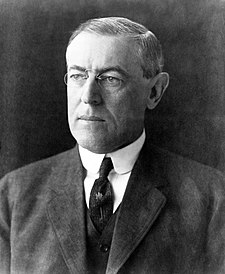 The Canada Institute of the Woodrow Wilson International Center for Scholars, The Canada Institute on North American Issues, and the CIBC are hosting in Toronto on September 25, 2009 a "dialogue on policy issues that have a significant impact on the bilateral relationship" under the banner "Copyright Law in Canada and the United States: The Digital Challenge". The announcement promises that there will be "debate."
The two speakers will be Canadian Barry Sookman and American Eric Schwartz.
It's not without irony that this event is part of what is called the "Two Voices series." I expect that this will be more of a duet in unison or close harmony than a dialogue and certainly far from a debate.
Barry and Eric are both quite accomplished representatives of similar clientele and are in many ways counterparts of each other in the Canadian and American contexts. Barry is a registered lobbyist for CRIA and CMPDA, the Canadian trade associations respectively representing US recording and film industry interests and the respective counterparts of the American RIAA and MPAA. Eric was Vice President and Special Counsel, International Intellectual Property Alliance (IIPA) from 1997-2006. The IIPA is an influential Washington coalition of trade associations, including the RIAA and MPAA. The IIPA, Eric's firm and his partner, Steve Metalitz, have been quite active in the "301" process.
This could have been an opportunity for a real debate. But I rather suspect that the only possible debate will be over the extent of the hyperbole about how Canada's copyright laws are supposedly inadequate and why Canada supposedly deserves its position of prominence on the USTR's "301" list.
It is truly disappointing that such a prestigious public policy organization would allow itself to appear as a podium for such a clearly unbalanced event as this one promises to be. I should say that I pointed out this lack of balance to a key organizer of the event several months ago, but clearly to no avail. The presence of an academic “moderator” does nothing in this instance to instill balance when there is none.
Woodrow Wilson was a great President of the USA from 1913 to 1921 and great intellectual in his own right. He presided as President during WWI and, according to Wikipedia, "supported a Democratic Congress to pass the Federal Reserve Act,[2] Federal Trade Commission, the Clayton Antitrust Act, the Federal Farm Loan Act and America's first-ever federal progressive income tax in the Revenue Act of 1913." Not bad, as far as legacies go.
However, the Wikipedia article goes on to note that "In a move that garnered a backlash from civil rights groups, and is still criticized today, Wilson supported imposing segregation in many federally-funded agencies,[3][4] which involved firing black workers from numerous posts.[5]"
Wilson was obviously a man who was not afraid of a good debate, for example the one that led to the Treaty of Versailles. Too bad that the same cannot be said in this instance of his namesake organization.
People from Toronto or nearby may wish to attend and to ask provocative questions in the hope of sparking at least some debate.
HK
Wednesday, June 24, 2009
A Canadian Copyright Policy Laundering Flow Chart
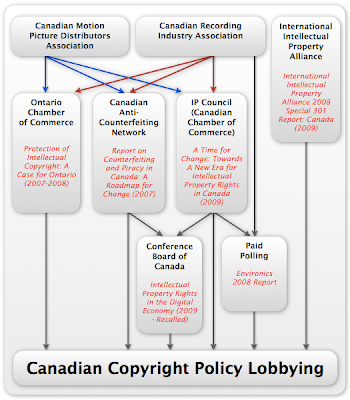

Michael Geist/The Register
Michael Geist has a thorough and excellent analysis today of the role of CRIA and CMPDA in copyright "policy laundering", as he calls it, in Canada - including in the recent Conference Board imbroglio. I had raised some questions about these two organizations in this context on June 17, 2009.
All of this may even be more incestuous than Michael's chart shows. For example, the USTR gets its "301" information from the International Intellectual Property Association ("IIPA"), a Washington advocacy group that runs out of a couple of Washington law offices and is heavily influenced by the US entertainment industries. As I have mentioned earlier, the reports on Canada are prepared with the considerable input of a well known Washington lawyer named Steve Metalitz.
And do you wonder where the IIPA gets its information about Canada?
HK
Subscribe to:
Posts (Atom)


 Posts