Tuesday, February 14, 2012

The University of Toronto Deal with Access Copyright & Governance Issues


(UofT)

Prof. Katz of the Faculty of Law at the University of Toronto has an important blog about "governance" issues arising out of the the recent controversial deal between UofT and Access Copyright. 

Prof. Katz begins:
In addition to serious copyright, privacy, and academic freedom problems arising from the Agreement signed last week between UofT and Access Copyright, the way it has been handled so far raises some questions about whether it is consistent with UofT’s governance procedures.
The last clause of the agreement makes it  "conditional upon applicable Governance approval..."

The agreement can be found here, in the blog post that first mentioned the deal. It is interesting that the agreement was first made available to the general pubic on this blog and NOT by the University of Toronto, or Western which also cut presumably the same deal. 

HK

Sunday, February 12, 2012

Trans-Pacific Partnership ("TPP") Agreement - Consultation Deadline of Valentine's Day February 14, 2011 - Towards "Copyright Forever" and Higher Prices Now


World Copyright Terms (created by Balfour Smith of Duke University)


The Canadian government is asking for submissions on the proposed TPP agreement by February 14, 2012.

One of the identified items for consultation is:
  • Views and experiences with the protection of intellectual property rights. 
According to Sean Flynn of American University's Washington College of law, preliminary analysis of "leaked" documents indicate that the USA will be seeking:
  • a life + 70 year copyright term, 
  • to abandon the access to medicines flexibilities of the 2007 New Trade Deal and the U.S.-Peru Free Trade Agreement
  • to create a new international legal requirement to provide copyright owners an exclusive right to block parallel trade of  copyrighted works.
See Sean Flynn's analysis here and here. If Sean is right, the USA will be seeking to impose a regime that goes far beyond  Canada's NAFTA and WTO obligations and even way beyond still controversial IP and trade agreements not yet ratified, such as the 1996 WIPO treaties and ACTA.

This sounds like policy shopping on a grand scale.


The DFAIT document is available
here.

Remember - the deadline for comments if February 14, 2012. You may also wish to to include with your submission a  lovely Valentine, such as the one below.

Valentine's Day
Wikipedia
 
Don't forget to send in your view by Valentine's Day February 14, 2011.

Tell the Government of Canada what you think about extending the copyright term for another 20 years to life + 70. That's a very long time. For example, the iconic Canadian writer, scholar, academic, economist, comedian and genius-about -town (small and large) Stephen Leacock died in 1944. If this regime applied to him, his works would be locked up by a publisher - likely a multinational - or an estate of remote descendants who did nothing to create these works - until 2014. Would such a term extension benefit anyone, except some foreign corporation, some clever copyright lawyers, some distant descendants, or others who have no obvious claim to monopoly entitlement?

Ask whether this would provide any incentive for the next Glenn Gould, Leonard Cohen, Robert LePage - or, indeed, Stephen Leacock. Would such a regime have made Leacock any more clever or productive when he was alive? On the other hand, what are the costs to scholarship, culture, and nourishment for new creators by locking away the rights to Leacock from the public domain for another 20 years?

Or whether it's just a question of sending even more money to Disney and other mostly American and European copyright owners and exploiters of the rights of long dead creators.

Does Canada want to join the American campaign towards "copyright forever", which would result in the stagnation of creativity?

Do you want to see Canada being told by other countries (that really means, effectively, the USA) how to deal with TPMs' and what type of SOPA-like provisions we would be expected - make that "required" - to enact?

By the way, if Sony Bono's zealous widow, Congresswoman Mary Bono, had gotten her way, we would indeed have seen "copyright forever" in the USA:
Actually, Sonny wanted the term of copyright protection to last forever. I am informed by staff that such a change would violate the Constitution. ... As you know, there is also [Motion Picture Association of America president] Jack Valenti's proposal for the term to last forever less one day. Perhaps the Committee may look at that next Congress.
The provision mentioned above that would enable copyright owners to prohibit parallel imports would also require a major change in Canadian law. Parallel imports are legitimate products, such as CDs or  DVDs, manufactured abroad with the consent of the rights owner in the country of manufacture. Blocking such imports into Canada would eliminate an important element of competition and result in immediate price discrimination and higher consumer prices. I fought this battle on behalf of the Retail Council in the Supreme Court of Canada in the Kraft case, where my client's submissions were the basis of the prevailing reasons for judgment.

Send your views here:
consultations@ international.gc.ca 

HPK 
 

Wednesday, February 08, 2012

Global News Interviews Michael Geist and Me about #Bill C-11 and #SOPA

I was interviewed online today by Global News, My comments, along with those of Michael Geist, appear online here. Part of my responses appear to have been inadvertently omitted online but appears below.

GLOBAL:
There has been an information overload about both SOPA and Bill C‑11. Readers have understood that these proposals would protect musicians, filmmakers and writers from having their work stolen and distributed over the Internet, but what's been misconstrued is what potential changes would mean to Canadians using the Internet. How would Bill C‑11 affect Canadians' experience online? How would SOPA affect Canadians' experience online?   

HPK:
First of all, we have to distinguish between the Bill C-11 that we see now - and the one waiting in the wings, which will include SOPA-like amendments that will supposedly be "technical" but may be very far reaching if certain lobbyists such as Mr. Barry Sookman, who wrote today in the National Post, get their way. I can only address the Bill in front of us. While it will supposedly create more freedom for consumers to engage in format shifting, time shifting, private copying, fair dealing and other "users' rights", it will actually be a big step backwards because virtually all of those gains - which we should have had long ago and which American's already largely enjoy - will be rendered nugatory by the iron-clad technical protection measures. These "TPMs" can prevent Canadians from watching a perfectly legal DVD made in India, or cutting and pasting for an educational project or a documentary, from using locked material in the public domain, or from making a backup of expensive game, BlueRay, or computer program product. Canadians will end up with less rather than more access to knowledge and entertainment products and pay higher prices for what they are allowed to do. Users' rights will be determined by lawyers and executives in Hollywood and New York and imposed by TPMs, the circumvention of which will be illegal even if the use is not.


SOPA, if had been enacted, could have shut down all kinds of Canadian websites - including perfectly legitimate ones - based upon an  extremely aggressive extraterritorial approach with very little due process that would require Canadians and other foreign parties to defend themselves in American courts at enormous expense and with little chance of success. This is not just paranoid fear mongering. Those who fought for SOPA have been trying their best in the American courts to shut down YouTube for several years just because of cute cat and baby videos that supposedly infringe entertainment industry content. SOPA would have enabled this kind of overreach.

GLOBAL:
What are the differences and similarities between these two potential pieces of legislation? Do they have the same protections?


HPK:
Canada's Bill C-11 and the US SOPA bill are very different on the surface. Bill C-11 is far more balanced in many respects, if only because it is more of an omnibus revision. Prof. Michael Geist has pointed out its several positive points. However, both bills would achieve the same ultimate end, which is the protection of legacy business models and the unnecessary inhibition of digital innovation. Bill C-11 is a very general bill that has been in the works for many years in various iterations. SOPA is the latest and perhaps most blatant example of US entertainment overreach aimed at blocking or inhibiting new technology. First it was the player piano. Then radio. Then VCRs. Now, it's the internet. And there were many other attacks in between.

GLOBAL:
While sifting through stories and community blogs in my research, I've read that the Stop Online Piracy Act could even affect sites, such as YouTube among others B Megaupload.com, IsoHunt.com, surfthechannel.com. What websites would we see shut down in Canada once these bills become law? To clarify to concerned Canadians, what sites won't be affected?

HPK:
It's quite clear that the laws that are already in place in the USA and Canada can work against the truly bad actor "rogue" sites. However, the entertainment industry has squandered most of its goodwill by focussing in the USA on suing children, college students and dead grandmothers. Now they want the U.S. Government to take over at taxpayers expense and enforce their private rights with heavy handed blunt-force legislation. In Canada, we have good tough laws in place that are much stronger than U.S. laws in many crucial respects.    But the entertainment industry has been unwilling to use these laws to their full effect because they want even tougher and overreaching laws that would enable easy overkill. They haven't made their case that the current laws are inadequate because, for whatever reason, they have not fully utilized them. They would rather claim that they don't work or are inadequate, even if this claim is incorrect.  If they had used these laws, pushed forward and actually lost in a timely, properly and vigorously contested court case, then they might have a real case to ask for tougher legislation in Canada. But this has not happened.

GLOBAL:
Do you think that much of the discussion is escalating into fear mongering or should Canadians have some concern in these potential laws and how they'd affect their ability to share information online?

HPK:              
The most important thing I learned at law school is that any legislation or court decision should be viewed in the light of the worst possible and most absurd result it could produce - because this is what usually follows and sooner rather than later. So, in the USA, the music industry is still pursuing a judgment of almost $2 million against a single mother for downloading 22 songs. We have seen a home video of a baby dancing to Prince's barely recognizable music being taken down. We have countless well documented examples of the "chilling effects" on research, education, speech and expression through overreaching current laws.  According to many proposed definitions of "rogue site" or “enabler”, the biggest offender would be Google. You can find all the infringing material you could ever imagine of simply by doing a Google search.  Would anyone try to take Google down?  The answer is that there is already a longstanding mega battle underway to take down YouTube, which Google owns. So, even Google itself could be a target for litigation. Collateral damage? No problem for the entertainment industry, which sees this as the "war on piracy" and has actually gone so far as to link it to the war on terrorism not only in terms of moral panic rhetoric but with suggestions that funds from counterfeit DVDs fund real terrorists. 

GLOBAL:
SOPA led to a historic day of online blackouts on Wikipedia, Reddit, Mozilla and others who closed their sites in an appeal to users to get in touch with their Congressional representatives to argue against the passage of the two bills. What is your stance on these sites protesting these changes? Is Bill C‑11 flying under the radar compared to SOPA and if so, why do you think this is happening?

HPK:
First, this is Canada and we are generally less excitable about than Americans, unless hockey is involved. Second, we don't have big home grown industry players fighting back directly and with so much resources as is now the case in the USA with Google, etc. We do have highly respected communications companies and the Retail Council of Canada (a client of mine) making some important and principled points and taking a stand for their customers. In Canada, the lobbying is more subtle and the resources available are much less than in the USA.  For example, Google is much less visible on the policy front in Canada than in the USA.  The educational and library sector is much less assertive in Canada than in the USA. Moreover, many of the most important issues in Canadian copyright law are being dealt with by the Copyright Board, which has been given sweeping power by Parliament to devise and implement “tariffs”. This process results in almost half a billion dollars of copyright payments by Canadians per year that add to the cost of everything from blank CDs to K-12 education to retail prices on countless products. There are about 36 collectives working hard to increase these payments even more, There is simply no counterpart in the USA to some of the most important Canadian tariffs and collectives, and no organization comparable to the Copyright Board.  This process is largely “under the radar” to most Canadians.


HPK

Friday, February 03, 2012

Supreme Court of Canada on Access to Information, meaning of "trade secret" - for IP and copyright watchers

The Supreme Court of Canada (“SCC”) has just issued a very important decision on access to information. It involves a request under the Access to Information Act ("ATI") by one pharmaceutical company regarding the new drug submission of a competitor.  Bottom line – the Court comes down in favour of more rather than less disclosure while clarifying and preserving principles of fairness to ensure that disclosure is not made wrongly or by mistake. The case is Merck Frosst Canada Ltd. v. Canada (Health), 2012 SCC 3
  
Of interest to IP watchers:

·         There is an important and substantial discussion of the meaning of “trade secret”, which is a critical but undefined term in the ATI legislation. This includes a discussion of the “common law” origin of the concept and a rejection of an attempt to rely on international treaty law in the form of NAFTA and TRIPS to construe the meaning of “trade secret”.
·         This is the first opinion by Justice Cromwell with major IP implications.
·         There is a dissent penned by Justice Deschamps (joined by Justices Abella and Rothstein) focussed on “standard of review”.
·         This is a 151 page judgment with a substantial dissent citing a very large number of cases and involving what must surely have been a very substantial record. The case was argued on November 12, 2010 and the judgment is now here, about 15 months later – more than the usual six or seven months during which the Court reserves judgment.

The following questions may be of particular interest to copyright watchers of the “pentalogy” argued on December 6th and 7th, 2011:

·         Does the reasoning about the definition of “trade secret”, a key but undefined term in the ATI legislation and a term that has its origins and is construed in light of the common law, suggest how the Court may address “fair dealing”, also a key and undefined term in the Copyright Act and also a term that has its origins in common law, as Prof. Ariel Katz and I argued in the K-12 case in the pentalogy on behalf of the U. of T. Centre for Innovation Law and Policy?  We also addressed the meaning of “research” and “private study”, other undefined terms, in light of the common law.
·         Does the discussion about the non-applicability of international treaty law suggest how the Court will address the arguments on behalf of some major content owners about the “three-step test” that were put forward  in the two fair dealing cases  in the SCC pentalogy (i.e. the K-12 and SOCAN “previews” cases)?
·         Will the “sempiternal question”, as Justice Létorneau calls it, of “standard of review” be important in the “pentalogy”?  The Court is still clearly quite concerned about it and the issue has clearly not gone away. And with respect, the Federal Court of Appeal has arguably not been consistent on this issue, even in dealing with cases coming from the Copyright Board cases, a point raised in at least three of the pentalogy cases.

HPK

Tuesday, January 31, 2012

U. of T. and Western Capitulate to Access Copyright

In an astonishing development that has caught all but a handful by surprise, U. of T. and Western have signed copyright deals with Access Copyright that appear to be an early and complete capitulation to an important battle over the costs and parameters of access to knowledge in Canadian post-secondary institutions.

See here and here.

In a nutshell:
  • The cost will be $27.50 a year per full time student.
  • The agreements include an indemnity and digital rights.
  • The agreements will be until the end of 2013 and will renew automatically for one-year terms during which any party can cancel or renegotiate the agreement based on six months notice. A UWO official says “The new royalty is substantially below the amount initially sought by Access Copyright in its Tariff application before the Copyright Board.”
A few preliminary comments:
  • This is an 800% increase over the current basic amount of $3.38 per student. Although this eliminates the current $0.10 a page cost for course packs, such course packs are increasingly irrelevant as more and more material is available legally online at no cost or through licenses that the university has already bought and paid for. Many students don’t need or use “course packs” anymore.
  •                 It is unclear how this new deal will affect existing arrangements at U. of T., for example, where many course packs have long been printed off campus by third parties, who have been separately licensed by Access Copyright on the basis of a $0.10 a page “royalty”. Since this is to be an “all you can eat” rate, how and by whom is the course printing going to be handled and how will the costs be allocated? Will students who don’t need course packs have to subsidize those who do?
  •  As Access Copyright itself admits, the $45.00 figure was only a “suggested” figure. It may as well have been – and probably was – pulled out of thin air. The comparable rate in the USA – for the relatively few universities (usually the smaller ones) that feel any necessity to pay it – is about $3.75 per head.
  • Those familiar with the way the Copyright Board usually works might reasonably expect the final tariff to be less than half of the $45 “suggested” rate. Where there are two somewhat rationale rate proposals, the Board usually finds a position somewhere near the middle. Even the K-12 decision, which CMEC appealed, essentially split the difference between the two parties’ positions. $27.50 is a VERY, VERY GOOD DEAL for Access Copyright. In fact, it is about 50% MORE than Access Copyright now gets per university student on average overall in Canada – and this is almost 8 years AFTER CCH. For any number of reasons, including the proliferation of already paid for or cost free legal digital alternatives and reliance on the empowering fair dealing provisions of CCH, one would have expected the payments to Access Copyright to significantly decrease, not to increase.
  • In the present case, the $45 “suggested” figure was pure conjecture even on the part of Access Copyright. Cutting this back by less than 30% is unlikely to be widely seen as a victory.
  • The deal supposedly includes an indemnity and digital rights. There is plenty of reason to question whether Access Copyright has any chain of title to any significant amount of the repertoire required by Canadian universities, much less in the digital rights to such repertoire. Therefore, whether Access Copyright has the right to grant these digital licenses and offer any indemnity and whether the universities should rely on such provisions are good questions.
  • Both of these institutions will almost certainly pass this $27.50 cost entirely on to their students and wash their hands of this issue. Once again, this is more than 8 times the current basic rate under the already controversial interim tariff that most universities have walked away from. Should two leading universities negotiate with their students’ money in a way that will affect the entire post-secondary sector in Canada both quantitatively and qualitatively for years to come?
  • U. of T. has prepared a document for its student body rationalizing its decision, which is available here. The document contains too many questionable assumptions and assertions to discuss here. However, the most surprising aspect is that the settlement is apparently being rationalized by the rates being paid in Quebec.  Suffice it for the moment to say that this is quite possibly the least logical and appropriate rate precedent or proxy that could possibly have been chosen. The document also refers several times to the fear of possible retroactivity of any ultimate Board tariff. This fear is arguably overstated. 
Some preliminary questions:
  • Why would two such prestigious and financially able institutions not stand up to fight against a proposed tariff that is so problematic and expensive?
  •  Why did they not wait to hear what the Supreme Court of Canada had to say about fair dealing?
  • Why not wait for Bill C11, which Access Copyright proclaims will enhance the educators’ position with the explicit  inclusion of "education" in "fair dealing"?
  • What are the all-important terms and conditions that have been agreed to? For example, did the universities acknowledge that absurd provision purporting to entitle payment to Access Copyright for mere linking? Or the outrageous and privacy invasive demand to monitor professors’ email accounts? Or the completely arbitrary quantitative limits in the proposed tariff?
  • What effect will this have on the future of current post-secondary case at the Copyright Board? 
  • Will that case proceed and set a tariff that will be effectively “mandatory”? Were the other universities – which had reportedly budgeted two million dollars for this fight and then mostly “opted out” of any dealing with Access Copyright – aware of this development and, if not, how will they react? How can the publicly “agreed” upon and arguably much too high high rate of $27.50 NOT affect the outcome at the Copyright Board for everyone else?
  • Was the AUCC – which was coordinating the universities’ fight at the Copyright Board – involved with or even aware of  this development?
  • Of immediate concern, when will these agreements be made public? These agreements surely should be made public because tens of thousands of professors and students are now bound by them, whether or not they wish to be.  And tens of millions of taxpayers’ dollars per year are now at stake if these agreements become the new normal in Canada. 
HPK


PS - Here is a a copy of the executed U. of T. license. It is not in searchable format. At the time of posting, I haven't had a chance to read it yet.

PS - Sam Trosow offers some possible answers to the above questions here.

Wednesday, January 25, 2012

Seeing Red - Can Copyright Protect the Idea of a Red Bus on a Black & White Background of the Houses of Parliament?


Does the lower image constitute copyright infringement of the upper one? The highly respected Judge Birss of the Patents County Court in the UK has ruled  in Temple Island v. New England High Teas that it does. The images – which are both collages - are clearly not identical. However, there is clearly some similarity in look and feel. The ruling seems to challenge the conventional wisdom in  many circles that taking a picture of a public place taken from the same perspective and under similar conditions to an earlier picture is not an infringement. The idea of a red object or figure on an otherwise black and white background is hardly new. In fact, the Plaintiff  got the idea from the famous film Schindler's List.  The ruling is controversial and has been discussed by in some detail by my favourite feline IP bloggers at the 1709 Blog and the IPKat blog.

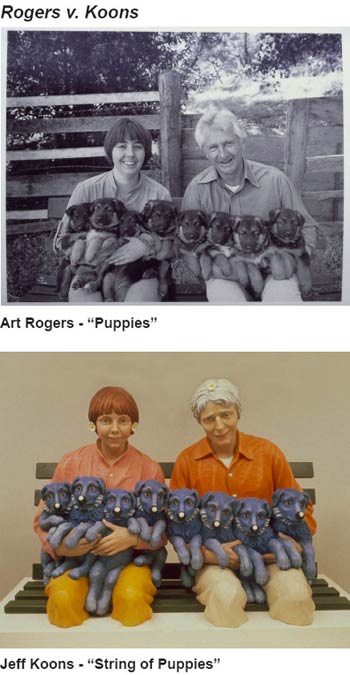
Americans will not be particularly astonished by this ruling, given that the US 2nd Circuit ruled in 1992 that Jeff Koons sculpture at the bottom infringed Mr. Rogers photo above it. See Rogers v. Koons.


For more on Jeff Koons' various copyright cases, see here - from whence the above images come.


The Koons decision is a major and controversial  milestone in the American law of fair use. The UK decision - which is not binding on higher courts - does not mention fair dealing.


HK