Showing posts with label sound recordings. Show all posts

Wednesday, September 16, 2009

When is a Sound Recording Not a Sound Recording?


Earlier this year I posted about the NRCC's attempt to get a tariff on the use of sound recordings as embodied in the soundtracks of movies and as performed in theatres and on TV. See here and here:

It will be recalled that the Copyright Act defines “sound recording” as:

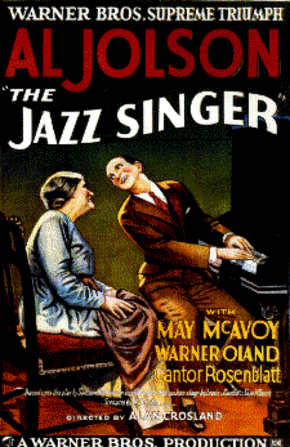
"sound recording" means a recording, fixed in any material form, consisting of sounds, whether or not of a performance of a work, but excludes any soundtrack of a cinematographic work where it accompanies the cinematographic work;

(Emphasis added)

The definition of “cinematographic work” is this:
"cinematographic work" includes any work expressed by any process analogous to cinematography, whether or not accompanied by a soundtrack.
Sections 15, 17, 18 and 19 are also pertinent.

The Copyright Board has just issued its decision on a threshold legal question as to whether NRCC (the neighbouring rights collective - of which there is no counterpart in the USA) is entitled to seek a tariff related to:
the performance in public or the
communication to the public by
telecommunication, in Canada, of published
sound recordings embodying musical works and
performers’ performances of such works.
The NRCC made a rather strained argument heavily dependent on foreign and mostly Australian case law that, despite the clear wording of the statute and the legislative history, it is entitled to a tariff for the above uses.

Today, the Board came to the predicable and correct conclusion along the lines I had suggested in my earlier blogs. It ruled against the NRCC. I believe that the Board got this right and did so decisively, if not particularly quickly. The tariff was published on May 31, 2008 and the hearing on this issue took place on May 7, 2009. Here's the Board's well written and well reasoned decision.

I have little doubt, however, that the NRCC will seek judicial review. This time, unlike the "iPod levy” case where the Board wanted to proceed with a tariff hearing in spite of the clear wording of the statute and a previous Federal Court of Appeal decision on the same issue, I believe that the Board will be upheld in any judicial review.

It is useful for the Board to dispose of as many threshold questions as possible to avoid unnecessary hearings, since Board hearings are so expensive and stretch out over such a long time. It is good to see that the Board is prepared, when appropriate, to decline to proceed with a proposed tariff that clearly cannot be legally justified.

HK

Friday, March 20, 2009

EU Sound Recording Term Extension Vote Delayed

Big reported news from Europe. The vote scheduled for March 23, 2009 on copyright term extension for sound recordings from 50 to 95 years has according to the Open Rights Group been postponed until late April. Here's the posting from the Soundcopyright blog:
Amid intense lobbying in the European Parliament next Monday's vote on the proposal to extend the term of copyright has been struck off in a shock move. Following a meeting of the presidents of the political groups in the European Parliament on Tuesday, and with controversy and a lack of consensus surrounding the proposal, MEPs have delayed voting till the end of April - just before this summer's European elections. A trialogue discussion between the European Commission, Council and Parliament, set for the end of March, will now attempt to broker a deal to see if the directive will be allowed to pass.
Prof. Martin Kretschmer has had a lot of useful things to say about all of this recently in The Telegraph.

This is not necessarily a victory for opponents of the term extension. Sources suggest that there is a danger of a "compromise" deal that would still result in a 70 year term.

HK

Monday, March 09, 2009

Our Neighbour's Proposed ""Tax on the Performance of Sound Recordings"

The National Association of Broadcasters ("NAB") in the USA is the counterpart of the CAB in Canada.

The NAB, not surprisingly, opposed what it calls a proposed "Tax on the Performance of Sound Recordings", otherwise known in Canada as one of several "neighbouring rights." Down there, they don't even like the word "neighboring" as they spell it - but the concept is very much alive and in play in H.R. 848, the "Performance Rights Act", introduced by Rep. John Conyers, a great friend to the music industry.

Canada's Copyright Board values these rights essentially as equivalent to classic copyright rights, although in practice they are discounted to about 43% of their counterpart copyright rights due to the "eligible repertoire" requirements that limit liability to pay to rights owners in countries without equivalent protection.

The NAB has published an interesting white paper based upon international comparisons, in which Canada is mentioned several times.

There's a hearing going on today March 10, 2009 in Washington on this. Interestingly, Stan Liebowitz -a regular witness at Copyright Board hearings in Canada - is testifying, along with Mitch Bainwol and others.

Naturally, CRIA, NRCC, the CAB and and others up hear will be watching this with great interest. This is because the implementation of "neighbouring" rights in the USA could lead eventually to the the granting of full or partial reciprocity to the American rights owners, thereby greatly increasing the cost of certain tariffs and exacerbating the outflow of money from Canada and into the hands of RIAA and CRIA members.

Saturday, February 28, 2009

Copyright Term Extension Notwithstanding the Evidence?


Concerning term extension of sound recordings, the UK government as per Minister David Lammy has decided to ignore the Gowers Report that it had commissioned. This follows the volte face of the European Commission, which has has likewise decided to ignore the independent analysis it had commissioned from Prof. Bernt Hugenholtz et al. Once again, lobbying trumps logic.

An impressive who's who of UK academics has signed an open letter dated February 24, 2009 to Minister Lammy challenging him to present "any evidence" on which the Government's policy reversal is based. This should bevery interesting because virtually all of the credible and independent evidence points the other way.

The letter concludes:
There has been some talk of 'moral arguments' for extension but it is hard to discern a compelling 'moral' case for a proposal whose prime effect is to benefit major label shareholders and a few, already highly successful, artists while imposing significantly greater costs on new creators, the general listening public and the custodians of our cultural heritage.

As Gowers concluded, and the Government has until now consistently reaffirmed, policy-making in this area should be evidence-based and designed to promote the broader welfare of society as a whole. Policies that appear to reflect nothing more than lobbying will only perpetuate the "marked lack of public legitimacy" which the Gowers report lamented — and discourage those who wish to contribute constructively to future Government policy-making in these areas. We therefore call on the Government to present any evidence that has led to this change of policy.

(emphasis added)
And by the way, if a group of academics in the UK can get together and sign a joint open letter on an important public policy issue, as we also sometimes see in the USA, why has this never happened in Canada?

HK


PS: Here's a video of Becky Hogge of Open Rights Group addressing EU MEPs:


Becky Hogge: Speech at Sound Copyright conference in the EU Parliament 27.01.09 from Open Rights Group on Vimeo.

Tuesday, January 27, 2009

EU Sound Recording Term Extension Battles

A major battle is brewing in the EU over term extension for sound recordings - from 50 to 95 years.

The European Commission - ignoring the independent expert report it commissioned from Bernt Hugenholtz and the work of other independent experts - is insisting that session musicians will benefit to the tune of about €2,000 a year. On the other hand, according to IP-Watch,
the Open Rights Group, a civil liberties organization, has contested McCreevy’s estimates about the extra revenue that would accrue to session musicians. It has calculated that some 80 percent of recording artists would only receive between €0.50 and €26 each year if the proposal becomes law.
Ironically, in a dangerous downward (or maybe upward) spiral, the EU is trying to harmonize the term of sound recordings with that of the USA. It will be recalled that the Mickey Mouse Copyright Term Extension Act of 1998 in the USA was justified by a need to harmonize to Europe's life + 70. In turn, Europe went up to life + 70 so as not to offend Germany.

In any discussions about renegotiating NAFTA, recall that Mexico has gone to life + 100.

Anyway, more details of the mess are available here from IP-Watch.

Saturday, January 17, 2009

Video on Proposed Term Extension of Sound Recordings in EU

Here's an outstanding video from the Open Rights Group on the European Commission's determination to ignore all the reliable evidence (including the work it itself commissioned from Bernt Hugenholtz et al) and push for term extension of sound recordings to 95 years. According to ORG, this would create a windfall for record companies and potentially provide negligible help and even harm to ordinary working session musicians - all at great cost to economic cost to consumers and a considerable encroachment on the public domain. There are lots of specific numbers here...

HK