Showing posts with label Obama. Show all posts

Thursday, April 02, 2009

Obama, the Queen and her new iPod


(The Guardian)

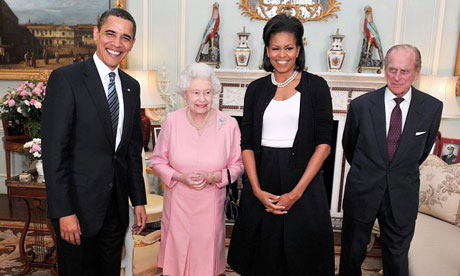
Not long after giving UK Prime Minister Gordon Brown a gift of DVDs that doesn't work due to region coding, President Obama has given Queen Elizabeth an iPod with 40 Broadway tunes that raises some complex questions according to Fred von Lohmann of the EFF. He raises issues concerning first sale, breach of contract and fair use for starters - and that's only under American law.

As Fred says:
Of course, no one thinks that copyright owners are going to send lawyers after either President Obama or the Queen over this. But none of us should want a world where even our leaders--much less the rest of us--can't figure out how copyright law operates in their daily lives.
Bill C-61 would have raised these types of questions - and then some. And ordinary Canadian citizens don't have crown immunity.

BTW, the President received a portrait of the Queen and Prince Philip. No batteries to wear out and no legal clouds involved. And likely to last a great deal longer.

The British have much more class than the MPAA and RIAA, both of which must be patting themselves on the back for the recent rather odd gifts from Obama to the UK.

HK

Thursday, March 19, 2009

Obama and Diplomatic DRM


Wow - the USA does seem to take DRM and TPM seriously!

It seems that President Obama gave UK PM Gordon Brown a gift of 25 classic American movies on DVD. The trouble is that they were region coded for North America only.

So Gordon Brown couldn't watch Psycho or any of the others.

Presumably, Prime Minister Brown isn't going to engage in any illegal circumvention. That might upset the MPAA and cause who knows what international ramifications. Not to mention litigation. On the other hand, the Brits not only invented the concept of the Crown but also that of Crown immunity...

Who knows where this will lead?

HT to Cory Doctorow at Boing Boing and a prominent Washington lawyer.

HK

Obama's Royalties


President Obama made $2.5 million last year from his two popular books. And he has other big publishing plans, as is being widely reported.

Somehow, I don't think that he's about to quit his day job. But I wonder whether this will lead him to believe that, if copyright is good, even more of it must be better.

HK

Thursday, March 12, 2009

ACTA FOIA Request FOILED

Jamie Love of KEI reports in Huffington Post that their Freedom of Information Act ("FOIA") request for copies of ACTA documents have been denied by the Obama USTR on the basis of state secrecy.

Love says:

The texts are available to the Japanese government. They are available to the 27 member states of the European Union. They are available to the governments of Canada, Mexico, New Zealand, Australia. They are available to Morocco, and many other countries. They are available to "cleared" advisers (mostly well connected lobbyists) for the pharmaceutical, software, entertainment and publishing industries. But they are a secret from you, the public.

Today we received this letter from the White House, Office of the United States Trade Representative. Our FOIA request was denied on the grounds that the documents are "information that is properly classified in the interest of national security pursuant to Executive Order 12958."

Here is a link to a PDF of the denial of the FOIA request.

This is very disappointing for those had "hope" for "change" in the way the USTR does business.

HK

Tuesday, February 10, 2009

Fair(ey) Use of Obama Photo?


New York Times, Mannie Garcia/Associated Press

Here's a good article about the preemptive law suit (complaint is accessible through the article) started by Shepard Fairey, the artist of the famous Obama poster that was based on an AP Photo (both shown above). Interestingly, the photographer, Mannie Garcia, says that he and not AP owns the copyright in the photo and he has no problem with Fairey' creation.
"I feel very proud that I made the photograph," Garcia said. "I never would have imagined that it became what it is, and it's pretty cool. The AP is being very aggressive with Fairey, and I don't want to be a part of that. My last conversation with the AP was that I own the copyright, and that's what I'm maintaining."
Mr. Fairey is a very lucky man to have some heavy hitting legal talent behind this claim, including Anthony Falzone of the Stanford Law School Center for Internet and Society and Mark Lemley, renowned Stanford Professor and litigator of important cases.

While the fair use issues are fascinating and important, the interesting short term question from a procedural standpoint will involve AP's reaction, especially in view of the photographer's assertion that AP doesn't even own the copyright.

The NY Times also has a good article here.

PS - it seems that the renowned and/or notorious Mr. Fairey is getting a lot of publicity on other legal fronts, having been prominently arrested in Boston the other day on the way to a major opening of his show at the
Institute of Contemporary Art in South Boston. The Boston Globe reports on the kerfuffle, which could be considered pretty impressive performance art.

If, as some say, all publicity is good publicity, then Mr. Fairey is doing exceptionally well.

Mr. Fairey may become Mr. Fair Use.

HK

Thursday, February 05, 2009

Is Canada Protecting Itself From Protectionism?

The Toronto Star is reporting that Stockwell Day is essentially already claiming victory in the business of the nearly trillion dollar “Buy American” bill.
Speaking in Toronto this morning, he also said Ottawa must remain vigilant as the legislation moves forward.


"This shows the importance of and the power of diplomacy," Day told a Bay Street audience of about 100 people at the Toronto Board of Trade.


He emphasized that Ottawa's "full-court press" to counter growing protectionism in Washington is being successful. The minister said there has been "enormous pressure" on Ottawa to enact retaliatory legislation against U.S. business, but he and Prime Minister Stephen Harper resisted, preferring the diplomatic route.


"Prime Minister Harper was the first world leader to raise this issue and speak against it," he said.


Noting that Canadian firms ship $11 billion in steel to the U.S. annually, Day warned that a "Buy American" policy on Washington's stimulus spending projects would have severely hurt Canada.
If Minister Day and the Prime Minister really believe that a clause to the effect that the bill will be "applied in a manner consistent with U.S. obligations under international agreements” will make this issue go away, we could be in big trouble.

Canada got seriously outsmarted on IP negotiations (particularly on the pharmaceutical patent file) and many other issues with the Americans in the FTA and NAFTA, which set the stage for the WTO agreement and much that has happened since. Now, the Americans have their sights on copyright.

Besides, we don't want to have to start a NAFTA or WTO dispute to figure out what “in a manner consistent with U.S. obligations under international agreements” means on the basis of a particular case or potentially thousands of them. These cases take many years, cost a fortune to prosecute, and have uncertain outcomes. Moreover, when the Americans don't like the outcome, they basically ignore or even flout it.

If Canada and other major G-20 powers stick together, President Obama will have not only the basis but the necessity to play hardball with Congress and to veto a protectionist bill. If Canada runs off and declares victory on the basis of something as flimsy as this, we will have played right into the protectionists' hands.

And we may never know what was discussed in the corridors that led to The Star reporting that:
He [Day] emphasized that Ottawa's "full-court press" to counter growing protectionism in Washington is being successful.
Besides, we should be entitled to assume that American law will be applied "in a manner consistent with U.S. obligations under international agreements." What else have the past 2.5 decades of trade negotiations been about? That's hardly a concession.

In Canada, at least, there is a presumption that all statutes, both federal and provincial, do comply with international treaties and should be interpreted in such a way as to ensure compliance. Thus, the kind of language that Minister Day seems so happy about would add nothing to the meaning of a Canadian statute. I would be surprised if things are different in the USA.

The new wording is at best redundant and political. More likely, it is a smoke screen. Minister Day ought to be very careful about proclaiming what amounts to "Mission Accomplished" at this stage. Once again, "it ain't over 'till its over."

HK

Wednesday, February 04, 2009

Verrilli to DOJ - Three Strikes?

President Obama has just appointed another big time content industry lawyer to DOJ.

Donald Verrilli, of Jenner and Block, who fought and won the Grokster case for the music industry in the US Supreme Court along with many other important caess, has been named as associate deputy attorney general. This follows the recent appointment of Tom Perrelli of the same firm as associate attorney general.

This also follows the appointment of Neil MacBride of the BSA, who was the person responsible for the BSA's highly successful but ethically troubling "snitch" reporting program that encourages disgruntled employees to find and report illegally installed software with a view towards retribution and reward.

This makes three appointments to senior DOJ positions of very competent and potentially very hawkish enforcers who have served the music, motion picture and software industries very well indeed.

Does this portend a greater policy and/or enforcement role for DOJ in IP?

Will we see the appointment of someone with a record of serving the user side or the public interest side in IP?

Or do these three strikes now establish a pattern to be continued?

HT to Michael Geist, who is now BTW, the number one ranked political blogger in Canada.

Update February 5: Declan McCullagh has a more thorough analysis of Verrilli's involvement with policy sensitive files such as the Jammie Thomas, Viacom and Cablevision cases that are all very much "live" and in which DOJ has played or could play a key role. Declan also says:

During the campaign, when CNET News asked Obama for his views on copyright, he replied: "As policymakers, we are in a constant process of examining our laws to ensure that the protections we place on intellectual property are sufficient to encourage invention without hindering innovation that builds on previous work or unfairly limiting consumers from using the goods they purchase in a way that is fair to creators."

That was, unfortunately, rather vague. Now it's a bit more clear where he stands.

HK

Thursday, January 29, 2009

Obama and NAFTA?

This story is coming back.

It seems that there is an effort in the US Congress to restrict all "stimulus" spending on iron, steel and perhaps other goods to "made in the USA" sources. That's illegal under NAFTA, perhaps under WTO, and would be a very bad way in any event to begin a new era in Canada/USA relations. NAFTA is still in full force, last I heard.

Industry Minister Tony Clement is already speaking out. Prime Minister Harper has expressed "grave concern." The issue clearly could and should arise during President Obama's visit to Canada on February 19, 2009 - if it has not been fully defused by then.

It will be really interesting to see what President Obama does about this, given his past pronouncements about NAFTA and the conventional wisdom about the Democratic Party's relative predilection for protectionism. Let's see whether there will be "change" afoot on this front.

If such a blatantly protectionist move as this is enacted into law, it will be even more interesting to see if the current Canadian government is once again in an unseemly hurry to enact the American wish list for a DMCA North "Made Worse in Canada" version of American copyright law.

There are things that need to be done to improve Canadian copyright law. But we don't need to import the worst features of American law, particularly if the Americans are going to become even greater scofflaws of international law. And we don't need to shovel money at the Americans for copyright rights that they don't provide to Canadians.

This is an old story that goes back well into the 19th century. It probably won't end soon. It is now beginning to be documented and analyzed by by scholars such as Sara Bannerman.

Let's hope that Canada learns not to get pushed around on copyright policy by the USA, as it once was by the UK. It's time for Canada to finally stand on its own feet on copyright and other fronts, and move on from being part of declining empires.

HK

Friday, January 23, 2009

McCullagh on MacBride

Declan McCullagh has a story on President Obama's appointment of a senior BSA enforcer to a senior position at the Deaprtment of Justice:

For his vice president, Barack Obama chose Joe Biden, a senator with a long history of aiding the Recording Industry Association of America. Then Obama picked the RIAA's favorite lawyer, Tom Perrelli, for a top Justice Department post.

Now, as one of his first official actions as president, Obama has selected the Business Software Alliance's top antipiracy enforcer and general counsel, Neil MacBride, for a senior Justice Department post. Among other duties, MacBride has been responsible for the BSA's program that rewarded people for phoning in tips about suspected software piracy...

Is there a pattern emerging here? If there is, will be soon see a balanced pattern?

There is some speculation that antitrust enforcement could stiffen up - which could help to establish balance.

HK

Tuesday, January 20, 2009

A Magic American Musical Moment

A wonderful and auspicious inauguration of President Obama today included a magic moment of chamber music from a diverse and stellar ensemble that we can only hope will give us more in the future. Perlman and Ma need no comment. They are stars of the highest magnitude. The impressive pianist was Gabriela Montero, a Venezuelan born American classical pianist. I particularly admired the clarinetist, Anthony McGill, who I've heard many times in his role as a co-principal at the Metropolitan Opera Orchestra. He's only 29 and is already one of the finest clarinetists I have ever heard - and I used to play this instrument professionally. In fact, as an orchestral player, he may well be the very finest. Here's an article about him in the NYT. He's about to leap from being a star to a superstar. I greatly look forward to hearing him as a chamber musician and a soloist. And he too happens to be an African American. There are still extremely few African Americans in the ranks of the major symphony and opera orchestras. Hopefully, this too will now change.

BTW, it's very difficult to play outside in cold weather. These artists made it seem easy.

And here's the performance of arrangement by John Williams of an Aaron Copeland arrangement of a Quaker song, Simple Gifts.

President Obama's good taste and America's capacity for excellence and beauty are an auspicious beginning for a new era.

PS - It turns out as confirmed by the NY Times that the artists were "faking" and doing a "Milli Vanilli" finger synching version of of their own recording done a couple of days earlier in anticipation of the cold weather. So, there was "magic" afoot in several senses.Frankly, that's fine - it was them synching their own recording and I was totally skeptical that they could play that well in sub zero weather. Or that they would take their Strads outside in those circumstances. At least they didn't flub any notes... ;-)

PS - The plot thickens. Apparently, they were actually playing according to AP but the sound wasn't amplified. Those nearby heard them live. The rest of the world heard the tape. That makes sense - and accounts for why the "faking" seemed so real. It's probably more evident on HD, but it looked good live on the computer CNN stream.

HK

Monday, January 12, 2009

Obama's Canadian Visit and Copyright

Michael Geist has beaten me to the punch on the subject of the forthcoming Obama visit to Canada. Naturally, copyright lobbyists in Washington and Ottawa will try to take full advantage of the occasion.

The Democrats have traditionally been even cozier with the entertainment industries than Republicans. Maybe the Dems like to party more. However, the Bush administration was extremely aggressive in its attempts to impose the DMCA on other countries, including the acquiescent John Howard regime in Australia. This is nothing if not ironic, given that Bruce Lehman, the father of the DMCA and the WIPO treaties under the Clinton administration, has now essentially all but disowned them.

Much may depend on whether Obama follows through on the unwise recent legislation that would appoint an IP czar that would, effectively, have cabinet level status. The last thing the new President needs in this economy for the foreseeable future is a cabinet secretary knocking on his door whining about how the sky is falling due to an absurdly expanded notion of “piracy” and how Canada and other supposedly rogue states should be dealt with under the US “Special 301" regime. Of course, he could equally as well appoint Larry Lessig - but don’t hold your breath. The best appointment for the foreseeable future for the czar position may be no appointment.

Specifically, Obama has proposed an interesting appointment as Associate Attorney General, namely Thomas Perrelli, a lawyer at Jenner & Block, who has been a key lawyer for the RIAA. While this may cause concern in some quarters, I have heard from some people on the other side of the fence from the RIAA who nonetheless speak very highly of him as a professional and are optimistic that he could bring an open and informed mind to this important position - which, of course, deals with lots of things other than IP.

Hopefully, President Elect Obama will give Canada the courtesy of full space and sovereignty on this and other issues to do what’s best for Canada, consistent with existing international law. And hopefully, Canada will do just that. That would be “change” that many in both countries would welcome.

By the way, while we all greatly look forward to this historic visit by this historic person, there should not be any excessive significance given to the fact that Canada will be his first official foreign visit. It has become something of a tradition that Canada will be the first port of call for a new U.S. President.

Prime Minister Harper and President Obama will have a lot to talk about. It is entirely possible and would not be such a bad thing, considering the state of the world now, that copyright does not even arise on the agenda.

HK
Monday, December 15, 2008

Google and Lessig on Net Neutrality

Is Google changing its tune on net neutrality? The Wall Stree Journals seems to be so so suggesting in a widely linked and discussed artcicle:

Here's a taste...According to WSJ:
Google Inc. has approached major cable and phone companies that carry Internet traffic with a proposal to create a fast lane for its own content, according to documents reviewed by The Wall Street Journal. Google has traditionally been one of the loudest advocates of equal network access for all content providers.
...

The developments could test Mr. Obama's professed commitment to network neutrality. "The Internet is perhaps the most open network in history, and we have to keep it that way," he told Google employees a year ago at the company's Mountain View, Calif., campus. "I will take a back seat to no one in my commitment to network neutrality."
[Barack Obama]

Barack Obama

But Lawrence Lessig, an Internet law professor at Stanford University and an influential proponent of network neutrality, recently shifted gears by saying at a conference that content providers should be able to pay for faster service. Mr. Lessig, who has known President-elect Barack Obama since their days teaching law at the University of Chicago, has been mentioned as a candidate to head the Federal Communications Commission, which regulates the telecommunications industry.

Is the Internet going to become more and more like cable and pay TV?

PS - UPDATE: Google's answer to this can be found here.

HK

Tuesday, December 09, 2008

Suggestion for Obama Foreign Policy on IP

Here's a provocative op-ed in the Mercury suggesting that the new US Obama administration should be less aggressive on IP in US foreign and trade relations.

Here's the conclusion:

Whoever becomes Obama's U.S. trade representative must re-evaluate our IP foreign policy and reassess how much foreign infringement affects U.S. interests. The USTR should examine whether protecting Hollywood and some established companies is handicapping innovative industries.

Hollywood should direct movies — not trade policy. The USTR shouldn't be pressured to adopt extreme views on copyright, including harsh unbalanced IP enforcement rules in trade agreements, particularly since these policy preferences find little support in economic data.

We need a balanced IP agenda that shows other nations what's good about American culture, yet respects theirs, and that doesn't discriminate against the Internet. We won't have a 21st century IP policy until we question why national security and foreign trade interests are taking a back seat to securing profits for some well-connected companies.

The author is Ed Black, who s president and CEO of the Computer & Communications Industry Association.

HK

Wednesday, November 05, 2008

The Obama Effect on IP

IP-Watch has a good analysis of the likely direction of the Obama administration here. IP-Watch also speculates on some Obama appointments here.

Although a Democratic administration is likely to be very sympathetic to the wishes of IP owners and rightly so, there is reason to hope that the Obama administration will take a more nuanced approach than we've seen in the past as a result of such factors as:
  • Obama's commitment to affordable health care
  • Obama's commitment to improving child education in order to improve competitiveness
  • Obama's experience as an academic
  • the very Internet savvy campaign he ran
  • the need to balance traditional Democrat protectionist instincts with the pressing need to to restore America's lead in high tech R&D and even manufacturing
  • the need for the USA to regain respect internationally by informed policy leadership and not by brute force trade hegemony
  • the need to satisfy likely great expectations from Africa and developing countries in other regions
  • more intellectual rigor and honesty in separating bogus terrorism and exaggerated counterfeiting issues from real trade and IP issues.
It's worth noting that Bill Clinton's IP point man, Bruce Lehman, has stated that the DMCA "didn't work out very well" under the last Democratic administration. Hopefully, Bruce's soul searching and public confessions will impart valuable wisdom to the new Democratic White House, whether or not he has part to play in it.

As I say, and without being political, there is now indeed plenty of reason to hope.


HK