I wish I could say something more useful about the full day hearing scheduled for Tuesday, June 25, 2013 in Toronto involving Voltage's attempt to get Teksavvy to divulge the identity of potentially thousands of its allegedly infringing subscribers. I have blogged about this extensively in the last few months and recently.
One had hoped that the main materials - e.g affidavits, transcripts if any of cross-examination, and memoranda, would have been posted by now either by Teksavvy or CIPPIC, which has been granted intervener status to do what Teksavvy is unwilling to do, which is to oppose the motion and to protect its customers' privacy.
But I can't find anything new. The docket is rather confusing, but indicates a flurry of last minute activity including a motion by CIPPIC filed on June 19, 2013 to extend the time for it to file its motion record responding to Voltage that had been due on June 18, 2013 pursuant to the Court's order of May 13, 2013.
Presumably, the motion is still proceeding at 10:00 AM in Tuesday, June 25, 2013 at the Federal Court at 180 Queen St. W., Toronto.
Live tweets will be interesting and useful, if the Court so permits. I suggest the hashtag #Teksavvy - since the real issue here in many respects is Teksavvy's vigorous and expensive effort to date apparently directed at not taking a position on protecting its customers' privacy rights, and instead relying on a law school clinic to do the job. I have suggested several times that Teksavvy's cash flow is estimated to be between $5 and $10 million per month.
I'll update as soon as I find out - or am informed of - anything more.
There's a lot at stake on this motion, not least of which is whether a wide door will be opened to copyright trolling in Canada. It's too bad that the current holder of the keys to this door is unwilling to do anything more than throw the keys to the door up in the air, and stand by to watch where they land.
HPK
PS #1: CIPPIC has provided me with the transcript of the cross-examination of Barry Logan of Canipre, who provided evidence concerning the alleged IP addresses of the alleged infringers. For the historically minded, here's a link to the corresponding document in the BMG case from 2004. Hoping to get more documents tomorrow at the latest.
PS #2: Here is CIPPIC's Memorandum of Fact and Law.
PS #3: Here is Voltage's Supplementary Memorandum of Fact and Law.
Friday, June 21, 2013


Sunday, June 16, 2013
Is the Party Over for the "Happy Birthday" Song?
The Happy Birthday song is in the news once again. Watch the video above for what is perhaps the most historic, famous and transparent performance ever of this song. Viewer discretion is advised.
Here is the complaint in a class action lawsuit in the Southern District of New York, which seeks a declaration that any copyright rights owned by Warner/Chappell are extremely limited (to certain piano arrangements published in the 1930's) and that the song is and has been for a long time in the public domain.
More to the point, it seeks restitution of all license fees paid for the song going back to 2009. Presumably, that date is based upon a limitation period. And that could mean millions of dollars for the lawyers involved, if this succeeds.
Here's a remarkable paper by Prof. Robert Brauneis - which presumably forms the basis for the litigation. Prof. Brauneis told the NY Times:
“I believe this song is in the public domain and therefore it is not owned by anyone,” Professor Brauneis said in a phone interview on Thursday. He said “Happy Birthday to You” was “economically significant” in that it “still produces millions of dollars of income in a year,” and that a successful legal challenge “might be a model for challenges to other songs.”
The law suit has been assigned to the legendary Judge Louis Stanton.
And here's the best arrangement ever of this song - by Igor Stravinsky, the best composer of the twentieth century:
Speaking of birthday's. May 29, 2013 was the 100th birthday of Stravinsky's Rite of Spring, easily the most influential musical composition in the last century. It is performed here brilliantly by Michael Tilson Thomas and the San Francisco Symphony:
HPK
Monday, June 10, 2013
More on “Tilting at Windmills”: Ontario Tables Anti-SLAPP Legislation – & How It Could Cover Existing Cases
At just about the same time that news was breaking
of NextEra’s
controversial lawsuit
against Esther Wrightman, the Ontario Government AG, the Hon. J. Gerrertsen, tabled
Bill 83 – which would, if passed, introduce
some remarkably positive changes to Ontario law regarding #SLAPP lawsuits. The
bill, if passed, would provide much needed encouragement of public interest
expression, commentary and participation. It would, indeed, serve as a serous chill
against litigation of little or no merit that is intended to stifle or prevent
public expressions of comment on matters of public interest. @EzraLevant, a
well-known Sun News commentator, had some written and spoken comments on June 9, 2013 on the
Sun website about NextEra’s lawsuit against Esther Wrightman and whether he
sees it as a “SLAPP” suit.
Bill 83 would provide that if a party is sued as
the result of “expression” made by a person concerning a matter of public
interest, the defendant can move to have the proceedings thrown out unless the plaintiff can show that:
· The
proceeding has “substantial merit”;
· The
moving party has no valid defence; and
· The
harm resulting from the defendant’s expression is sufficiently serious that
that public interest in allowing the proceeding to continue would outweigh the
public interest in protecting that expression.
Motions
brought under the legislation must be heard within 60 days
and, once the motion is made, no further steps can be taken by either party until
the motion is finally disposed of. Indeed, the bill creates a process by which a person who brings
a motion for dismissal can have an administrative tribunal proceeding automatically
stayed if he or she believes that the tribunal proceeding is related to the
same matter of public interest that he or she alleges is the basis of the
proceeding that is the subject of his or her dismissal motion.
The stay remains in effect until the motion is finally disposed of; however, a
judge may, on motion, order that it be lifted earlier under certain
circumstances.
And the moving party, if successful, can recover full
costs if the proceeding is dismissed. If the proceeding is not dismissed, the
responding party will not be awarded costs unless the judge determines that
such an award is “appropriate” in the circumstances. The moving party may be awarded “appropriate”
damages if the judge finds that the proceeding was brought in bad faith or for
an improper purpose.
This is really important – and would dramatically change
the legal landscape in Ontario, as any litigation lawyer will know.
At
the present time, it’s very difficult to get any lawsuit – even a SLAPP lawsuit
–dismissed at an early stage unless a defendant can show that there "no
genuine issue requiring a trial" – a burden that a defendant is rarely
able to meet, based upon many years of judicial precedent. A more recent formulation
of the threshold test for summary judgment is known as the “full appreciation” test:
“Can
the full appreciation of the evidence and issues that is required to make
dispositive findings be achieved by way of summary judgment, or can this full
appreciation only be achieved by way of a trial?”
See
also here, on the “full appreciation” test. The Supreme Court of Canada has recently heard arguments
and reserved judgment on its consideration of these issues, which
arose in the closely watched cases of Bruno Appliance and Furniture Inc. v. Hryniak and Hryniak v. Mauldin, which
were argued on March 26, 2013. We can presumably expect to hear from the Court in
the next several months. These are very complicated commercial law cases
involving a lot of money and allegations of fraud, but none of the elements of
a SLAPP case. Thus, whatever the Supreme Court has to say about summary
judgments, the resulting and much hoped for clarity about summary judgments cannot
and likely will not address the particular types of issues that can arise in a
classic SLAPP law suit.
According to Bill 83, dismissal of a SLAPP case at
an early stage because the plaintiff cannot show that its case has “substantial
merit” should be much easier than getting summary judgment under present rules
and jurisprudence – and so it should be in a SLAPP situation. Recall that The Ontario Government defines SLAPP litigation as:
Strategic
litigation against public participation (SLAPP) has been defined as a lawsuit
started against one or more people or groups who speak out or take a position
on an issue of public interest. The purpose of a SLAPP is to silence critics by
redirecting their energy and finances into defending a lawsuit and away from
their original public criticism. Concerns have been raised that SLAPPs also act
as a warning to other potential critics. The effect of SLAPP suits is to discourage
public debate.
Those
affected by existing litigation that would qualify for dismissal under Bill 83,
if enacted, will no doubt be delighted to know that this legislation would explicitly
apply to lawsuits commenced even before it comes into force, which could be in
the fall session later this year. Although there is a minority government in
Ontario, this seems to be an issue that apparently attracts
the support of at least one of the opposition parties.
It
will be interesting to see what may transpire if NextEra pursues its current
litigation against Ms. Wrightman and if this legislation is passed soon in its
present form.
Ms.
Wrightman’s courageous quest may shed some light not only on windmills but the
justice system itself in Canada. This is why she is tilting at windmills in
more ways than one.
For
those looking for more background, The Ministry’s resource material on
anti-SLAPP legislation, including the advisory panel’s report that led up
to this bill, is here.And
some media material about the new bill can be found here – first four items.
It should be noted that Ontario is usually a trend-setter for the common law provinces in procedural matters, especially ones that have substantive and “access to justice” significance – and sometimes even for the Federal Government in such matters. This is definitely something to think about in terms of possible amendments to the Federal Courts Act.
It should be noted that Ontario is usually a trend-setter for the common law provinces in procedural matters, especially ones that have substantive and “access to justice” significance – and sometimes even for the Federal Government in such matters. This is definitely something to think about in terms of possible amendments to the Federal Courts Act.
HPK
Friday, June 07, 2013
Good News from Simcoe Hall at University of Toronto re Access Copyright (#ACdeal)

U of T has shown strong leadership by decisively giving
Access Copyright notice that it will exercise its right to not extend the current
license beyond the end of the year. In doing so, U of T invites AC to negotiate
a "substantially" better deal:
…
if there is to
be a renewal of the License there needs to be a clear, demonstrated value to
the University over the course of the renewal term – a value
that takes into account and gives credit for the expansive interpretation of
fair dealing endorsed by the Supreme Court, as well as the amendments to the
legislation and other factors.
As I am sure you will
understand, the University also
continues to explore all its options, including alternative approaches that
would involve utilizing other licenses, fair dealing and legislative
authorizations to provide comprehensive availability of relevant material for
the University’s teaching and learning activities.
(Emphasis added)
This is a
wise approach that shows leadership, confidence and an appreciation of the
position of strength that U of T and other institutions now enjoy by virtue of
recent legislation, Supreme Court of Canada decisions, and other factors. This
also shows U of T’s wisdom in insisting on its right to end the license at the
end of 2013, two years earlier than other universities that signed the AUCC
model license deal on the basis of the “negotiated settlement” that came as
such a shock to virtually all AUCC members in April of 2012.
Congratulations
to U of T and to President David Naylor, Provost Cheryl Misak, Senior Legal Counsel Steve Moate, and others involved in this important decision. This good news comes three weeks earlier than the June 30, 2013 deadline everyone was watching. Decisiveness is indeed a virtue.
HPK
Thursday, June 06, 2013
Tilting At Windmills - Has Nextera Just SLAPPed a Canadian Erin Brockovich?
A young mother and environmental activist in southern
Ontario is being sued by Nextera, a wind turbine company, which is part of an an American based enterprise that has sales of about $15 billion a year. It apparently cut down a tree with a bald
eagle nest, an act which she did not like and which she filmed. Here’s her video.
Here’s Nextera’s Statement of Claim, which required the
efforts of three McCarthy’s lawyers to come up with a very long and fulsome list
of allegations involving “Offending Material” under the the Trade-marks, Copyright,
and Competition Acts and various common law torts including "common-law trade libel", and one I’ve never
heard of, namely “appropriating an insignia in which the Plaintiff has a
proprietary interest.”
Here’s a great interview by Ezra Levant,
in which the woman explains that she can’t afford a lawyer or even the filing
fee for her Statement of Defence.
As Ezra suggests, this could be another Erin Brockovich story. Moreover, Nextera is likely going to learn the lessons of the Streisand effect, which is that trying to suppress a discussion on the internet usually just draws more attention to it.
As Ezra suggests, this could be another Erin Brockovich story. Moreover, Nextera is likely going to learn the lessons of the Streisand effect, which is that trying to suppress a discussion on the internet usually just draws more attention to it.
Is this a classic SLAPP lawsuit? The Ontario Government defines SLAPP litigation as:
Strategic litigation against public participation
(SLAPP) has been defined as a lawsuit started against one or more people or
groups who speak out or take a position on an issue of public interest. The
purpose of a SLAPP is to silence critics by redirecting their energy and
finances into defending a lawsuit and away from their original public
criticism. Concerns have been raised that SLAPPs also act as a warning to other
potential critics. The effect of SLAPP suits is to discourage public debate.
Hopefully, the very courageous Ms. Wrightman will find
competent counsel to defend her against this extraordinary combination of wind
and legal power.
If NextEra pursues this matter, it will no doubt be reminded that "parody" is now explicitly included in s. 29 of the Copyright Act as one of the recognized purposes of fair dealing. In the light of that amendment and recent Supreme Court of Canada decisions having to do with fair dealing, the 1997 Michelin decision is surely no longer good law - if it ever was - with respect to copyright. That was the case in which Michelin used copyright law to stop a union from protesting with a parody of "Bibendum", the jolly Michelin character and design trade-mark And even that decision correctly held that the defendant did not "use" Michelin's trade-mark within the meaning of "use" under the Trade-marks Act. The reasoning with respect to trade-mark "use" is still good law. And recent Supreme Court of Canada defamation decisions suggest that claims that attempt to accomplish via the Trade-marks Act what cannot be accomplished via normal defamation law may face a very rough ride if adequately challenged.
HPK
Thursday, May 30, 2013
Update on Voltage, Teksavvy, Trolls, and Mass Litigation in Canada and Abroad
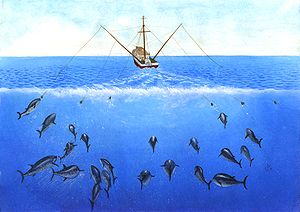

(Wikipedia) (Wired.com)
Trolling has many metaphorical connotations, but
two that can apply to mass copyright litigation are suggested above.
It looks like the controversial Voltage litigation
is about to heat up once again in Canada, as Voltage (purveyor of several films
including Hurt Locker and countless titles of lesser merit and fame) pursue
potentially thousands of Canadian John and Jane Does. The next major step
will unfold in the Federal Court on June 25,
2013 as Voltage continues to seek the disclosure of the names and addresses of thousands
of customers of Teksavvy, an indie ISP that has vigorously taken the position
that it takes no position in this matter and has spent at least $190,000 to do
so. That was as of several months ago. That presumably included the cost of
sending two senior counsel from Ottawa to Toronto at least twice just to ask
for an adjournment.
Teksavvy’s efforts to date seem to have been
directed towards buying time for the intervention by CIPPIC, the University of
Ottawa law school clinic. Teksavvy has an estimated cash flow of between $5 and $10 million per month.
I was pleased to have been CIPPIC’s lead counsel in its first and probably most significant intervention to date, namely the first mass litigation attempt by the US based recording industry that resulted in stopping mass litigation at the time unless the record companies were able and willing to provide adequate non-hearsay evidence and could show a good faith intention of actually commencing litigation. Apparently, the record industry folks were unable or unwilling to meet these modest requirements. For whatever reason, they never returned to the Court in that case. That was the BMG case.
I was pleased to have been CIPPIC’s lead counsel in its first and probably most significant intervention to date, namely the first mass litigation attempt by the US based recording industry that resulted in stopping mass litigation at the time unless the record companies were able and willing to provide adequate non-hearsay evidence and could show a good faith intention of actually commencing litigation. Apparently, the record industry folks were unable or unwilling to meet these modest requirements. For whatever reason, they never returned to the Court in that case. That was the BMG case.
In any event, flash forward to the present in
which disclosure of allegedly infringing ISP customers’ identities is now being
sought by Voltage Pictures. Involved in this litigation is a company called Canipre. Canipre’s Barry Logan has
provided the evidence in this case upon which Voltage relies to identify the IP
addresses of the alleged infringers. Canipre is hardly a disinterested expert investigator.
In its own recent words on its website, it says:
Canipre
provides internet based anti-piracy solutions to the domestic and international
entertainment markets.
Our programs
utilize advanced technologies and investigative techniques to mitigate piracy
loss resulting from the illegal distribution of digitized content.
Canipre incorporates the same media technologies that distribute
digitized content through P2P and File Sharing Networks. With our constant involvement
in the piracy wars since the litigation of Napster we are pioneers at the
forefront of the internet anti-piracy initiative.

We run our
technology hard
and the bad guys know us well ...
and the bad guys know us well ...
We invest continually to ensure technologies that are adaptable, robust
and finely tuned. This has been demonstrated time and again. More importantly,
our technology gets attention and once we've got it, we maintain it.
The bad guys pick up the phone when we call.
And it gets
results.
In the last five years, Canipre has interdicted an estimated 40,000,000
files and issued more than 3,500,000 take-down notices with a compliance rate
of 100%. Sometimes its [sic] a phone call; our black book is deep. And if that
doesn't get it done, Canipre staff is extremely adept at manipulating
file-sharing technology; the same technologies that are used to perpetuate
piracy are used to effectively [sic] quarantine piracy.
There has been lots of other interesting stuff on Canipre’s
website, including reportedly infringing
graphic material. The role and motivations of Canipre could raise
interesting questions in the court case, if the Court is sufficiently apprised
of the readily available evidence concerning the circumstances of Canipre’s involvement
in this litigation and what may turn up in any cross-examination. As an
intervener, CIPPIC has very unusually been granted right the right to cross-examine and to
adduce its own evidence by way of affidavit. The reasons why CIPPIC was given this unusual scope are
set forth in the Court’s order allowing the intervention
and basically stem from Judge Mandamin’s earlier explicit call assistance
and the presentation of opposing views in this very unusual circumstances and
the fact that Teksavvy was unwilling to fulfill this role. Cross-examinations are to be completed no later than June 10,
2013.
This will be all the more interesting in light of Mr. Logan’s recent media statements
about Canipre’s apparently financially driven motivation and clearly aggressive,
determined and partisan view of downloading and file sharing, which may be of
relevance in the eyes of the Court. Some of the potentially useful evidence in
this case could presumably have been easily provided by Teksavvy staff, as Distributel is apparently able and willing to do. However,
Teksavvy apparently won’t provide such evidence.
The problem with evidence in these types of cases
is that copyright trolling, like trolling for tuna, often catches many unintended
victims such as warm, cuddly and defenceless dolphins. There are all kinds of
frailties in these largely automated detection methodologies. In the USA, they
have hooked dead grandmothers, 12 year old children, and countless truly
“innocent” victims – either through outright mistake, stale records, or loose
use of a Wi-Fi router by persons unknown, such as neighbours, children, friends of
teenage children or whatever.
If Voltage gets its way, its troubles may only be
beginning. Voltage may have to start hundreds or thousands of individual law
suits, which the Court won’t want and Voltage won’t likely want to do. If
Voltage thinks is can sue thousands of John and Jane does in one singles
lawsuit, it is likely going to be disappointed, given that each case could present
different facts and different defences.
Hundreds or thousands of separate law suits can’t possibly be cost
efficient for Voltage. There would likely be standard form defence and motion
templates circulating online and the lawsuits could quickly grind to a
halt. Or, more likely, Voltage would send
out thousands of “demand” letters trying to obtain “settlement” – which may get
ignored unless Voltage actually follows up with a lawsuit – which may be
unlikely other than in perhaps a few token cases. While that may be enough to provoke
fear amongst recipients and some “settlements” in the hundreds or low few
thousands of dollars, it could also suggest the inference that the failure to
actually sue each intended victim may not comport with the “bona fide”
requirement to commence litigation laid down in 2005 in BMG by the Federal Court of Appeal.
...It is sufficient if they show a bona fide claim, i.e.
that they really do intend to bring an action for infringement
of copyright based upon the information
they obtain, and that there is no other improper purpose
for seeking the identity of these persons.
It would be a test of Canadian tradition, if not
Canadian law, to use the mere threat of litigation to force disclosure of
private information of thousands of persons simply for the purpose of
extracting so-called “settlements”, if there is no “bona fide” intention to
“bring an action for infringement” in any more than a few token cases at most.
One would be surprised if the Court knowingly allows itself to be used in this
way.
And there are other possibilities that could make Voltage’s mass litigation very problematic, if it gets that far. As has often been said on this blog, “be careful what you wish for…”
Anyone following American copyright law will be aware
that trolling litigation has recently been dealt severe blows in the USA. The lawyers behind the Prenda law firm face
disbarment and other severe sanctions for the troll tactics involving porno
websites. See this devastating ruling from a US District Court invoking The Wrath of Khan but
deadly serious in all respects and almost certainly
career ending for the troll lawyers involved. The Righthaven litigation, which is not porno based but also involves
very aggressive lawyering and artificial attempts to assert standing, appears
to be finally dead. Troll litigation in
England appears to be at and end, along with the careers of some of the lawyers
behind it.
Nobody has suggested any problematic behaviour by
any counsel in any of the mass litigation efforts to date in Canada. Indeed,
this being Canada, one can be hopeful and, indeed, confident that the issues
will be dealt with on the merits and that counsel do not themselves become victims
in the copyright troll wars, as has somehow happened in the USA and UK.
All eyes are now on CIPPIC to see if it will do
what needs to be done to keep Canada safe from mass troll litigation – a goal
clearly intended by the Government in Bill C-11 based upon, inter alia, its
$5,000 cap on statutory minimum damages for non-commercial activity. However, this
depends in large measure on the vigilance of ISPs and others who structurally-speaking
should step up the plate to defend the public interest – if for no other reason
than that they make a lot of money from the public. And, we also have a law in the form of PIPEDA that arguably
requires such vigilance and, indeed, active defence of customers where
warranted.
CIPPIC, with its limited resources, is to be
commended for stepping up to the plate here where Teksavvy would not. This is
really an unfair burden for CIPPIC to have to carry. Canadian public policy
regarding copyright and internet matters should not fall to be defended only by
an overworked and taxpayer subsidized law school clinic, however capable it may
be. But it now falls to CIPPIC and possibly other ISPs, such as Distributel in
another pending case, to do what Shaw and Telus did in earlier days, which is
to pay heed to PIPEDA and to stand up for customers’ privacy rights. Arguably,
this wouldn’t only be the right thing to do but is the required thing to do,
since we also have a law in the form of PIPEDA that arguably requires
such a defence in instances such this appears to be.
HPK
Subscribe to:
Posts (Atom)


 Posts
Posts