- In the the US Department of Justice is waking up its potent s, 2 Sherman Act mandate after decades of Reagan induced coma and focusing on telecom giants AT&T and Verizon.
- The CRTC is holding hearings on Net Neutrality - and the elephant in the room, of course, is the duopolistic, vertically integrated and often very conflicted ISP regime we have virtually throughout Canada, at least where broadband is available. In other words, the major ISPs may have strong incentives to throttle because of their content ownership interests, and no incentive not to throttle because there is no effective price or service competition and they can control resellers and force the latter to throttle as well.
- Meanwhile, the Canadian Competition Bureau - which hasn't been heard from by the public for a long time on much of anything other than misleading advertising, seem very concerned about on the "Nigerian Letter Scam." This affects about 10 poor Canadians a year who are sufficiently gullible to fall for it. If the Bureau wants to do something really useful, it needn't look far.
Tuesday, July 07, 2009
Prioriites in Antitrust Law?
There's some remarkable competition and antitrust law coincidences afoot at the moment:


Saturday, July 04, 2009
The SAC Double Negative Option Celestial Jukebox


Eddie Schwartz/bluepower.com
The quest for a viable "Alternative Compensation System" to deal with perceived problems involving P2P downloading and file sharing lives on.
The Songwriters Association of Canada (“SAC”), led by Eddie Schwartz, was in Ottawa on the Hill on June 3, 2009 and at the University of Ottawa, in an event organized by CIPPIC. Too bad there weren’t more people there because it was very revealing - though frankly not very convincing.
Here is the latest version of SAC’s proposal.
On the plus side, the SAC is to be complimented for daring to think outside the box. Unlike the power brokers in the music industry establishment, they don’t want to kill file sharing technology and they don’t want to sue their fans. They say that they really like P2P technology. And their fans. That much is good, but after that there are some probably fatal devilish details to consider.
The essence of the SAC’s proposal is that it's a negative option for both consumers and rights owners. For $5 a month, every Canadian household that doesn't opt out of the scheme (and "sign and undertaking to pay a predetermined amount of damages if they are caught file sharing") would get the right to download and share all the music authorized by the rights holders that choose not to opt out.
Here is the essential wording of the SAC proposal:
7. While at least 70% of Canadians regularly use the Internet to file share music, and 90% of them use it occasionally, naturally not all Canadian Internet users use the Internet for that purpose. We propose that they should be allowed to opt out of the payment of the fee. Broadband internet and wireless subscribers will be able to opt out of the licence fee if they do not share music files and if they sign an undertaking to pay a predetermined amount of damages if they are caught file sharing.(footnote omitted)
Payment of this fee would remove the stigma of illegality from file sharing. In addition, it would represent excellent value to the consumer, since this fee would grant access to the majority of the world’s repertoire of music. Existing download subscription offer a mere fraction of the file-sharing repertoire.
Creators or other persons entitled by by this system to claim a portion of the licensing fees but who nevertheless do not wish to be compensated under such a system could similarly opt out. Acceptance of license fees would amount to a waiver of the right to sue for the unauthorized transmission by Canadian users.
Leaving aside the accuracy and provenance of those figures about the percentage of Canadians who file share, the obvious problem with this is that it's a negative option "tax" (or so it will be called) on consumers - with the prospect that exercise of that negative option would give rise to invasive snooping and liquidated and presumably high damages payable by Daddy or Mommy if one of the kids downloads something and gets "caught". And maybe even the additional prospect of litigation at the suit of any of the rights owners who do opt out.
I get the feeling that SAC doesn't want to highlight the "negative option" aspects of this proposal. Somehow I can't see the prospect of a a negative option "tax" for the benefit of the music industry with the alternative being significant fines payable to the music industry being attractive or vote-catching in the eyes of politicians. While Canadians may be passive and polite about many things, the juxtaposition of something that looks and walks, and smells like a tax with a negative option and for the benefit of mostly foreign and mostly wealthy corporate interests may not escape controversy, to put it mildly.
And the negative option for the music industry won't sit well either. If this is backed by legislation, it could be seen, among other things, as a mandatory "formality" that would be contrary to the Berne Convention. There are millions of mostly untraceable rights holders around the world who enjoy copyright rights in Canada. Must they "opt out" if they don't want to be part of this? If they don't opt out, how are they going to get paid? Through their national collectives, who will have no similar reciprocal scheme in place. The mind begins to boggle.
This is apparently so simple and straightforward, according to SAC, that all the details and MOUs can be worked out by this September, just in time for a new bill that would put it into effect. The few remaining matters could presumably be dealt with by the Copyright Board. (BTW, the Copyright Board and the Courts are still struggling with SOCAN’s notorious Tariff 22 for music via the internet, which is now about 14 years old and potentially still years and another trip to the Supreme Court away from fruition. That tariff was filed years before Napster, iTunes, YouTube and Facebook even existed. In fact, many users of the latter two services in particular weren’t even born when Tariff 22 was first filed.
Anyway, I hate to be negative. However, if I had a positive solution to the problems of the music industry that those in power could understand and would act upon, I wouldn’t be counting time at stop lights every morning. I’d be counting grains of sand and composing fugues on my own island in the Mediterranean.
That said, here are a baker’s dozen specific serious problems with SAC’s proposal, any one of which could prove fatal:
1. We already have a levy scheme in Canada that the Copyright Board itself and a Federal Court Judge suggest would cover downloading onto computer hard drives. It’s called the private copying levy (most people call it a “tax”, even if the Board and the Courts don’t) and it has generated more than $250 million to date (based upon extrapolation from 2007 published figures, which are, as usual, out of date), much if not most of which comes from people who never copy music - but never mind that inconvenient truth. The major record companies, i.e. CRIA, got what they asked for, i.e. legalized private copying regime with a levy. That this turned out, effectively, to be a legalized downloading regime recalls the maxim about being careful what you wish for. This speaks volumes about short sighted solutions to doubtfully serious or even relevant problems and the credibility of the industry’s current wish list of copyright “cure-alls” for all the various industry problems that have much to do with bad management and little or nothing to do with copyright law. In any case, the SAC scheme would encourage technology and architecture that would allow for downloading that is already legal, but not permit uploading or sharing - and thus would thus encourage avoidance.
2. Similar schemes to SAC’s have been touted in the past - indeed for years. Paul Hoffert of Canada and Terry Fisher of Harvard has been pushing NOANK for a long time - but the world seems to be largely saying “No Thanks”. True, there are differences with the SAC scheme - but they are not that obvious or important overall. The bottom line is that neither scheme will work unless all major copyright owners agree to it. So far as I known, none have.
3. There are significant potential privacy concerns. For the scheme to be viable and fair to creators, it must be accurate in its measurements of usage. Do you really want CRIA members to know what you are downloading and sharing? What if your tastes run to Tiny Tim, or Liberace? Or Falun Gong Favourites?
4. There are treaty concerns. A massive blanket/compulsory license of the reproduction and communication rights imposed by legislation on the basis of a “negative option” regime raises lots of obvious treaty issues even under Canada’s existing obligations, not to mention the 1996 WIPO treaties to which Canada is not bound but has signed.
5. The scheme is inherently socialistic. I have to agree with Graham Henderson on this, who famously referred to Harvard’s Terry Fisher (co-proponent of NOANK) as “Comrade Fisher” at a conference. It’s true that the many SOCAN members make only a few hundred bucks a year, if that, from royalties - though some earn much, much more. Anyone who has “created a musical work or part of a musical work” that is performed anywhere (e.g. a bar or in the subway) can join SOCAN for free. Nobody guarantees self proclaimed musicians an income in Canada. Copyright law rewards success, not simply membership and not necessarily merit. Only failed car manufactures and unsuccessful investment bankers can count on legislated bailouts these days.
6. We already have about three dozen collectives in Canada. This more than anywhere else in the world, I believe. We would need a giant new collective and maybe even several sub-collectives here - resulting in a mechanism that would make the CPCC look like child’s play in comparison.
7. We would need counterpart international schemes - otherwise Canada would be shovelling almost all that $900 million across the border to the USA and over to Europe with virtually nothing coming back. Even if we get our full share back, it’s going to be trivial. Despite the celebrity of a few performers and success of a few songwriters, we have only about 2% of the international music publishing market. Most of the money from this scheme would leave Canada, and almost nothing would come in. Especially so if the propose scheme is fully "national treatment" in nature, as appears to be the case.
8. This scheme wouldn’t work for emerging artists, who don’t show up reliably in any of the current methods used to measure downloading and sharing behaviour. SAC admits that Big Champagne is only “70% accurate” - which, whatever that may means. isn’t very impressive if you are in a garage band and on the margin. Air play and CD sales (what CD sales?, some may ask) are a poor proxy for downloading and sharing behaviour. However, that’s what the CPCC has been using. The long tail theory may work at Amazon - but won’t work here.
9. Unless virtually all of the major record companies, music publishers and performers go along with this, there would still be threats of litigation against individuals - so Canadians would have multiple levies, digital locks and litigation.
10. We would need significant buy in by ISPs - who would have to keep track of which subscribers are “in” or “out” and when - and transmit that information to the collective. More privacy issues and much more expense to ISPs. Not to mention that the perceived “tax” - even if “voluntary” - will be seen as an add-on to the ever expanding monthly bills from Bell and Rogers, etc. that will further alienate customers and result in other “optional” and more profitable service being dropped. And if there’s enough of a financial incentive to the ISPs from the new collective to let them swallow this scheme, consumers and artists may see it as a kick-back and react accordingly.
11. If this works, which it likely won’t, we would likely see similar schemes touted by movie distributors, book publishers, newspapers publishers, knitting pattern publishers and every other sector that claims to be a "victim of piracy” on the internet. Will Canadian consumers greet the add-on of another $20, $50, or $100 a month or more to their ISP bill with flowers? I doubt it.
12. We will see the largest copyright tribunal anywhere (Canada's Copyright Board) get even larger, and full employment for lots of copyright lawyers - which some readers of this blog might regard as a good thing. However, how this will serve actual Canadian creators or consumers remains rather unclear.
13. Last but not least, if this scheme works, it would surely kill or seriously wound virtually all remaining retail store and online iTunes-type activity in Canada, and stifle any innovation in the business end of the music industry for a long time to come.
The bottom line is this. If there is a problem out there that requires a copyright solution - and that remains to be proven - a bad solution enacted in haste could be worse than no solution.
As CRIA well knows, or at least ought to know by now, be careful what you wish for.
HK
Canadian Copyright Consultations - Summer of 2009? You Betcha!
 A Town Hall Meeting (The Guardian)
No - she didn't resign to devote herself to copyright reform in Canada.
But, speaking of town hall meetings, rumours are rife about a summer consultation on Canadian copyright law.Here's a recent Billboard report, by Robert Thompson, who looks at the issue from the standpoint of the record industry, as he usually does. (How I miss Larry Leblanc, who was tended to look at life from a broader and much better and more balanced journalistic perspective).
Any announcement had best come soon and I sense that it will. We're now well into July. There will be difficult logistical questions as to timing, format, etc. Live town halls or online, or both? Not to mention that it's already well into summer time, when the livin' should be easy.
It's hard to see how any live town hall meetings or other live events can take place over the summer at this stage, especially cross country.
In any event, let's hope that the Government avoids one obvious trap that some will likely advocate for, namely that an interested person or organization should be able to make a confidential submission to this process.
If there is to be an online consultation exercise, all bona fide submissions in either official language that are on point and not profane should be posted in a transparent and timely manner, right after whatever closing date is established. There is no reason why any such submissions should be sheltered by claims to confidentiality.
HK
Update on BNN Copyright Clips
I've just learned from Michael Geist's update that there is an important follow up to a story about take downs from YouTube at the behest of Canada's Business News Network ("BNN") of clips concerning the Canadian copyright debate, in one of which I was a participant. This was based upon an original posting by the Canadian Coalition for Electronic Rights ("CCER"), on June 30, 2008 noted by Michael Geist. BNN has since denied any censorship intentions.
CCER has now revised and updated its original posting and notes as follows:
UPDATE: Rose Noonan of the Business News Network has provided CCER with clear evidence that BNN is indeed targeting all YouTube content and not just that relating to the Canadian copyright debate. While this is a reassuring development it is at the same time troubling that in a time when many broadcasters are forging partnerships with YouTube BNN has chosen the forced removal of content. Detailed post to follow.Zeropaid has a report which includes quotes from a BNN spokesperson:
Also, Jesse Hirsh has updated his blog on this issue and says:“When it became evident that numerous unauthorized BNN clips were posted on Youtube, a request was made that they remove all of the clips. This process involves finding each individual URL and sending them to Youtube to request that they be taken down. Attempts were made to find all the clips, but if there are still some there, that is an indication that a few may have been overlooked. There was never any intention to target clips of any topic.” Noonan said.
“In total,” Noonan said, “over 193 BNN clips were removed from Youtube – less than 3% of these clips were related to copyright. They were clips covering numerous topics and certainly not limited to copyright issues or anything else.”
I'm happy to read BNN's side of this story and relieved that it has indicated that censorship was not afoot in this instance. Accordingly, and since I was in a sense a part of this story, having been a participant in one of the interviews in questions, I have taken down my own blog entry on this subject from July 1, 2009. And I have not been contacted by BNN.Update: Rose Noonan from BNN promptly got in touch with me to clarify that in fact they are removing *all* BNN videos from YouTube. So this is not an example of censorship in Canada's copyright debate, and that they are not discriminating against a particular topic, but rather are removing the items regardless of the topic.
While I still disagree with their actions I acknowledge that they are not targeting copyright in particular nor do they wish to curtail the debate on this subject.
HK
Friday, July 03, 2009
From Girl Scouts to Ringtones
 ASCAP THEN AND NOW
In the USA, ASCAP, who once tried to license Girl Scouts for singing around camp fires, is now taking the position that when a ringtone is heard in public, that's a public performance. ASCAP won't sue the phone users but want's to add another layer to the payments already being made behind the scenes. This is beginning to sound rather like Canada.
So before whistling or singing in public, as the late Michael Jackson said, in another context, "Remember to always think twice." SOCAN, ASCAP's cousin, already goes after buskers via cities, transit commissions, etc.
Best thing is to be safer and just whistle a happy tune from Verdi, Puccini, Bach or Mozart.
HK
Monday, June 29, 2009
More on Myths about Myths about Downloading
Here's a fairly detailed guest blog on the influential SLAW site about downloading in Canada. It's by Neil Melliship of Clark, Wilson.
Glad to say he agrees with my take from a few days ago.
HT to MG.
HK
Glad to say he agrees with my take from a few days ago.
HT to MG.
HK
Saturday, June 27, 2009
Posner's Peculiar Proposal

Judge Richard Posner, one of the most prolific, provocative and brilliant judges, legal scholars and public intellectuals of all time (and the only blogger on the bench of whom I know), has come up with a frankly bizarre proposal to save newspapers. He wants to toughen up copyright law to make linking or paraphrasing without permission illegal. He may not realize that news websites can use embedded robots text code to prevent aggregator sites from linking if they so wish (few do). And to make linking without permission illegal would basically destroy the internet. Linking is what the "world wide web" is all about.
Here's his bottom line:
Expanding copyright law to bar online access to copyrighted materials without the copyright holder's consent, or to bar linking to or paraphrasing copyrighted materials without the copyright holder's consent, might be necessary to keep free riding on content financed by online newspapers from so impairing the incentive to create costly news-gathering operations that news services like Reuters and the Associated Press would become the only professional, nongovernmental sources of news and opinion.Yes, newspapers are suffering and not just because of the drop in advertising revenue due to the recession. But a drastic change in copyright that would protect facts and prevent linking and would likely do nothing to rescue a lost business model surely isn't the answer.
HK
PS: Mark Lemley has pointed me to an earlier article from 2003 by the same Judge Posner called "Misappropriation: A Dirge." The title says it all. It's hard to fit the 2003 piece with the above.
MORE ACCESS EXCESS


If one thinks that it’s excessive for Access Copyright (“AC”) to get $5.16 per K-12 student for a total of about $20 million a year not counting Quebec, get ready for this.
For 2010-2012, AC wants to increase this to $15 per K-12 student. There are about 4 million of these “FTEs”. So that’s about $60 million a year.
AC will throw in rights to make copies of lost sheet music and choir parts. That’s sweet of them, considering that AC probably has little if any music in its repertoire. It will be really interesting to see what, if anything, the Canadian Music Publishers Association does about this. Turf is at stake, not to mention money. The Copyright Board should not be certifying tariffs for collectives that can't provide repertoire entitlement. Why AC got a free pass in the June 26, 2009 decision on this issue without submitting evidence is not apparent.
And as if that’s not enough, AC wants $24 per year for every FTE employee of provincial and territorial governments. I don't know exactly how many such FTEs there are, but there are about 340,000 members of the National Union of Public and General Employees which appears to be the main union. Add in managers and perhaps other unions - and I would guess there are about 500,000 provincial public sector FTE employees in Canada.
And I’d surprised if most or all of the photocopying that goes on insider government is for anything other than internal housekeeping (i.e. copying of internal government documents) or “research” purposes, so government can do its job. Like lawyers serving their clients in the Supreme's landmark CCH decision. Let’s see if anyone steps up to plate to defend Canadian taxpayers here. At least $12 million a year at stake here.Not to mention the cascade effect on the federeal government, which has tended to be rather generous to Access Copyright in the past, at least. If corporations and law firms are virually all taking a pass on AC licenses because they can normally charachterize their copying activity as mostly, if not all, being "research" or for internal admin purposes, one would think that governments would have an even stronger case for doing so. Except that some governments - including notably the Federal governemnt - decided early on that it was politically correct to sign expensive licenses with AC, which gave AC crucial funding to get up and running and chase after more markets.
Will governments be responsible with taxpayer dollars in the current climate?
And I’d surprised if most or all of the photocopying that goes on insider government is for anything other than internal housekeeping (i.e. copying of internal government documents) or “research” purposes, so government can do its job. Like lawyers serving their clients in the Supreme's landmark CCH decision. Let’s see if anyone steps up to plate to defend Canadian taxpayers here. At least $12 million a year at stake here.Not to mention the cascade effect on the federeal government, which has tended to be rather generous to Access Copyright in the past, at least. If corporations and law firms are virually all taking a pass on AC licenses because they can normally charachterize their copying activity as mostly, if not all, being "research" or for internal admin purposes, one would think that governments would have an even stronger case for doing so. Except that some governments - including notably the Federal governemnt - decided early on that it was politically correct to sign expensive licenses with AC, which gave AC crucial funding to get up and running and chase after more markets.
Will governments be responsible with taxpayer dollars in the current climate?
Here’s the proposed tariff. The deadline to file an objection is July 8, 2009.
HK
Canada's Intervention at WIPO SCCR meeting
This is a summary of Canada's intervention at the WIPO SCCR meeting May 25-29, 2008. As can be seen, Canada is more positive about the concept of treaty for the rights of the blind than certain other prominent Group B countries:
The Canadian delegation made two interventions at the meeting, one on access by the visually impaired to copyright works (on May 27) and the other the proposed treaty on broadcasters' rights (on May 28).The substantive discussion on access by the visually impaired focussed primarily on the Brazil, Ecuador and Paraguay draft treaty.
The Canadian intervention on this issue included the following elements:
1) It noted that it would be premature for the Canadian delegation to comment specifically on the Brazil, Ecuador and Paraguay draft treaty (given that it was introduced during the meeting).
2) It said that any instrument should allow a variety of mechanisms for the production of accessible copies for domestic purposes, e.g. an exception, a compulsory licence or a conditional exception.
3) It expressed general principles that should feature in any eventual solution. The principles expressed were intended to apply regardless of the type of instrument (i.e. binding or non-binding) which might be adopted.
4) It noted that countries should be allowed to have different types of limitations or exceptions with respect to different types of adapted materials.
(Note: for example, a country might have an exception to produce Braille material but a compulsory licence to produce audiobooks.)
5) It noted that it is not necessary to have a uniform rule in all countries to allow the international exchange of adapted materials.
6) It noted that it would be necessary to discuss the norms which would apply to the exchange of materials among countries which have different limitations or exceptions for the production of adapted material.
(Note: for example the export of an adapted copy made under an exception to a country which used a compulsory licence.)
7) It noted that any instrument should facilitate the international exchange of adapted material.
8) It would be necessary to clarify how the three step test for limitations and exceptions applies to the import and export of material made under a limitation or exception.
-----------------------------------------------------------------
Friday, June 26, 2009
Excess Access Copyright Tariff Ruling
While both sides will no doubt claim some element of victory, the Copyright Board's decision today in the K-12 reprography matter is bad news for Canadian educators, librarians, students, and taxpayers. The price of knowledge just went up a lot today in Canada.
Access Copyright (“AC”) was opposed by the provincial Ministers of Education (other than Quebec) and each of the Ontario School Boards (“the Educators”). It took that Board almost two years to issue a decision that essentially divides the amount sought by AC ($8.92) and the amount proposed by the Educators of $2.43 per FTE more or less down the middle to arrive at $5.16 per FTE. The exact arithmetic average would have been $5.68. Oh yes - there is a lot of detail about fair dealing - with a little bit of water in everybody's wine.
The amount per FTE paid for on behalf of K-12 students will more than double to $5.16 from the amount previously paid. With almost 4 million FTEs, and an increase of almost $3 per FTE over the previous negotiated rate, Access Copyright will reap a windfall of about $12 million a year from Canadian taxpayers - not counting those in Quebec.
Moreover, the decision eliminates the admittedly dubious “indemnity” scheme operated by Access Copyright for works not in its repertoire. The Board accepted Access's argument, without supporting evidence, that more than 99 per cent of works reproduced by educational institutions are currently part of its repertoire. That seems to be very counter-intuitive, considering the vast number of publishers and authors from around the world who have never heard of Access Copyright and the iffy international payment system for reprographic rights.
So - taxpayers in English Canada will pay out $12 million more per year and lose their indemnity scheme, which was about the only sensible thing about the previously negotiated deal from the user viewpoint, even if Access Copyright is not a licensed indemnity/insurance company.
The fair dealing analysis is complicated and inconclusive overall - but overall probably a real setback for users. The Board ruled that what the teachers do for the students (“upstream dealing”) isn't fair dealing. On the other hand, criticism by students needn't be communicated to the public to invoke fair dealing.
But the main problem with the fair dealing issue may have been that the Educators had agreed at an early stage of these proceedings to a survey methodology that resulted in evidence that by their later admission “needs to be collected differently” in light of the CCH v. LSUC case, even though it was obvious at the outset that the landmark CCH decision could and should affect what happens in Canadian schools. The Educators then tried to use a law professor's opinion to show that “most, if not all, photocopying in schools is fair dealing”, an approach that the Board naturally rejected, since it is for the Board to make this determination, not a professor. (If only the Board were so hard nosed on some of the other opinion evidence it accepts without question or even qualification of the witness!)
Incidentally, as I've said before on many occasions going back to the early days of this blog in early 2006, the educators in Canada - particularly the K-12 crowd under CMEC - apparently are still largely ignoring the potentially empowering and money saving potential of the CCH decision. CMEC still publishes and endorses and countless educators and school officials in Canada rely upon Copyright Matters! by Wanda Noel and Gerald Breau, which is aimed at teachers and which, as I have noted before, is overly cautious and was obsolete at the time of publication of the second edition in 2005. This is because it does not mention or appear to even take into account the landmark 2004 decision of the Supreme Court of Canada in CCH v. LSUC that opens the door to fair dealing for purposes of research or private study, and says in crystal clear language that copying of an entire work may well be fair dealing. As well, the CMEC publication perpetuates what is essentially an urban myth - that copying anything more than 10% of a work is illegal.
It may be that this excessively cautious approach to the CCH decision influenced the approach taken to the survey methodology that the Educators later tried to resile from.
In any event, and for whatever reasons, by the time the hearing took place, now almost two years ago, the evidence that the Educators may have needed on fair dealing may not have been available.
The Board used its usual complex methodology of crunching numbers to establish values - all of which is difficult to understand and normally impossible to reverse on judicial review.
This decision will set a dreadful precedent for higher education. If K-12 students generate $5.16 per year for AC, what will university students be worth? AC will argue that they will be worth several times more.
This will result in a huge windfall for AC now and down the line, which is suffering now from the decline of reprography in general. With the internet, reprography is much less important. AC will try to go digital. This could impact well beyond schools and universities to ISPs and others, especially if the educators get their educational exception for the internet and its inevitable “a contrario” implications. The educators enthusiasm for this proposed exception can ultimately only benefit AC.
Meanwhile, AC has budgeted an astonishing $915,000 for “Copyright Board applications” for 2009 - when there are no AC hearings scheduled. You can bet that this is going straight into the Mother of all cases aimed at post secondary copying. Will anyone step up to the plate to fight this really hard with a truly adversarial approach aimed at saving the taxpayers tens of millions of dollars? Based upon what we have seen in the past, it's very unlikely.
BTW, the real incongruity here is that American schools and universities simply don't face payments of this type. Worse still, these payments and the enormous bureaucracy required to support them also put a big chill on the use of material in the classroom - again, something that doesn't happen in the USA or other countries that are leaving Canada in the dust when it comes to competitiveness and innovation.
All of this is something to consider when we revise our Copyright Act and think about Canadian competitiveness and innovation. We have a series of incredibly picky little exceptions for educators and librarians, who have fared poorly in the legislative forum in the past. We need to think outside the box - and look no further than the USA to adopt classroom exceptions and make other changes such as “such as” language in the fair dealing provisions. Otherwise, Canadian taxpayers will get poorer, students will get less educated, and only collectives and their managers and counsel will continue to benefit.
Do we really want to pay more for less education?
Both sides may have a tricky task in succeeding in judicial review in this instance, because most of what the Board did appears to involve the assessment of evidence. There may be some scope for review on the legal results flowing from that evidence, but it may be hard to extricate the evidence from the legal issues - which would mean that the Board gets more deference.
However, given the deep and ultimately taxpayer funded pockets on both sides, a judicial review attempt by one or both sides would not be surprising.
HK
PS - there will be a whopping four year retroactive liability here of about $18 million a year starting in 2005-2006. That's about $72 million to date, of which about $40 million is additional to what was already presumably being paid at the old rate, allowing for a token discount of 10% to soften this blow. It'll be really interesting to see what AC does with all of this. Almost two of this four year period involved waiting for the Board to issue its decision after the hearing concluded. In fact, most of the hearing took place in June, 2007 with some follow up delayed unitl October of 2007 due to the illness of a key AC witness.
Wednesday, June 24, 2009
Copyright Reform Back on Course?
There's very encouraging news from Michael Geist, who was at Monday's exclusive government digital agenda pow wow.
There are strong indications that Ministers Clement and Moore really "get it" when it comes to copyright reform and its relation to innovation, and matters generally digital and cultural.
Minister Clement, who has incredibly important responsibilities for everything from competition to communications to copyright, notes that a lot has changed since Bill C-61. And the twittering, young, and very tech savvy Minister Moore once again prominently notes Michael Geist's tweets as a positive example of all that can be done with the various gadgets that he carries in his pockets and uses so often and so well.
All of these positive statements and strong hints at what could be a very exciting and constructive consultation process can be seen on Michael's posting today.
Lobbying organizations such as CRIA and CMPDA, which have clearly spent a fortune trying to hijack the copyright policy agenda in Canada for their members' special purposes and engage in "policy laundering" regarding their own role, may be worried about ministers who actually care about balance, innovation, cool technology and culture - and who are clearly listening to voices other than those of the usual suspects.
Could Canada get back on track and show some world leadership here? That would be cool indeed.
Clearly, what we are currently seeing in France, the UK, and in the USA is not the way to go. Any smart politician - and both Ministers are clearly very smart - can see that directions such as three strikes, statutory minimum damages against individuals, and digital lock downs are neither good policy nor good politics.
This could be an interesting and hopefully very productive summer.
Hopefully, we finally have the right Ministers, the right officials, the right politics and the right timing to modernize Canada's copyright law in a constructive, balanced and forward thinking manner - rather than resorting to desperate and artificial attempts to preserve failed and obsolete business models.
HK
A Canadian Copyright Policy Laundering Flow Chart

Michael Geist/The Register
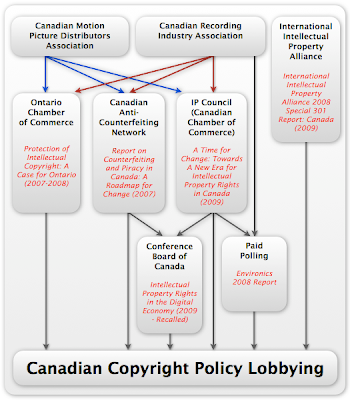
Michael Geist has a thorough and excellent analysis today of the role of CRIA and CMPDA in copyright "policy laundering", as he calls it, in Canada - including in the recent Conference Board imbroglio. I had raised some questions about these two organizations in this context on June 17, 2009.
All of this may even be more incestuous than Michael's chart shows. For example, the USTR gets its "301" information from the International Intellectual Property Association ("IIPA"), a Washington advocacy group that runs out of a couple of Washington law offices and is heavily influenced by the US entertainment industries. As I have mentioned earlier, the reports on Canada are prepared with the considerable input of a well known Washington lawyer named Steve Metalitz.
And do you wonder where the IIPA gets its information about Canada?
HK
Friday, June 19, 2009
Boyle on Obama Admin Opposition to Rights for the Blind, etc.
Jamie Boyle - who was one of the pioneers of the articulate and erudite academic movement in favour of balanced copyright has a good piece in the Financial Times today.
It indicates that the Obama administration is opposing rights for the blind due to its deference to the content owners agenda.
Here's his conclusion, re the proposal under discussion at WIPO:
Save this while you can. These things don't last too long at the FT website.
HK
It indicates that the Obama administration is opposing rights for the blind due to its deference to the content owners agenda.
Here's his conclusion, re the proposal under discussion at WIPO:
Why oppose this proposal? Scaremongering aside, there is no real threat to anyone’s business model here. But if one sees any limitation of the most extreme version of copyright as a dangerous and ideologically driven attack on property itself, well then, one must fight. This proposal represents the ideas that rights should have limits and that we should harmonise limitations and exceptions as well as rights themselves. It is that principle, the principle of balance, that must be resisted. Even if it puts one in the embarrassing position of – ever so pragmatically – sacrificing one’s blind citizens to an industry agenda. In a world where we have to deal with torture and climate change and the collapse of our economic system, this little piece of moral cowardice is not something many people are going to notice. But it leaves a nasty taste in the mouth, nonetheless.
Save this while you can. These things don't last too long at the FT website.
HK
Thursday, June 18, 2009
RIAA: Be Careful What You Wish For
Various tweets from Minnesota confirm that a federal jury as just returned an astonishing verdict of $1,920,000 against Jammie Thomas for downloading 24 songs. That's $80,000 per song.
So I post this now - more in sadness than in anger.
Whether or not Ms. Thomas is the ideal post-card defendant for this type of case (she clearly isn't, since there were obvious credibility issues), and whether or not she had counsel capable of matching the RIAA team at critical stages, this is not a verdict that should please the RIAA.
If a single mother of two kids, age 32, can be whacked for almost $2 million for downloading 24 songs, and the RIAA actually believes that such a verdict should be enforced, can a law that allows this to happen be left on the books for long?
It's important to note that, in the USA, bankruptcy does not necessarily discharge a debt involving "willful" infringement. This was clearly such a "willful" case in the eyes of the jury and the amount of $80,000 per work is more than half of the maximum permitted under the statute for such infringement.
So - the RIAA has probably achieved more than it wished for here. It has the dubious honour of having achieved a damage award of $1,920,000 for downloading 24 songs - a fraction of what millions of American households have probably downloaded without authorization.
Given the civil wrongs caused by drunk drivers, incompetent and/or dishonest doctors and lawyers, polluting corporations, and countless others scenarios, the American justice system should take no pride in this verdict.
It could very well come back to haunt those who are now celebrating it. Maybe sooner rather than later in the form of a constitutional challenge to the damage award.
HK
PS - here's the Ars Technica story.
So I post this now - more in sadness than in anger.
Whether or not Ms. Thomas is the ideal post-card defendant for this type of case (she clearly isn't, since there were obvious credibility issues), and whether or not she had counsel capable of matching the RIAA team at critical stages, this is not a verdict that should please the RIAA.
If a single mother of two kids, age 32, can be whacked for almost $2 million for downloading 24 songs, and the RIAA actually believes that such a verdict should be enforced, can a law that allows this to happen be left on the books for long?
It's important to note that, in the USA, bankruptcy does not necessarily discharge a debt involving "willful" infringement. This was clearly such a "willful" case in the eyes of the jury and the amount of $80,000 per work is more than half of the maximum permitted under the statute for such infringement.
So - the RIAA has probably achieved more than it wished for here. It has the dubious honour of having achieved a damage award of $1,920,000 for downloading 24 songs - a fraction of what millions of American households have probably downloaded without authorization.
Given the civil wrongs caused by drunk drivers, incompetent and/or dishonest doctors and lawyers, polluting corporations, and countless others scenarios, the American justice system should take no pride in this verdict.
It could very well come back to haunt those who are now celebrating it. Maybe sooner rather than later in the form of a constitutional challenge to the damage award.
HK
PS - here's the Ars Technica story.
Wednesday, June 17, 2009
More Myths about Myths about File Sharing

250,000 legal and levy free P2P songs for less than CDN $200?
Can CRIA seriously say it isn't so?
Richard Pfohl of CRIA has taken on Prof. Michael Geist in a letter to the Editor published in The Star on June 12, 2009 in response to Geist's column on file sharing “myths” published June 8, 2009 The Star.Can CRIA seriously say it isn't so?
Mr. Pfohl says:
Michael Geist fabricates more myths than he dispels, and misinforms Star readers about the legality of unauthorized downloading.As Mr. Pfohl knows. or ought to know, his description of Canadian jurisprudence on downloading music is inaccurate and misleading. The consistent thread of what the Copyright Board said in 2003 and the Federal Court of Appeal said in 2004 and 2008 is that downloading sound recordings onto something that is not an “audio recording medium” may be infringing. For example, the Federal Court of Appeal said in its 2004 decision at para. 147 that:
Downloading pirated music is not legal in Canada. The copyright law conclusions in the case he cites were overturned on appeal. In fact, the Federal Court of Appeal has subsequently twice ruled that the private copying regime doesn't apply to downloads made to hard drives.
Widespread misunderstanding of this legal fact illustrates precisely why digital copyright reform, and the legal clarity it would provide, is needed in Canada.
If, indeed, digital audio recorders (or the memories embedded therein) fall outside the scope of the definition, copyright infringement could result from the use of such devices to private copy.So - copying unauthorized sound recordings obtained via P2P onto a 120 GB iPod Classic, for example, where the hard drive memory is permanently embedded (don't even think about trying to take it out!) may indeed be infringing - because the iPod as a whole is a "device" and not a medium subject to the levy.
However, a PC internal hard drive that is not “permanently embedded” and particularly an external plug and play hard drive that is clearly not in any sense “embedded” in anything and serves no function other than to be a large memory medium may very well be “audio recording media.” In that case, downloading any sound recording onto them obtained in any way from any source for private use would be legal in Canada, regardless of whether a levy has ever been sought from the Copyright Board. This follows from what the Copyright Board said in 2003 at page 20-21 of this famous decision and, contrary to Mr. Pfohl's assertion, no Canadian Court has ever ruled to the contrary.
A levy-free terabyte external hard drive that now sells for less than CDN $200 can hold about 250,000 songs downloaded via P2P. The fact that this is apparently legal in Canada is the direct consequence of the private copying levy scheme that Mr. Pfohl’s employer, the Canadian Recording Media Association (“CRIA”), so enthusiastically and effectively lobbied for and was given in the 1997 amendments to the Copyright Act. CRIA was short sighted. Mass access to the internet was already in full flight and the concept of the “celestial juke box” was already old news at that time. The Canadian levy scheme has now generated more than a quarter billion dollars. CRIA members whine about the consequences of their legislation all the way to the bank (and indeed incessantly afterwords), but keep on cashing the cheques.
As CRIA must constantly be reminded, “be careful what you wish for.” And hopefully, Government officials, MPs and Ministers will be careful about who they listens to when it comes to Canadian copyright law and sound public policy. CRIA and some of those who speak for it it, have a poor record for foresight, wisdom, credibility and even basic accuracy in these matters.
All of that said, it is by no means clear that well conceived litigation against individual file-sharers (in contrast to mere downloaders) backed up with sufficient, reliable, non-hearsay and convincing evidence would necessarily fail in Canada under current law under some scenarios. CRIA's members were given a green light or at least an orange light to proceed on such a basis by the Federal Court of Appeal in 2005, but have been unable or unwilling to bring forward the necessary evidence to even try. Perhaps they prefer instead to propagate the myth that current Canadian laws are inadequate, to play the role of the victim of mass "piracy", and to demand new, unnecessary and overreaching legislation.
One would have thought that the recent Conference Board of Canada fiasco would have resulted in lessons being learned by copyright lobbyist organizations. Apparently, in CRIA's case, that’s not the case.
BTW, Michael Geist has a prominent new tech savvy fan in high places in the person of the Hon. James Moore, one of the Minsters responsible for copyright, whose tweet on a more recent column of Michael's in the Ottawa Citizen on June 16, 2009 could easily have described the earlier one which so upset Mr. Pfohl:
Excellent column by Michael Geist in the Ottawa Cit. today. Nice to read policy ideas & substance - not just horse race politics & gossip.BTW, I should disclose that I've been involved as counsel in all of the above cases about which Mr. Pfohl is inaccurately opining.
HK
Still More Conference Board of Canada Fallout
 The Conference Board has taken the next step in damage control arising from its recent plagiarism scandal. Here's today's statement.
 The most notable and useful disclosure from the Conference Board is that:
The evidence indicates there was undue reliance on feedback from a funder who was deemed to have important technical expertise.(Emphasis added)
The Conference Board should identify the funder who provided the “feedback”, and why this funder's “deemed” technical expertise managed to effectively poison the process. It should, as a matter of course, identify all funders of all its reports. This is normal practice, and is absolutely essential if a report is to have any serious credibility in academic, policy, business and government circles. The Conference Board must guard against letting its good name be used by special interest lobbyists in what Dr. Michael Geist calls “policy laundering.”
The report in question was to have been rolled out as a key item at a Conference Board conference on May 29, 2009. Here is the program, which shows a list of sponsors and the Advisory Board of that rather imbalanced and expensive event, which, in fairness, covered quite a lot of material other than copyright. Nonetheless, and despite the breadth of the conference, two of the four members of the “Advisory Board” for the conference were the heads of CRIA and CMPDA. These have been two of the most, if not the most, energetic, persistent and successful (in terms of legislative influence) copyright lobbyist organizations in Canada since the 1980's. It's a fair question to ask whether either or both these two well known and well funded organizations (which represent mainly American interests) were among the funders or were otherwise involved in the specific ill-fated research project now in issue.
BTW, here's what it costs to “sponsor” a Conference Board conference.
Interestingly, the Conference Board has engaged Dr. Ruth Corbin to “to review all relevant research and consult multiple sources, and redo the reports.”
The Board indicates that:
When completed, this work will be presented to a multi-stakeholder Roundtable to be held in the fall. We will publish a summary of the Roundtable discussion, reflecting the full spectrum of views on the issue, as an Appendix to the research.One can only wish Dr. Corbin and the Board luck in sorting all of this out. The scandal may not reside only in the fact that much of the key content of the now withdrawn work was plagiarized but that much of the IIPA material that was apparently recycled as “research” may have been utterly unreliable to begin with. I'm not sure that it's possible to “redo” that kind of work.
HK
PS & Update - the Conference Board did acknowledge the financial support of several coalition or umbrella groups in this case. But that still leaves questions unanswered - namely who was really actively involved in the sponsored research. See comments below.
PS and update #2 - more connecting of dots and about the courageous Curtis Cook, former employee of the Confernce Board, in a Canwest story here.
Tuesday, June 16, 2009
Thursday, June 11, 2009
Scotch Whisky Association's Appeal Attempt Scotched by Supremes
 The Scotch Whisky Association's attempt to get leave to appeal the very sensible decision of the Federal Court of Appeal has - as I predicted - been scotched by the Supreme Court of Canada this morning. (Coram: McLachlin / Abella / Rothstein ).
As usual, with costs and without reasons.
Now, Glenora Distillers in Nova Scotia can have its trade-mark registration of GLEN BRETON for "single malt whisky." The whisky is made in Canada and has never been called "Scotch" whisky by its manufacturer, althougn Justice Sexton of the Federal Court of Appeal did note that "I believe it is fair to say that Glenora has marketed its product as being like a single-malt Scotch in everything but name."
The Federal Court of Appeal had rejected the argument that, by "segmenting" several trade-marks for single malt Scotch whisky that include GLEN, the Scotch Whisky Association could block Glenora's use of the word:
The word “glen,” being a common word and forming part of numerous registered trademarks, is at best a weakly distinctive component of those trademarks. However, by segmenting those trademarks to consider “glen” as a mark on its own, this court would be affording stronger trade protection to that word than is due.The great irony of this case is that, had the Scotch Whisky Association succeeded in its appeal based upon its rather creative and unprecedented interpretation of s. 10 of the Canadian Trade-marks Act, several of its members might would have found their own trade-marks in jeopardy. Justice Sexton concluded:
In short, success in this appeal would jeopardize the trademarks of many of the Association’s members. In my view, this cannot be the correct result, and is not true to the spirit and purpose of section 10 of the Act. Accordingly, I would allow the appeal, and direct the Registrar to allow Glenora’s application for the registration of GLEN BRETON.s. 10 provides that:
10. Where any mark has by ordinary and bona fide commercial usage become recognized in Canada as designating the kind, quality, quantity, destination, value, place of origin or date of production of any wares or services, no person shall adopt it as a trade-mark in association with such wares or services or others of the same general class or use it in a way likely to mislead, nor shall any person so adopt or so use any mark so nearly resembling that mark as to be likely to be mistaken therefor.(emphasis added)
HK
Wednesday, June 10, 2009
Three Strikes Strikes Out

The French Three Strikes law has stuck out in that country's Constitutional Court - - le Conseil constitutionnel:
AFP - France's highest legal authority on Wednesday struck down a key provision of a contested Internet piracy law that set up a new state agency to cut off offenders from the web.(emphasis added)
...
The Constitutional Council ruled that "free access to public communication services on line" was a human right, and that only a judge should have the power to strike an individual from the Internet.
Here's the breaking story from AFP.
And here's much more detail from Ars Technica
And from Cory Doctorow at Boing Boing.
And here's the decision.
HK
Tuesday, June 09, 2009
"Copyright War" Online Program Today
REMINDER:
I will be participating today Tuesday June 9 at 3:15 EST in a day long session of online interactive presentations on Copyright Wars hosted by an exciting new enterprise called Brighttalk.com.
I would encourage you check out the other presentations and tune in free - you can see them listed here. Note that Ray Beckerman will be talking about the the RIAA mass litigation campaign at 5:45.
I'll be dealing with ACTA, WIPO and Canada. You'll be able to send in questions in real time...this is interactive.
Hope to see you...
HK
I will be participating today Tuesday June 9 at 3:15 EST in a day long session of online interactive presentations on Copyright Wars hosted by an exciting new enterprise called Brighttalk.com.
I would encourage you check out the other presentations and tune in free - you can see them listed here. Note that Ray Beckerman will be talking about the the RIAA mass litigation campaign at 5:45.
I'll be dealing with ACTA, WIPO and Canada. You'll be able to send in questions in real time...this is interactive.
Hope to see you...
HK
Subscribe to:
Posts (Atom)


 Posts
Posts